Whether you're looking for endless bouldering in beautiful forests or multi-pitch crack climbs with incredible views of the Howe Sound, Squamish has what you're looking for and everything in between.
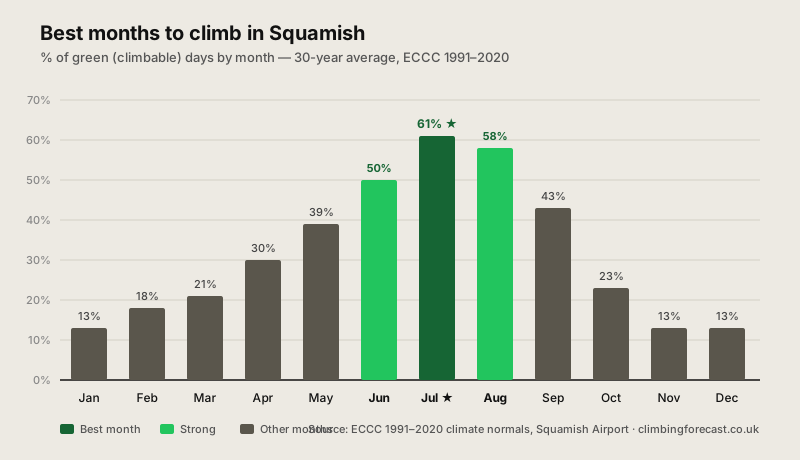
Best time to go: Early July offers the lowest chance of rain based on 30 years of weather data, though late June is increasingly popular as July temperatures rise. Check climbingforecast.co.uk before you go — conditions can change quickly.
Squamish climbing: what to expect
Squamish rock is made of glacier-carved granite with excellent texture and grip. The bouldering is powerful climbing that translates well for those who train mostly indoors. The trad is known for its mixture of slabby high-friction climbs and crack climbs, and there's also steep hard sport climbing — it genuinely has something for everyone.
Trad climbing in Squamish
Squamish has thousands of trad climbs within 20 minutes of town. Smoke Bluffs and Murrin Park are the go-to spots for single-pitch; head to areas like Papoose to get started on the multi-pitch routes. Mountain Project has a lot of information, but if you want a guidebook, Squamish Select by Mark Bourdain covers everything you need. It's hard to get a physical copy in the UK, but a downloadable PDF is available online.
Anchors are typically bolted, which means faster movement and less route-finding. For gear, you'll want a full set of nuts, some offsets, and a double set of cams. We doubled up on size 0–5 DMM Dragon cams — worth it if you plan to do more crack climbing, but check whether you can borrow some or share the cost with your partner. Bring a 70m single rope, as some climbs exceed 30m.
If it's your first time, start at Smoke Bluffs to get used to the style and the grading system (Yosemite Decimal System, not UK grades), then move on to Welcome to Squamish to ease yourself into multi-pitch. The topo isn't in the guidebook yet but can be found here. Get an alpine start to beat the crowds. For crack climbs, bring crack gloves and plenty of tape. Walkie-talkies are standard kit in North America — we picked some up from Home Depot. Note that Canadian frequencies differ from UK ones and will interfere with emergency services, so don't bring them home.
Recommended trad climbs
Single pitch:
- Check Mark Right Hand (5.6, Smoke Bluffs)
- Easter Island (5.8, Smoke Bluffs)
- Out to Luge (5.10a, Smoke Bluffs)
- Gong of Foreplay (5.10b, Smoke Bluffs)
Multi-pitch:
- Welcome to Squamish (5.8, South Chief)
- Skywalker (5.8, South Chief)
Squamish bouldering areas
The bouldering is as impressive as the trad, with thousands of problems throughout beautiful mossy forests. The Grand Wall boulders are a five-minute walk from the car park, less than 15 minutes from Squamish town. Start on classics like Superfly (V4) and Heartbreak Hotel (V2) to get used to the style. Paradise Valley and the Fridge Boulders are well worth the trip — great variety in a stunning forest setting. You can rent quality pads from Climb On in town at a reasonable rate, along with any gear you need and a solid guidebook selection.
Sport climbing in Squamish
Cheakamus Canyon and Murrin Park both have plenty of sport climbing — generally steeper and harder, but many areas stay dry in the rain, making them a good wet-weather option. Murrin Park also has excellent walking trails; The Loop Trail takes you to some of the best views of Howe Sound.
Getting to Squamish: flights, car hire & accommodation
Getting there: Fly into Vancouver, British Columbia (around a nine-hour flight from London). Hire a car at the airport and you'll be in Squamish in 1.5 hours.
Where to stay: Klahanie Campground is the most budget-friendly option; MTN Fun also has cabin-style accommodation. The Squamish Adventure Inn is well located.
Where to eat: Locavore for post-climbing burgers, Fox & Oak for coffee and doughnuts. For lunch, Green Olive Café and Sunflower Bakery are both great.
Best time to climb in Squamish
To reduce the chance of rain, your best bet is early July, based on our weather model and 30 years of data from the Environment and Climate Change Canada 1991–2020 climate normals for Squamish. July is getting increasingly hot, so late June may be the sweet spot. Conditions in Squamish can change quickly — always check climbingforecast.co.uk before heading out.
Frequently asked questions
Is Squamish good for beginner trad climbers?
Yes, particularly Smoke Bluffs. The bolted anchors and well-documented routes can make it a good introduction, but the climbs will be much taller than somewhere like the Peak District.
What is the best time of year to climb in Squamish?
Late June to early July offers the best balance of dry weather and manageable temperatures based on 30 years of climate data. August is also popular but can be very hot for trad climbing.
Do I need the Squamish Select guidebook?
It's not essential — Mountain Project and online topos cover a lot — but it's worth it if you're spending more than a week. A PDF copy is available from the Quickdraw Publications website.
What grading system does Squamish use?
Squamish uses the Yosemite Decimal System (YDS), not UK adjectival or French sport grades. 5.10a is roughly equivalent to HVS/E1 in UK trad grades. Give yourself a session or two at Smoke Bluffs to calibrate before committing to harder routes.