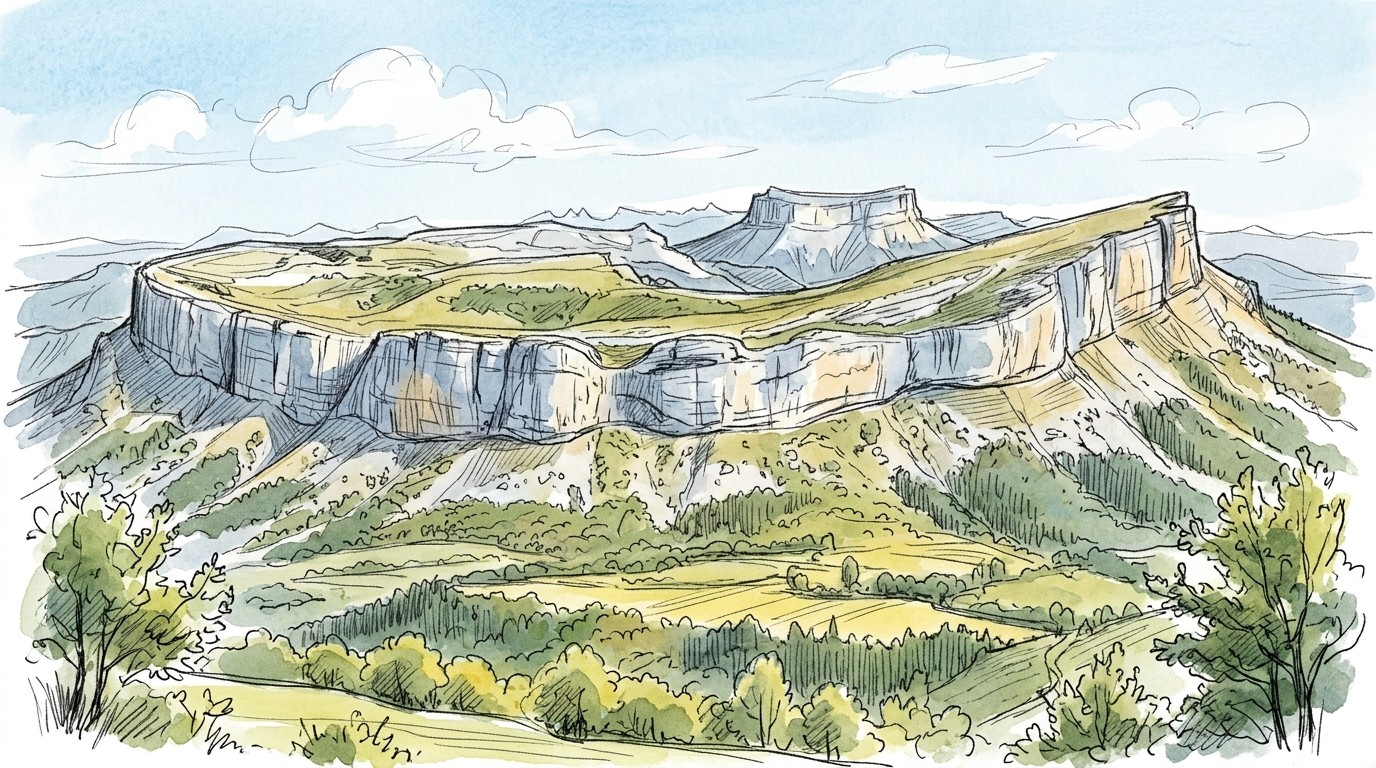
Céüse is often called the best sport crag in France. A band of blue-grey limestone wraps around the top of the mountain above Gap, in the Hautes-Alpes, at around 1,800 to 2,000 m, with routes from the 5s to the 9s, famously pocketed rock, and famously spaced bolts. It's where Chris Sharma climbed Realization, or Biographie, in 2001, the first route graded 9a+, and where Alex Megos climbed Bibliographie, 9b+, in 2020. It's a summer crag, at the end of a steep walk of 45 minutes to an hour, and snow covers it in winter. We used 30 years of weather data to find out which months are best, when the snow melts, and how late into the autumn you can climb there.
We replayed 30 years (1996–2025) of real daily observations from the Météo-France station at Gap-Tallard, in the valley about 10 km from the crag, through the climbingforecast drying model. The station is 1,250 m below the crag, so we adjusted the temperature, humidity and rain to the 1850 m of the main south-facing wall, using other Météo-France stations nearby and at the same height. We also kept track of the snow from one day to the next, so the winter snow builds up and melts as it would on the cliff. At this height, heat is rarely a problem, so each day is scored for an afternoon session, and cold, dry days count as climbable: plenty of people come to Céüse (or Ceuse, without the accents) to try hard routes in the cold.
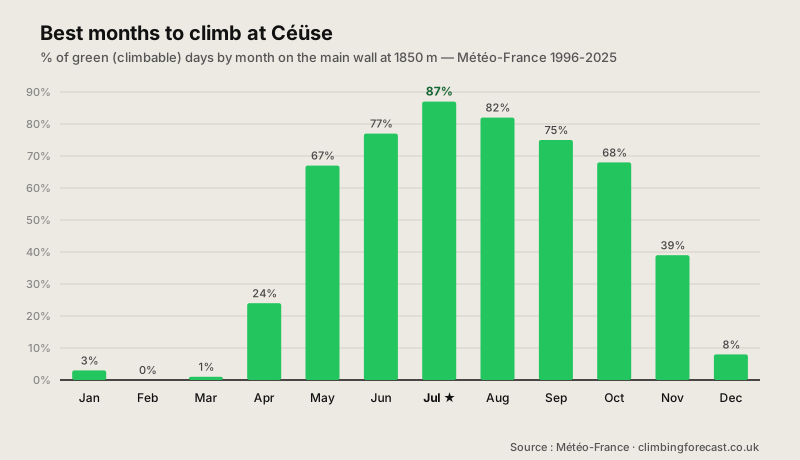
When is the best time to climb at Céüse?
June to September, and July is best. July scores 87% green days, August 82%, June 77% and September 75%. Summer is the driest time of year at Céüse, and at 1850 m it's rarely too hot, so there's little to stop you apart from the odd thunderstorm.
July is the most dependable month. It reached 70% green or more in 29 of the 30 years, and never dropped below 58% (2013). August reached 70% in 27 years, September in 23 and June in 22. Whichever summer month you pick, the odds are good.
May and October are good shoulder months. May scores 67%, once the snow has gone, and October 68%. Both are cold: highs average about 13°C in May and 10°C in October, with frost on 8 and 13 nights. That's good weather for trying hard on the sunny walls, but not for long days on the shady ones.
Winter is snow season. From December to March, the crag is under snow on almost every day, and April, at 24%, is mostly about waiting for it to melt.
Céüse climbing conditions month by month
| Month | Green | Red Days | High |
|---|---|---|---|
| Jan | 3% | 30 | 0°C |
| Feb | 0% | 28 | 1°C |
| Mar | 1% | 31 | 4°C |
| Apr | 24% | 21 | 8°C |
| May | 67% | 7 | 13°C |
| Jun | 77% | 4 | 18°C |
| Jul | 87% | 2 | 20°C |
| Aug | 82% | 3 | 19°C |
| Sep | 75% | 4 | 15°C |
| Oct | 68% | 7 | 10°C |
| Nov | 39% | 16 | 3°C |
| Dec | 8% | 27 | 0°C |
Main south-facing wall (Berlin sector, 1850 m), 30 years (1996–2025) of real daily observations from the Météo-France station at Gap-Tallard, adjusted to the crag's height. Green is the % of green (climbable) days, and Red Days are per month; the rest are amber. High is the average daily high at the crag. Factors in rain, drying time, wind, humidity, snow and heat. Cold, dry days count as green. Source : Météo-France.
When does the snow melt at Céüse? Late April
From December to March, snow covers the crag on almost every day of our replay, and it plays a part in about 12 red days in November. In a typical year, the snow at the crag's height melts out around 28 April. In 14 of the 30 years it lasted into May, and in 2013 until 25 May. In early years, such as 2011 and 2025, it had gone by the second week of April.
The crag isn't the only place the snow sits. The plateau above it is higher, holds its snow for longer, and has a small ski area on it. After a snowy winter, its meltwater drains down through the rock and out of the walls, and sectors like Berlin and Cascade can keep seeping into June. There can also be cornices above the cliff in spring. If you're planning an early-season trip after a big winter, aim for June rather than May. Our model rates seepage from recent rain, but not from snowmelt above the crag, so it can't see this.
Is Céüse too hot in summer? Rarely
At 1850 m, July highs average about 20°C at the crag, and August's about 19°C. A day of 27°C or more, the point where our model starts to flag the heat, happens on only about two days every three years, and the hottest day in our record, during the heatwave of 28 June 2019, reached about 30°C. Summer nights average about 6°C, so bring a warm layer.
What matters in summer is the sun, not the air. The main wall, with Berlin, Demi-Lune and Biographie, faces south and bakes in the morning, then goes into the shade in the early afternoon: around 13:30 in early summer, and later as the summer goes on. Most climbers walk up in the morning and climb in the afternoon shade. Face de Rat, at the east end of the cliff, gets the morning sun and is in the shade in the afternoon. Cascade and Petit Edenne, at the west end, are in the shade in the morning. So you can find shade at most times of day.
Summer rain at Céüse often comes from afternoon thunderstorms, which build over the mountains on hot days. Our data is daily, so it can't tell a morning shower from an afternoon storm. Keep an eye on the sky, and on the forecast each morning.
Can you climb at Céüse in October and November? Yes, in the cold
September is still a summer month, at 75%. October, at 68%, is the start of the cold season: highs average about 10°C, and there's frost on about 13 nights. On a sunny day, the south-facing walls warm up quickly, and the friction is good. It reached 70% or more in 13 of the 30 years, and 100% in 2017.
November is a gamble, at 39%. Highs average about 3°C, snow plays a part on about 12 days, and November is also the wettest month. But in a dry, mild autumn, such as 2015, the crag can stay in condition well into the month. Our model counts cold, dry days as green, so these numbers are for climbers happy to try hard in the cold. They also don't account for snow on the road or the walk-in, which can close the crag even when the wall is dry.
How much does it rain at Céüse? Mostly in autumn
The data averages about 930 mm of rain a year at the foot of the mountain, on around 79 days with 1 mm or more. Autumn brings 34% of it, spring 25%, winter 24% and summer only 17%. November (125 mm) and October (115 mm) are the wettest months, and July (40 mm) the driest. The wettest months in our record were all Novembers: 2000, 2002 and 2014 each brought over 300 mm.
Céüse's limestone is steep and clean, and it dries quickly after rain, but it's high and exposed. High humidity, when the cloud is down on the cliff, plays a part in one to three red days a month all year round.
Summer Is the Season
July leads at 87% green days, then August 82%, June 77% and September 75%. At 1850 m it's rarely too hot.
Late Snowmelt
The snow melts around late April, but after a big winter the walls can seep into June. Aim for June rather than May.
Cold Autumns
October scores 68% and is great for projecting in the cold. By November, the snow and the rain are back.
How we calculated this
We ran 30 years of real daily weather (1996–2025) from the Météo-France station at Gap-Tallard (05170001, 593 m) through the drying model behind the live Berlin forecast. It's about 10 km from the crag and the only station nearby with 30 complete years of daily rain, temperature, wind and humidity. On the few days with gaps, we used Météo-France's stations at Laragne-Montéglin and La Faurie.
Gap-Tallard is in the valley, 1,257 m below the main wall, so we adjusted it in three ways. For temperature, we measured how much colder Météo-France's station at St-Étienne-en-Dévoluy (1300 m) is than Tallard, month by month, separately for the day's high and low. The highs drop by 6.5–8.6°C per 1,000 m, and the lows by only 2.4–5.2°C, because cold air settles in the valley at night. Checked against the station at Super-Dévoluy (1915 m), this is much closer than the standard rate. For humidity, we matched each month to two Météo-France stations at the crag's height, St-Hilaire-du-Touvet (1756 m) and Arvieux (1825 m). They show that the heights are drier than the valley from October to February, when the valley fills with fog, and a little more humid in summer. For rain, we scaled Tallard up, month by month, to the gauges at Veynes and Barcillonnette at the foot of Céüse, about 1.2 times on average.
Each day is rated GREEN, AMBER or RED on recent rain, drying time, wind, humidity, snow and heat, at the day's high. Snow falls whenever the day's average temperature at the crag is around freezing, and builds up and melts from day to day. We didn't add a cold limit: cold, dry days count as green. The other sectors run close to Berlin: west-facing Cascade, which seeps more, scores three to five points lower from May to October.
Data retrieved 1 October 2026. Source : Météo-France, Données climatologiques de base – quotidiennes, Licence Ouverte / Etalab 2.0.
It won't replace checking the forecast the week you go, but it's an honest answer to "when should I book?". Before you go, check the live Berlin, Demi-Lune, Face de Rat, Cascade and Petit Edenne forecasts. For more French sport climbing, see our Gorges du Tarn article.
Good luck and enjoy the climbing!