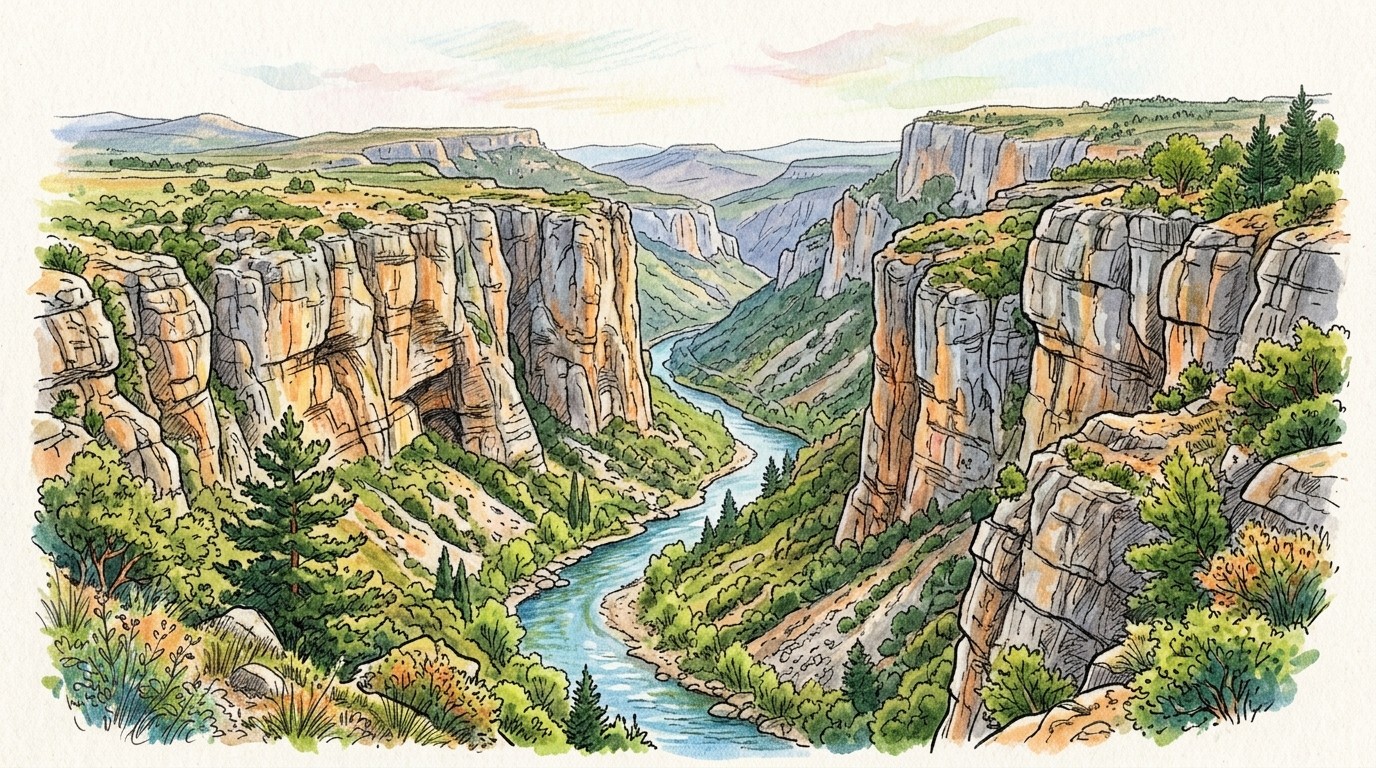
The Gorges du Tarn is one of the great sport climbing areas of France. The Tarn has cut a canyon up to 500 m deep between the limestone plateaus of the Causse de Sauveterre and the Causse Méjean, in Lozère, and the climbing is on its grey and orange walls: long, steep, pocketed pitches, mostly from 6b into the 8s, with Le Rozier as the base. Ask about the weather and you'll hear that the season runs from Easter to October, that winter is too cold in the bottom of the gorge, that summer is too hot and that the shady sectors seep. We used 30 years of weather data, and the flow of the springs that feed the walls, to find out which months are best and why.
We replayed 30 years (1996–2025) of real daily observations from the Météo-France station at St-Pierre-des-Tripiers, on the Causse Méjean just above Le Rozier, through the climbingforecast drying model. We corrected the temperatures to the height of the Tennessee sector, a north-facing wall at the bottom of the gorge, and also ran a south-facing sector, Baumes Chaudes, to show how much the aspect matters. A shady wall in the bottom of the gorge is about as warm as the air, so we counted any day whose high stays under 12°C as too cold, even if the rock is dry. Each day was scored twice: at the day's peak heat, for a full afternoon session, and at the day's low, as a proxy for a dawn start or a wall in full shade.
When is the best time to climb in the Gorges du Tarn?
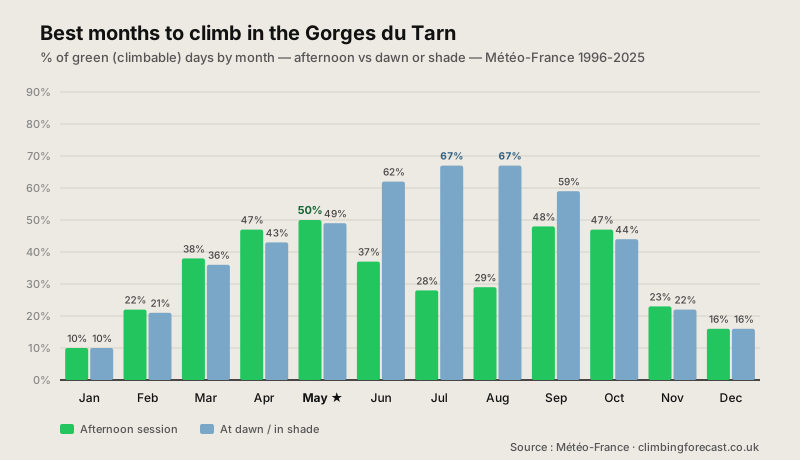
Late spring and early autumn, and May is best. Scored at the day's peak heat, May leads at 50% green days on Tennessee, with September at 48% and April and October at 47%. In these months, what costs you days is rain and the time the rock needs to dry afterwards. The Tarn gets a lot of rain for a southern French crag, so even the best months have about eight to eleven red days.
September and early October have the driest rock. The springs that feed the walls are at their lowest after the dry summer, so seepage is least likely. In spring, the scores are as good, but the springs are still flowing hard and the shady walls are more likely to have wet streaks. From mid-October, the big autumn storms start to arrive.
March is too early. Without the cold cut-off, March would come out on top, because it's often dry. But on about 15 days in March the high at the bottom of the gorge stays under 12°C, and the north-facing walls don't get the sun. With the cut-off, March drops to 38%. It's also the month when the springs flow hardest. From April, it warms up quickly.
Pick the side of the gorge that suits the season. Those numbers are for Tennessee, a north-facing wall that stays damp longer after rain. On a south-facing sector like Baumes Chaudes, May scores 58%, October 56%, April 55% and September 53%. In summer, it's the other way round: start on the walls in the shade.
Summer works if you climb early or in the shade. Summer afternoons are hot: 37% green in June, 28% in July and 29% in August. But summer is also the driest season. Scored at the day's low instead, July and August jump to 67%, the best score of the year, and June to 62%.
Every month varies from year to year. At Tennessee, May has been anywhere from 29% green (2007) to 71% (2011), and September from 23% (2020) to 73% (2007). April, May and September reached 50% in about half of the 30 years. Whenever you go, keep a spare day or two in the plan.
Gorges du Tarn climbing conditions month by month
| Month | Afternoon | Dawn | Red Days |
|---|---|---|---|
| Jan | 10% | 10% | 13 |
| Feb | 22% | 21% | 10 |
| Mar | 38% | 36% | 10 |
| Apr | 47% | 43% | 11 |
| May ★ | 50% | 49% | 10 |
| Jun | 37% | 62% | 7 |
| Jul | 28% | 67% | 7 |
| Aug | 29% | 67% | 8 |
| Sep | 48% | 59% | 8 |
| Oct | 47% | 44% | 10 |
| Nov | 23% | 22% | 13 |
| Dec | 16% | 16% | 13 |
North-facing Tennessee sector (600 m), 30 years (1996–2025) of real daily observations from the Météo-France station at St-Pierre-des-Tripiers. Afternoon and Dawn are the % of green (climbable) days, for a full afternoon session and for a dawn start or a wall in full shade. Red Days are per month, for an afternoon session. Factors in rain, drying time, wind, seepage, humidity, snow, heat, and a 12°C cold cut-off for the shady gorge floor. Source : Météo-France.
Can you climb in the Gorges du Tarn in summer? Yes, at dawn or in the shade
At crag height, July and August highs average about 27°C, and pass the model's 27°C heat line on about 15 or 16 days a month. June has about 10 such days and September 5. Only two or three days a summer reach 35°C, which the model rates too hot to climb at all. The hottest day in the record, 23 August 2023, reached about 39°C.
That's the air temperature on the plateau, corrected to the crag's height. Two things it doesn't capture pull in opposite directions. The bottom of the gorge traps the heat: Météo-France's station on the gorge floor at Ste-Enimie runs about 1.5°C warmer on summer afternoons than the plateau numbers suggest, so the sunny walls in the afternoon are hotter than our table shows. But the gorge is deep and winding, and the model doesn't know about shade. North-facing walls like Tennessee get little direct sun, and on every bend one side of the canyon is in the shade. Summer is also the driest season, so once the heat is out of the way there's little else to stop you: scored at the day's low, July and August (67%) are the best months of the year. Start early, follow the shade, and finish the day in the river.
When do the walls seep? February to May
The Tarn's limestone is fed by the plateaus above. Rain soaks into the causses and drains out through the gorge walls for days or weeks afterwards, long after the rest of the rock is dry. The wall just left of Tennessee is a well-known example. Our drying model only looks at the last few days of rain, so it can't see this. But the same water comes out of the karst springs in the bottom of the gorge, and France's national hydrometric network has measured them every day since 2002.
The spring at Mas de Lafon, near Le Rozier, flows about 20% above its normal level in March and stays high through May, then drops to 20% below normal in September. The spring at Beldoire, upstream at Les Vignes, follows the same pattern and is lowest in October, at 40% below normal. The Tarn itself, at La Muse below Le Rozier, runs at about 1.5 to 1.6 times its normal flow from December to March and about half or less from July to September. So the walls carry the most water from February to May, and the least in September and early October. If you're going for a route that seeps, that's when to go. After a very wet winter, such as January 2018, expect the shady sectors to stay wet well into spring.
How much does it rain in the Gorges du Tarn? Mostly in autumn
The data averages about 880 mm of rain a year on the plateau, on about 109 days with 1 mm or more. Autumn brings 29% of it, spring 26%, winter 24% and summer 21%. November is the wettest month (95 mm), followed by October (87 mm), May (86 mm) and December (84 mm). February and July are the driest, at 53 mm each.
The heaviest rain comes in autumn, when storms off the Mediterranean, the épisodes cévenols, can drop a month's rain in a day or two. The wettest months in our record were January 2018 (272 mm), November 1996 and December 2025. From October to May, about ten to thirteen days a month are red at Tennessee, almost all of them because of rain and the drying time after it. The steepest walls often stay dry in a shower, but a big storm puts the shady sectors out of action for days. The gorge floor gets about 10% less rain than the plateau, so our numbers lean slightly cautious, but scaling the rain down moves the monthly scores by only one or two points.
Can you climb in the Gorges du Tarn in winter? Rarely
From November to February, the sun barely reaches the bottom of the gorge. January highs average about 8°C at crag height, nights hover just above freezing, and there are about 12 frosty nights in January, 10 in February and 9 in December. The high stays under 12°C on about 26 days in January, 23 in December, 20 in February and 16 in November. That leaves 10% green days in January, 16% in December and 22–23% in February and November on the shady side.
On a mild, dry, sunny day, a south-facing wall can be good. But those days are rare: Baumes Chaudes only scores 12–27% from November to February. Don't bother starting early, either: scored at the day's low, the winter months don't improve.
What about the Gorges de la Jonte?
Le Rozier sits where the Jonte flows into the Tarn, and the Gorges de la Jonte, running east towards Meyrueis, have their own big sport climbing on the limestone and dolomite walls and towers between the Causse Méjean and the Causse Noir, under the vultures that nest there. Most climbers on a Tarn trip climb in both. The station we used is on the Causse Méjean, right above the Jonte, so the month-by-month picture here applies to both gorges. In the Jonte, as in the Tarn, what matters most on the day is which way the wall faces.
May and September
May leads at 50% green days, with September at 48%. September and early October also have the driest rock of the year.
Cold, Seeping March
March is often dry, but cold in the bottom of the gorge, and it's when the walls seep most. Wait until April.
Summer Heat
Summer afternoons drop to 28–37% green. At dawn or in the shade, July and August are the best months of the year at 67%.
How we calculated this
We ran 30 years of real daily weather (1996–2025) from the Météo-France station at St-Pierre-des-Tripiers (48176002, 929 m) through the drying model behind the live Tennessee forecast. It's on the Causse Méjean, about 10 km east of Le Rozier, and it's the closest station to the climbing with 30 years of daily rain, temperature, wind and humidity. The stations in the bottom of the gorge, such as Ste-Enimie, don't record wind or humidity. On the days when St-Pierre has gaps, mostly humidity in 1996–1999, we used Météo-France's station at Millau, adjusted to match St-Pierre month by month.
We corrected temperatures to Tennessee's 600 m using the standard lapse rate, about +2.1°C, and to 550 m for Baumes Chaudes. Météo-France measures wind at 10 m, which is what the model expects. We used the plateau's rain as measured, without scaling it down to the gorge floor. Each day is rated GREEN, AMBER or RED on recent rain, drying time, wind, humidity, snow and heat, and scored once at the day's high and once at its low. Our live model has no cold limit for limestone, so for this article we added one: a dry day whose high stays under 12°C counts as amber, not green. For seepage, we used the daily flows of the springs at Mas de Lafon and Beldoire (2002–2025) and of the Tarn at La Muse (1996–2025), comparing each month's typical flow with the year-round typical flow.
Data retrieved 1 October 2026. Weather: Source : Météo-France, Données climatologiques de base – quotidiennes. Spring and river flows: Hub'Eau, eaufrance. Both under the Licence Ouverte / Etalab 2.0.
It won't replace checking the forecast the week you go, but it's an honest answer to "when should I book?". Before you go, check the live Tennessee, Eglazines, Baumes Chaudes, Cinglegros and Le Boffi forecasts.
Good luck and enjoy the climbing!