The New River Gorge in southern West Virginia has more than 1,400 established rock climbs, according to the National Park Service: hard sandstone cliffs, 30 to 120 feet tall, lining the rim of a deep, forested gorge. Congress redesignated it New River Gorge National Park and Preserve in December 2020. Climbers say spring and fall are the seasons. We used 30 years of weather data to find out which months really are best.
We replayed 30 years (1995–2024) of real daily observations from the NOAA weather station at Beckley, about 25–35 km (15–22 miles) south of the crags, through the climbingforecast drying model. We ran it for five areas: Endless Wall, Kaymoor, Bridge Buttress, Beauty Mountain and the Junkyard. The numbers below are their average, scored at each day's peak heat. The model also checks each day at its coolest, as a stand-in for a dawn start.
When is the best time to climb in the New River Gorge?
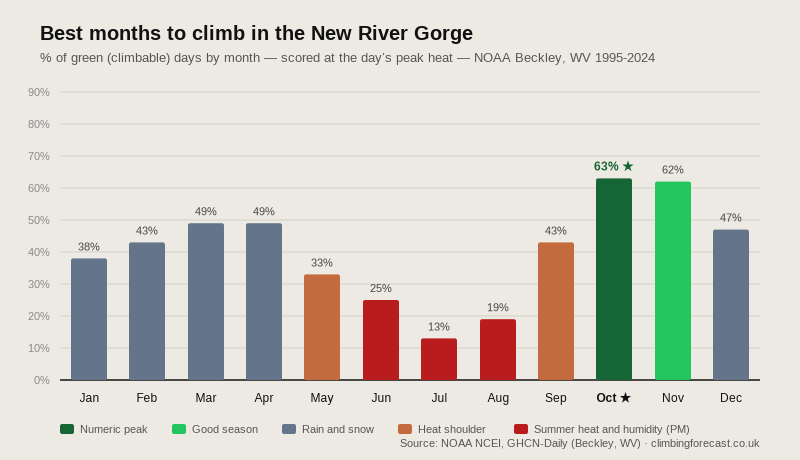
Fall, and October is best. October scores 63% green days for a full afternoon session and November 62%. Fall is the driest season in the Gorge: October and November get about 70 mm (2.8 in) of rain each, on eight or nine wet days, against 9 to 13 in spring and summer. The heat has gone too. October highs at Endless Wall average about 19°C (66°F), and November's about 13°C (55°F).
Fall is also the most dependable. October reached 70% or better in 7 of the 30 years, and 86% in 2000; November did so in 6 years. They still vary: the worst October was 42% (2018) and the worst November 44% (2002). If you're travelling for a week, keep a spare day in the plan.
Spring comes second. March and April both score 49%. Spring brings more wet days than fall, and May, at 33%, is held back by both rain and the first warm, humid afternoons. The National Park Service names late April to mid-June and mid-September to late October as the best months. Our replay agrees about fall; in spring it finds the weather less reliable, because it rains more often.
New River Gorge climbing conditions month by month
| Month | Afternoon | Dawn | High | Rain | Wet days |
|---|---|---|---|---|---|
| Jan | 38% | 38% | 6°C / 42°F | 82 mm | 11.1 |
| Feb | 43% | 43% | 8°C / 46°F | 83 mm | 10.6 |
| Mar | 49% | 50% | 13°C / 55°F | 92 mm | 11.5 |
| Apr | 49% | 57% | 19°C / 66°F | 90 mm | 10.5 |
| May | 33% | 52% | 23°C / 73°F | 119 mm | 12.8 |
| Jun | 25% | 56% | 27°C / 80°F | 109 mm | 11.3 |
| Jul | 13% | 56% | 28°C / 82°F | 131 mm | 11.4 |
| Aug | 19% | 63% | 28°C / 82°F | 95 mm | 9.2 |
| Sep | 43% | 69% | 25°C / 76°F | 87 mm | 7.4 |
| Oct ★ | 63% | 67% | 19°C / 66°F | 71 mm | 8.0 |
| Nov | 62% | 62% | 13°C / 55°F | 70 mm | 8.7 |
| Dec | 47% | 47% | 8°C / 46°F | 79 mm | 11.1 |
Average of Endless Wall, Kaymoor, Bridge Buttress, Beauty Mountain and the Junkyard (441–599 m / 1,450–1,970 ft), 30 years (1995–2024) of daily weather from the NOAA station at Beckley, WV (USW00003872), adjusted to crag height. Afternoon and Dawn are the % of green (climbable) days, scored at the day's high and at the day's low. High is the average daily high at Endless Wall; Rain and Wet days (1 mm or more) are monthly averages at Beckley. Factors in rain, drying time, wind, seepage, snow and heat. Source: NOAA National Centers for Environmental Information.
How much does it rain in the New River Gorge?
Beckley averages about 1,110 mm (44 in) of rain a year, on about 124 days with 1 mm or more, and there's no dry season. Summer brings 30% of the year's rain, spring 27%, winter 22% and fall only 21%. July (131 mm, 5.2 in) and May (119 mm, 4.7 in) are the wettest months. The wettest month in the 30 years was September 2018, with 254 mm (10 in).
In every month from October to April, rain and the drying time after it make 8 to 17 days red. That's the price of climbing in the green, wet Appalachians, and it's why a spare day matters more here than at a desert crag.
How long after rain can you climb?
The Park Service describes the Gorge's cliffs as "a very hard sandstone", and it's much harder than the soft sandstones of England or Fontainebleau. But it's still sandstone: wet holds are weaker, and repeated rain soaks into the rock, so climb on dry rock and leave wet lines for another day.
Our model marks a crag red on a day with rain and while the rock is still wet, then amber until about 36 hours after rain, longer after heavy rain or where walls seep. The crags don't all dry at the same speed. Kaymoor is shady and seepy, and in our replay it scores 5 to 10 points below the other crags in October and November, at 57% in October. Endless Wall, Bridge Buttress and Beauty Mountain score best, at 64–66% in October.
Can you climb at the New River Gorge in summer?
Early in the day. Highs at Endless Wall average about 28°C (82°F) in July and August, and pass 27°C (80°F), where our model starts to flag the heat, on about 19 to 21 days a month. The air is humid too, which makes the rock feel greasy. That's why June to August score just 13–25% in the afternoon.
Dawn starts work much better. Scored at the day's low, June to August hold 56–63%. In summer, start at first light, pick shady walls, and be ready for afternoon thunderstorms: the Park Service warns that the open cliffs are very dangerous in a lightning storm.
Can you climb at the New River Gorge in winter?
Sometimes. December to February score 38–47%. Highs at Endless Wall average 6–8°C (42–46°F) and it freezes on about 18 to 22 nights a month, so cold sunny days between fronts are the ones to pick, on south-facing walls. Snow and wet weather cost the rest. Our model doesn't mark days down for cold, so the winter numbers are about rain and snow, not comfort.
Visiting the New River Gorge
- No entrance fee. There is no fee to enter New River Gorge National Park and Preserve.
- Camping. The park's primitive campgrounds are free and first-come, first-served, with a limit of 14 days in any 28. Camping is not allowed within 100 feet of the top or bottom of the cliffs.
- Climbing rules. Motorized drills need a permit. Don't use trees or other vegetation as anchors, park only in designated areas, keep pets on a leash, and don't leave vehicles unattended overnight at parking areas. There is private land within the park boundary, so respect signs.
- Nesting falcons. Peregrine falcons nest in spring, so parts of the cliffs may close from mid-spring to early summer. Check the park's climbing page before you go.
Fall Wins
October leads at 63% green days and November is next at 62%. Fall is the driest season, and the summer heat has gone.
Rain All Year
About 1,110 mm (44 in) of rain a year on about 124 wet days, with no dry season. Keep a spare day in the plan.
Humid Summers
June to August afternoons score 13–25%. Climb at dawn, pick shady walls and watch for thunderstorms.
How we calculated this
We ran 30 years of real daily weather (1995–2024) from the NOAA station at Raleigh County Memorial Airport in Beckley (760 m) through the drying model behind the live Endless Wall forecast. It's the closest station with a full, long record of temperature, rain, snow depth and wind. The crags sit at 441–599 m, lower than the station, so we adjusted temperatures up by 1.0–2.1°C (2–4°F) using the standard lapse rate. Daily humidity was recorded from 2006; for 1995–2005 we used the station's own monthly averages from 2006–2024. Each day is rated GREEN, AMBER or RED on recent rain, drying time, wind, snow on the ground and heat, scored once at the day's high and once at its low.
Data retrieved 17 November 2026 from NOAA NCEI's GHCN-Daily dataset (station USW00003872). Source: NOAA National Centers for Environmental Information. Park information from the National Park Service (climbing, camping and fees pages).
It won't replace checking the forecast the week you go, but it's an honest answer to "when should I book?". Before you go, compare the crags on our New River Gorge weather page. For more sport climbing on Appalachian sandstone, see our Red River Gorge guide.
Good luck and enjoy the climbing!