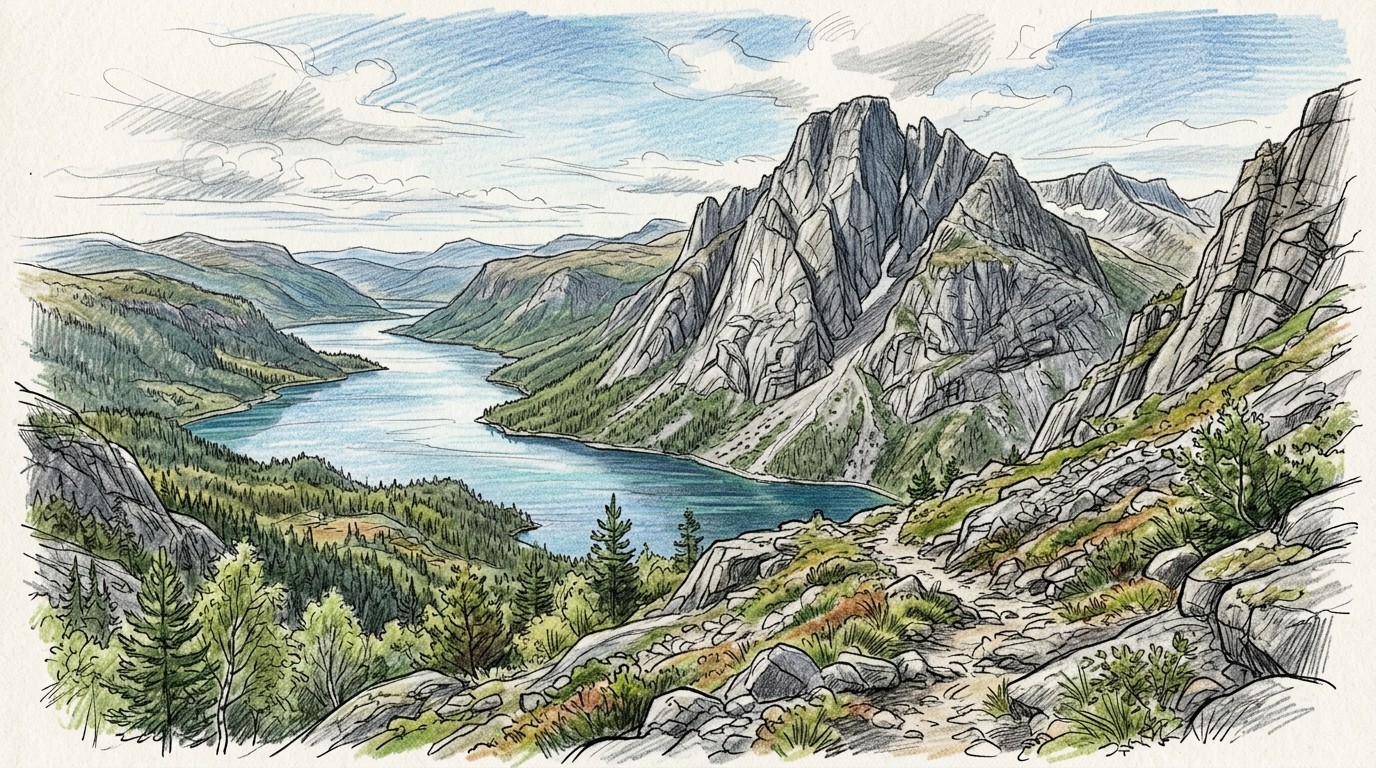
Hægefjell is one of southern Norway's best big crags: a granite dome above the Nissedal valley in Telemark, with long multi-pitch routes of 200 to 550 m up its south face, and a boulder field below. It's high enough to hold snow well into spring, and early summer there is drier than you might expect. We ran the weather from 2007 to 2025 through our drying model to find out when the granite is most often dry and climbable.
We took daily rain and temperature from MET Norway's seNorge grid, a 1 km map of Norway's weather built from its stations, at the foot of the Hægefjell face (600 m), and daily humidity from MET Norway's weather station at Høydalsmo, on the Telemark plateau at about the same height. Then we ran every day through the climbingforecast drying model, with the same granite rules as our live forecast. Each day is scored for an afternoon session, and again at the day's low for an early start.
When is the best time to climb at Hægefjell?
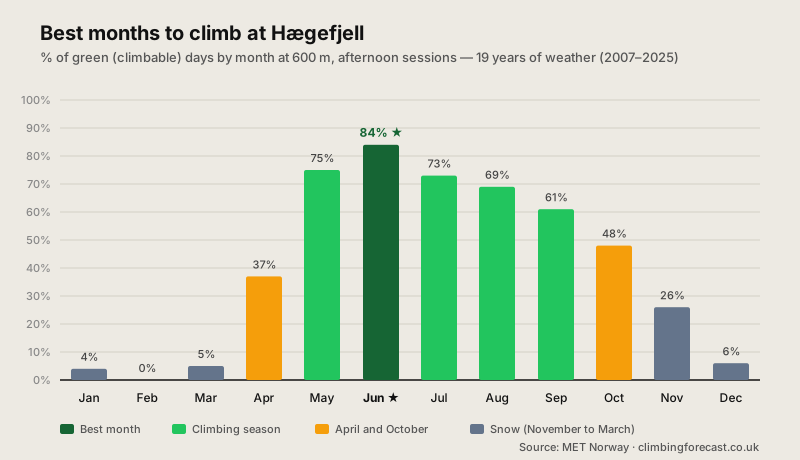
June is the best month. It scores 84% green afternoons, ahead of May (75%), July (73%), August (69%) and September (61%). June is the most reliable month too: it reached 70% green in 17 of the 19 years, and its worst year still scored 63%. Highs average 18°C (64°F) at the foot of the face, which is good friction weather for granite, and the days are long.
Why early summer? It's the driest time of year. May and June get 80–90 mm of rain a month, and April only about 50 mm, while August to October get 120–130 mm. The air is drier in early summer, too, which matters on granite: our model marks the rock amber when the air is very humid, because the friction suffers.
The season runs from May to September. May opens it once the snow has gone, July and August are still good, though wetter, and September can give cool, crisp days on the big slabs.
Hægefjell climbing conditions month by month
| Month | Afternoon | Morning | High | Rain | Rain Days |
|---|---|---|---|---|---|
| Jan | 4% | 4% | −1°C / 29°F | 130 mm | 13.6 |
| Feb | 0% | 0% | 0°C / 32°F | 88 mm | 11.1 |
| Mar | 5% | 5% | 4°C / 39°F | 67 mm | 8.3 |
| Apr | 37% | 35% | 8°C / 47°F | 52 mm | 6.9 |
| May | 75% | 67% | 13°C / 56°F | 79 mm | 9.3 |
| Jun ★ | 84% | 75% | 18°C / 64°F | 90 mm | 9.8 |
| Jul | 73% | 69% | 19°C / 67°F | 116 mm | 12.1 |
| Aug | 69% | 65% | 18°C / 64°F | 127 mm | 12.0 |
| Sep | 61% | 57% | 14°C / 57°F | 131 mm | 11.1 |
| Oct | 48% | 45% | 8°C / 46°F | 123 mm | 12.3 |
| Nov | 26% | 25% | 3°C / 37°F | 122 mm | 13.1 |
| Dec | 6% | 5% | −1°C / 31°F | 113 mm | 13.5 |
Hægefjell at the foot of the south face (600 m), 19 years (2007–2025) of daily rain and temperature from MET Norway's seNorge 1 km grid, with humidity from MET Norway's station at Høydalsmo (565 m). Afternoon and Morning are the % of green (climbable) days, scored at the day's high and at the day's low. High is the average daily high, Rain the monthly average (rain and melted snow), and Rain Days the days with 1 mm or more. Factors in rain, drying time, wind, humidity, snow and heat. Cold, dry days count as green. Source: MET Norway.
Spring: waiting for the snow to go
April is snowy, May is the start. At 600 m, snow lies at the foot of the face on most days until April, which scores 37%; the second half of April scores 47% as it melts. By May the rock is clear, at 75%. The road to the crag opens as the snow goes, so the start of the season moves from year to year with the winter's snow. Check the road and the snow before an early-May trip.
Spring is dry. April is the driest month of the year, at about 50 mm, and once the snow has gone, late spring often gives long runs of dry days. Cool spring granite has excellent friction.
Summer and autumn
July and August are wetter. They score 73% and 69%, still good, but with rain on about 12 days a month as summer showers and thunderstorms build inland. Highs average 18–19°C (64–67°F), so heat is rarely a problem on the face.
September is the last good month. It scores 61%, with the autumn rain starting (131 mm, the wettest month of the season). October drops to 48% as the days shorten and the first snow can arrive, and from November to March the face is under snow.
Climbing at Hægefjell: what to expect
Long routes on granite. Hægefjell's routes run 200–550 m, from Norwegian grade 4+ to 7b, on three sectors: a steep left side, a central section and an easier right side. Most routes are partly bolted, but four classics are pure trad from bottom to top: Via Lara, Sternschnuppe, Mot Sola and Hegar. Bring a rack of nuts and cams for any route. Below the face, a boulder field has over 180 problems.
Access. Hægefjell is reached by a toll road, which opens when the snow allows, usually in May. Parking is limited, so share cars where you can. The Gryttr guidebook (2020) covers the long routes and the bouldering.
Best: June
84% green afternoons, and 70%+ in 17 of the 19 years. May to September is the season.
Spring Snow
Snow lies at the foot of the face until April. The season, and the road, open in May.
Winter Off
From November to March, the face is under snow and scores fall to 0–26%.
How we calculated this
There's no long weather record at Hægefjell itself, so we used MET Norway's seNorge grid, which maps each day's rain and temperature across Norway on a 1 km grid from its weather stations, at the square at the foot of the face (an average height of about 670 m, moved down to 600 m). The grid has no humidity, and on granite our model marks the rock amber when the air is very humid. So we took the daily humidity measured at MET Norway's station at Høydalsmo (565 m), 29 km north on the Telemark plateau at about the height of the face, and adjusted it to the temperature at the crag. Høydalsmo started recording humidity in August 2006, which is why this replay covers 2007–2025, not 30 years. MET Norway's station in Nissedal, Tveitsund, has a longer record, but it sits by lake Nisser, 350 m below the face, in the valley's damp air and fog; using it would make August and September score 20–30 points worse than they do with the station at the crag's height.
Every day is rated on recent rain, drying time, wind, humidity, snow and heat, at the day's high (afternoon) and low (morning), and the snow is carried from one day to the next. The model reads the air temperature, not the rock, and wind is set to a steady breeze, so use the numbers to choose your month and the live Hægefjell forecast to choose your day.
Data retrieved 8 October 2026. Source: MET Norway, seNorge_2018 daily grid (version 23.09) and station observations from Høydalsmo II (32890) and Tveitsund (37230), licensed under CC BY 4.0. Route and access information from theTopo, Mountain Project and theCrag. For more Scandinavian granite, see our Lofoten and Bohuslän guides, and for Alpine granite, Valle dell'Orco.
Good luck and enjoy the climbing!