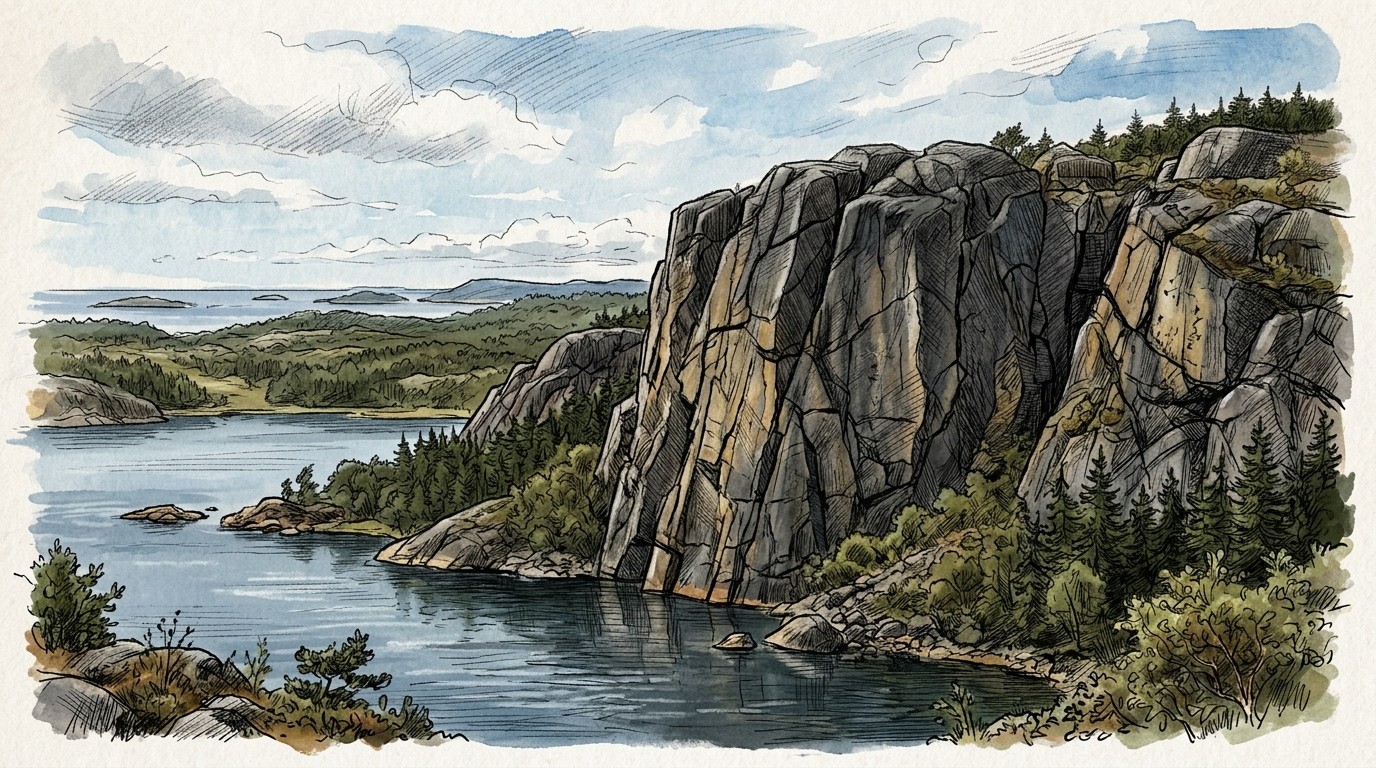
Bohuslän, on Sweden's west coast north of Gothenburg, is one of the great granite crack-climbing areas of Europe: hundreds of trad routes on smooth, pink Bohus granite, from easy cracks to E9, on crags that rise out of fields and forest a few kilometres from the sea. It's a long way north, so the season is short and the weather comes in off the North Sea. We ran 30 years of weather through our drying model to find out when the granite is most often dry and climbable.
We took 30 years (1996–2025) of daily weather from SMHI, the Swedish weather service: rain from its station at Heden, 6 km from the crag, and temperature, humidity and wind from its inland station at Kroppefjäll, adjusted to the coast. We used it for Hallinden, the best-known crag in Bohuslän, and ran every day through the climbingforecast drying model, with the same granite rules as our live forecast. Each day is scored for an afternoon session, and again at the day's low for an early start.
When is the best time to climb in Bohuslän?
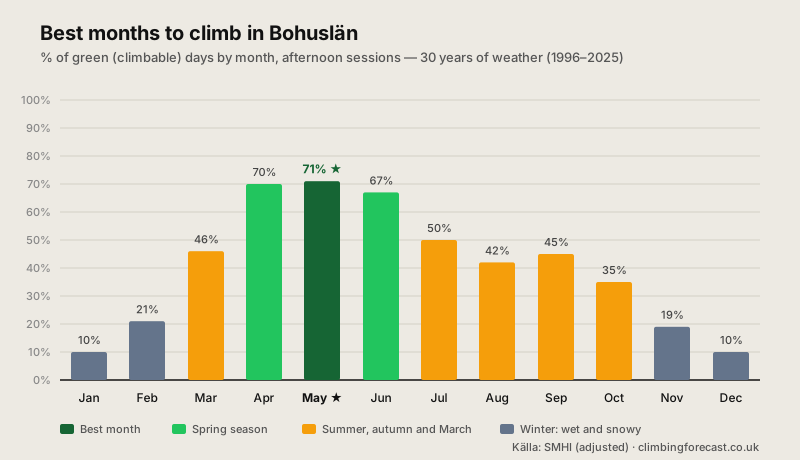
Late spring: May is the best month. It scores 71% green afternoons, just ahead of April (70%) and June (67%). The best weeks of the year are the second half of April (75%) and the first half of May (77%). Spring is the driest part of the year on the Swedish west coast: April and March get 58 mm of rain each, and April has only 8 rain days. The air is cool and dry, with highs of 11°C (52°F) in April and 16°C (61°F) in May, which is good friction weather for granite. The days are long, too: by late May it's light until about 10 pm.
Every spring is different. April, May and June each reached 70% green in 16 of the 30 years. May's worst year scored 42%, and its best 94%. Book a trip of a week or more if you can, so a wet spell doesn't take the whole trip, and check the forecast before you go.
Summer is good, autumn is wet. July scores 50% and August 42%, as the rain picks up and the air gets more humid. September (45%) and October (35%) are wetter still: October is the wettest month of the year, at 131 mm.
Bohuslän climbing conditions month by month
| Month | Afternoon | Morning | High | Rain | Rain Days |
|---|---|---|---|---|---|
| Jan | 10% | 10% | 2°C / 35°F | 96 mm | 12.7 |
| Feb | 21% | 20% | 3°C / 37°F | 77 mm | 10.8 |
| Mar | 46% | 44% | 6°C / 42°F | 58 mm | 8.4 |
| Apr | 70% | 65% | 11°C / 52°F | 58 mm | 8.1 |
| May ★ | 71% | 65% | 16°C / 61°F | 68 mm | 10.0 |
| Jun | 67% | 66% | 20°C / 67°F | 82 mm | 10.5 |
| Jul | 50% | 64% | 22°C / 71°F | 90 mm | 10.4 |
| Aug | 42% | 55% | 21°C / 69°F | 102 mm | 11.6 |
| Sep | 45% | 45% | 17°C / 62°F | 94 mm | 10.9 |
| Oct | 35% | 33% | 11°C / 52°F | 131 mm | 13.8 |
| Nov | 19% | 19% | 6°C / 43°F | 107 mm | 13.7 |
| Dec | 10% | 10% | 3°C / 37°F | 107 mm | 14.1 |
Hallinden (60 m), 30 years (1996–2025) of real daily observations from SMHI: rain at Heden, and temperature, humidity and wind at Kroppefjäll adjusted to the coast with SMHI's station at Dingle. Afternoon and Morning are the % of green (climbable) days, scored at the day's high and at the day's low. High is the average daily high at the crag, Rain the monthly average, and Rain Days the days with 1 mm or more. Factors in rain, drying time, wind, humidity, snow and heat. Cold, dry days count as green. Källa: SMHI (adjusted by climbingforecast).
Climbing in Bohuslän in spring
April to June is the season. All three months score 67–71% green afternoons. Spring is the driest season, and the dry spring air dries the granite quickly. Nights can still be frosty in April (about 11 frosty nights a month), so the shady crags take longer to warm up. Go for the sun in April, and for the shade by June.
March can be a bonus. It scores 46% overall, but the second half of the month scores 54%, as the snow goes and the dry spring weather sets in. Highs average only 6°C (42°F), so pick sunny, south-facing walls such as Hallinden.
Can you climb in Bohuslän in summer?
Yes, but expect some lost days. July scores 50% green afternoons and August 42%. Summer is wetter than spring, with 90–102 mm of rain a month, and the air is more humid. In our replay, about half of the lost August afternoons are drying time after rain, and the other half are humid air, when granite friction is poor.
Mornings and evenings are better. Scored at the day's low, July comes out 64% green and August 55%. It's rarely hot (July highs average 22°C, 71°F), but the summer sun on the south-facing slabs can make them greasy by midday. With light until late in the evening, climb early or late and take the middle of the day off at the beach.
Autumn and winter: the wet season
Autumn is wet. September scores 45% and October 35%. October is the wettest month, at 131 mm on about 14 days, and the damp autumn air keeps cracks and shady walls wet for longer. A dry spell of high pressure can still give great, cool days in September, so watch the forecast.
Winter is off. From November to February, scores fall to 10–21%. It rains or snows on 11 to 14 days a month, nights are frosty, and snow lies on the crag on many days from December to February. The days are short, too: in December it's dark by about 3.30 pm.
Trad climbing in Bohuslän: what to expect
Cracks in perfect granite. Bohuslän is best known for its crack climbing: splitters, corners and slabs on Bohus granite, a fine- to medium-grained pink granite that cooled about 920 million years ago and is one of Sweden's youngest granites. One English guidebook lists about 1,500 trad routes and 300 bolted ones across 91 crags, from Severe to E9. Most crags are single pitch.
A trad culture. Most routes are protected with nuts and cams, and many crags have no bolts at all. At Hallinden, the local club's bolt policy applies and no new bolts are accepted. Bring a full rack, and follow the local ethic.
Getting there. The crags are spread out between Uddevalla and Strömstad, about an hour or two north of Gothenburg, so you'll want a car. At Hallinden, the club asks climbers to park only at Hallinden's old station and walk in, never to drive to the crag. Many crags are near the coast, so a climbing trip is easily combined with swimming and the fishing villages of the Bohuslän coast.
Best: May
71% green afternoons. Late April and early May are the best weeks of the year, at 75–77%.
Summer Mornings
July afternoons score 50%, mornings 64%. Climb early or late, when it's cooler and less humid.
Wet Autumn
October is the wettest month, at 131 mm. From November to February, scores fall to 10–21%.
How we calculated this
There's no long weather record from the crags themselves, so we combined three SMHI stations. Rain comes from Heden, 6 km from Hallinden, which has a complete daily record. SMHI's nearest station with 30 years of temperature, humidity and wind is Kroppefjäll, 42 km inland. SMHI's old station at Dingle, 8 km from Hallinden, measured temperature until 2002, so we used the seven years both stations have to adjust Kroppefjäll to the coast: Dingle's days are about 1°C warmer, and its nights about the same. The humidity was adjusted to the warmer air at the crag. We didn't use the offshore lighthouse at Väderöarna, as its sea climate matches the crags much less well.
Every day is rated on recent rain, drying time, wind, humidity, snow and heat, at the day's high (afternoon) and low (morning). The model reads the air temperature, not the rock, and it doesn't know which walls are in the shade, so use the numbers to choose your month and the live forecast to choose your day. Sea-facing crags like Skälefjäll and Fjällbacka get more wind and sea air: in our replay, Skälefjäll scores about the same in spring but a few points lower in autumn.
Data retrieved 8 October 2026. Källa: SMHI, Meteorologiska observationer (stations 81310 Heden, 82360 Kroppefjäll-Granan A, 81320 Dingle), CC BY 4.0; the data have been adjusted to the crag as described above. Granite age from the Geological Survey of Sweden; route numbers from Bohuslän Selected Rock Climbs; access and bolt policy from 27 Crags and theTopo. For more granite crack climbing, see our Valle dell'Orco and Chamonix guides, and for summer granite in Canada, Squamish.
Good luck and enjoy the climbing!