Chamonix is the capital of alpinism, at the foot of Mont Blanc in the French Alps. But it's also a rock-climbing town, with crags on the valley floor and long routes on the gneiss of the Aiguilles Rouges, the "red needles" across the valley from Mont Blanc. The catch is the height: the valley sits at about 1,000 m and the climbing goes up to 2,500 m and more, so the season changes with every few hundred metres. We ran 30 years of weather through our drying model, at three heights, to find out when the rock is most often dry and climbable.
We took 30 years (1996–2025) of daily weather from Météo-France's station in Chamonix and its mountain station in the Aiguilles Rouges, and used them for three crags: Les Gaillands (1,037 m), the valley crag by the lake; the Aiguillette d'Argentière (1,843 m), in the Aiguilles Rouges above Argentière; and Le Brévent (2,525 m), the big wall under the cable-car station. Then we ran every day through the climbingforecast drying model, with the same rules as our live forecasts. Each day is scored for an afternoon session, and again at the day's low for an early start.
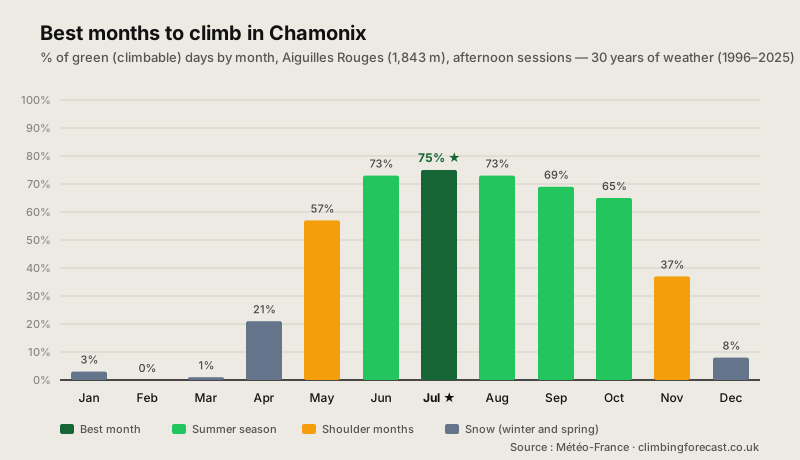
When is the best time to climb in Chamonix?
In the mountains, July. The Aiguillette d'Argentière scores 75% green afternoons in July, just ahead of June and August (73%). September (69%) and October (65%) are nearly as good. The second half of July is the best fortnight of the year, at 76%. At 1,843 m, July afternoons average a cool 17°C (63°F), so heat is never the problem: rain and storms are.
Higher up, the season is shorter. At Le Brévent (2,525 m), snow lingers into June: the first half of June scores only 29%, the second half 59%. July and August are the best months, at 69%, then September (62%) and October (54%). Above 2,500 m, plan for July to September.
In the valley, April. Les Gaillands has its best month in April, at 66% green afternoons, with highs of about 15°C (58°F). It's a sunny, south-facing wall, so it comes into condition as soon as the snow goes, in March, long before the mountain crags. In summer the valley gets warm and stormy, and the afternoons fall to 17–35%.
Every summer is different. July at the Aiguillette reached 70% green in 23 of the 30 years, but its worst July scored 39% and its best 90%. Chamonix weather can turn quickly in the mountains, so check the forecast before you go up.
Chamonix climbing conditions month by month
| Month | Les Gaillands 1,037 m |
Aiguillette 1,843 m |
Le Brévent 2,525 m |
High (valley) |
Rain | Rain Days |
|---|---|---|---|---|---|---|
| Jan | 3% | 3% | 0% | 3°C / 38°F | 100 mm | 9.4 |
| Feb | 12% | 0% | 0% | 6°C / 43°F | 71 mm | 8.2 |
| Mar | 38% | 1% | 0% | 10°C / 51°F | 84 mm | 9.2 |
| Apr | 66% | 21% | 0% | 15°C / 58°F | 85 mm | 9.6 |
| May | 51% | 57% | 6% | 19°C / 65°F | 129 mm | 13.8 |
| Jun | 35% | 73% | 44% | 23°C / 74°F | 120 mm | 12.5 |
| Jul ★ | 26% | 75% | 69% | 25°C / 76°F | 133 mm | 11.8 |
| Aug | 17% | 73% | 69% | 24°C / 76°F | 129 mm | 11.5 |
| Sep | 33% | 69% | 62% | 20°C / 68°F | 93 mm | 9.7 |
| Oct | 35% | 65% | 54% | 16°C / 60°F | 110 mm | 9.9 |
| Nov | 21% | 37% | 28% | 8°C / 47°F | 101 mm | 10.1 |
| Dec | 8% | 8% | 2% | 3°C / 38°F | 112 mm | 10.2 |
% of green (climbable) afternoons at three Chamonix crags, from 30 years (1996–2025) of real daily observations at Météo-France's Chamonix station (1,042 m) and Aiguilles Rouges mountain station (2,365 m), adjusted to each crag's height. High is the average daily high in Chamonix, Rain the monthly average in the valley, and Rain Days the days with 1 mm or more. Factors in rain, drying time, wind, humidity, snow and heat. Cold, dry days count as green. Source : Météo-France.
Climbing in Chamonix in summer
Go high in the afternoon. From June to August, the Aiguilles Rouges score 73–75% green afternoons, against 17–35% at Les Gaillands. Up at 1,843 m, July highs average 17°C (63°F); in the valley, they average 25°C (76°F), and pass 27°C (81°F) on about 11 days a month.
Watch for storms. July is the valley's wettest month, at 133 mm, and most of it falls in short, heavy afternoon thunderstorms. In our replay, about half of the lost summer afternoons at Les Gaillands are drying time after a storm, and the other half are warm, humid air, when friction on the gneiss is poor. Start early, and be off long routes before the storms build.
The valley crags are good in the morning. Scored at the day's low, Les Gaillands comes out 56–59% green from June to September, against 17–35% in the afternoon. It's a south-facing wall, so get there early, or wait for the evening.
Spring and autumn: the valley's season
Spring belongs to the valley. Les Gaillands scores 66% in April and 51% in May, while the mountains are still under snow: the Aiguillette scores 21% in April and Le Brévent 0%. April in Chamonix is cool and fairly dry (85 mm), and April afternoons at Les Gaillands reached 70% green in half of the 30 years. May is the valley's wettest spring month (129 mm, 14 rain days).
Autumn belongs to the mountains. September and October stay good in the Aiguilles Rouges (69% and 65% at the Aiguillette), with fewer storms than in summer. In the valley, damp autumn air holds Les Gaillands back to 33–35%. The weather breaks in November, when snow returns at height: the Aiguillette falls to 37% and Le Brévent to 28%.
Can you rock climb in Chamonix in winter?
Hardly. From December to February, snow lies on the valley floor for most of the month, and the Aiguilles Rouges are under snow from December to April. Les Gaillands has had the odd good January (64% green in its best year), when a long dry, mild spell melts the snow off the sunny wall, but most winters score close to zero. Winter in Chamonix is for skiing and ice climbing.
Rock climbing in Chamonix: what to expect
Les Gaillands: the valley crag. A roadside wall of gneiss by a small lake on the edge of Chamonix, with more than 100 routes from French 3 to 7, many of them bolted. It's been a training crag for over a century: Roger Frison-Roche wrote that he helped the guide Alfred Couttet clean the cliff in 1928, when Couttet placed its first pitons. It faces south, the rock doesn't hold water, and it's a two-minute walk from the car.
The Aiguilles Rouges: mountain rock. The range across the valley from Mont Blanc is made of gneiss with lots of small holds, and the routes are long, from a few pitches to a full day. Many are only partly bolted, so bring a rack of nuts and cams, and check a guidebook for each route. The Brévent and Flégère lifts take you most of the way up, and the Aiguilles Rouges often stay climbable when the weather rules out the big Mont Blanc routes.
The Mont Blanc granite is another season. The high granite of the Aiguilles de Chamonix and the Mont Blanc massif starts at about 3,000 m and above. It's alpine climbing, with glaciers, lifts and freezing levels to think about, and our model doesn't cover it. Use this guide for the valley and the Aiguilles Rouges, and a mountain forecast for the high peaks.
Best: July
75% green afternoons in the Aiguilles Rouges at 1,843 m. June to October is the mountain season.
Spring: The Valley
Les Gaillands is best in April (66%), while the Aiguilles Rouges are still under snow.
Summer Storms
July is the valley's wettest month. Climb early, and be off long routes before the afternoon storms.
How we calculated this
Météo-France's Chamonix station (1,042 m) has a complete daily record of rain, temperature, wind and humidity from 1996 to 2025, 2.6 km from Les Gaillands and only 5 m above it, so we used it as it is for the valley. For the mountains, we added Météo-France's Aiguilles Rouges station (2,365 m), which measures temperature, humidity and wind. The Aiguillette d'Argentière (1,843 m) is taken between the two stations in proportion to its height. Le Brévent (2,525 m) is taken from the mountain station and moved up 160 m. There's no long rain record at height, so we scaled Chamonix's rain to Météo-France's station at Le Tour (1,500 m), which gets about 5% more rain in summer and 40% more in winter.
Every day is rated on recent rain, drying time, wind, humidity, snow and heat, at the day's high (afternoon) and low (morning), and the snow on the crag is carried from one day to the next. The model reads the air temperature, not the rock, and it doesn't know about snow patches on the approach, so use the numbers to choose your month and our live forecasts for Les Gaillands, the Aiguillette d'Argentière and Le Brévent to choose your day.
Data retrieved 8 October 2026. Source : Météo-France, Données climatologiques de base – quotidiennes (stations 74056001 Chamonix, 74056405 Aiguilles Rouges-Nivôse, 74056005 Le Tour), Licence Ouverte / Etalab 2.0. Les Gaillands history from Roger Frison-Roche's tribute to Alfred Couttet. For more Alpine trad, see our Valle dell'Orco guide; for summer sport climbing in the French Alps, Céüse; and for winter trad in the south of France, Annot.
Good luck and enjoy the climbing!