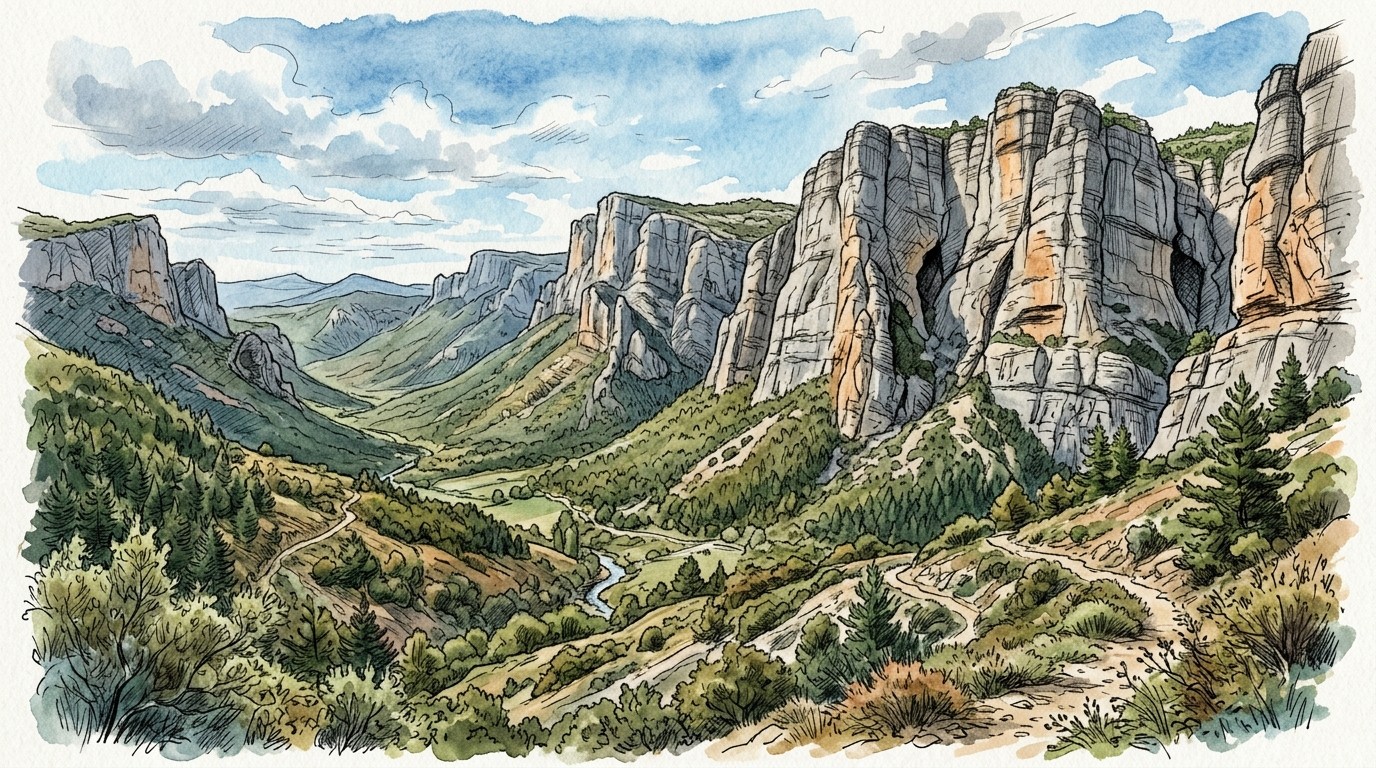
Annot is the reference for crack climbing in the south of France: towers and boulders of yellow and red sandstone, up to 20 m high, in the chestnut woods above a small village in the Alpes-de-Haute-Provence, less than 60 km north-west of Nice. It's mostly single-pitch crack climbing, and it's where James Pearson put up Le Voyage (E10) in 2017 and Bon Voyage, the world's first E12, in 2023. But Annot sandstone has one hard rule: never climb it wet. We ran 30 years of weather through our drying model to find out when it's most often dry enough to climb.
We took 30 years (1996–2025) of daily weather from Météo-France's station in the upper Verdon valley at St-André-les-Alpes, 11 km west of Annot, and adjusted it to 925 m, the height of La Chambre du Roi, the best-known trad sector, using Météo-France's station at Méailles, 5 km from the crag. Then we ran every day through the climbingforecast drying model, with the same sandstone rules as our live Annot forecast. Each day is scored for an afternoon session, and again at the day's low for an early start.
When is the best time to climb in Annot?
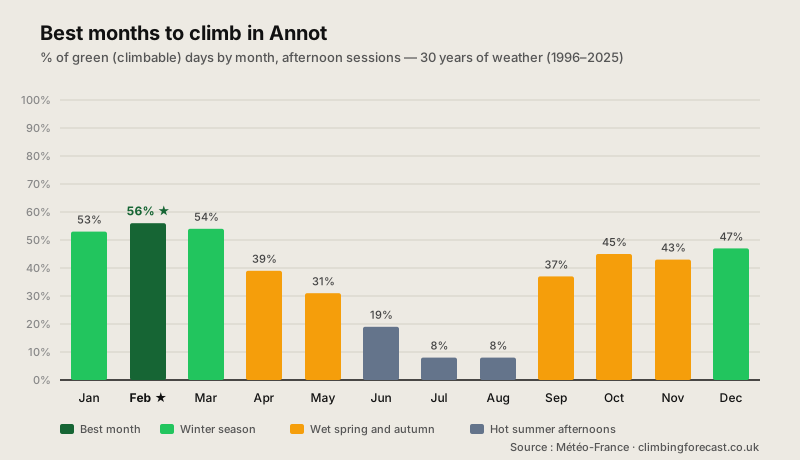
Winter: February is the best month. It scores 56% green afternoons, just ahead of March (54%) and January (53%). December scores 47%. Winter is the driest part of Annot's cool season: February gets 53 mm of rain, on about 5 days. The days are cold, with highs of 10–11°C (50–52°F), but cold, dry sandstone has the best friction. The hard routes go in winter: Pearson made the first ascent of Bon Voyage in February 2023, and Adam Ondra made the second in February 2024.
Why the scores look low. Every month loses days to rain, because wet sandstone mustn't be climbed. Our model marks the rock red for 24 hours after any rain, then amber for up to three days while the inside of the rock dries, so each wet day costs about three days. That's the rule our live forecast uses, and it's what keeps every month below 60%. These scores don't compare directly with those of limestone or granite crags.
Every winter is different. In a dry winter, almost every day is climbable: February has scored up to 93% green. In a wet one, it can be a write-off: its worst year scored 4%. February, January and March each reached 70% or more in 6 or 7 of the 30 years. Plan a few spare days if you can, and check the forecast before you book.
Annot climbing conditions month by month
| Month | Afternoon | Morning | High | Rain | Rain Days |
|---|---|---|---|---|---|
| Jan | 53% | 53% | 10°C / 49°F | 75 mm | 6.7 |
| Feb ★ | 56% | 56% | 11°C / 52°F | 53 mm | 5.1 |
| Mar | 54% | 54% | 14°C / 57°F | 70 mm | 6.2 |
| Apr | 39% | 39% | 16°C / 62°F | 91 mm | 9.1 |
| May | 31% | 35% | 21°C / 69°F | 100 mm | 9.8 |
| Jun | 19% | 47% | 26°C / 78°F | 75 mm | 7.4 |
| Jul | 8% | 58% | 29°C / 84°F | 50 mm | 5.1 |
| Aug | 8% | 57% | 29°C / 84°F | 49 mm | 5.1 |
| Sep | 37% | 50% | 24°C / 74°F | 74 mm | 6.2 |
| Oct | 45% | 45% | 19°C / 65°F | 124 mm | 7.9 |
| Nov | 43% | 43% | 12°C / 54°F | 140 mm | 8.5 |
| Dec | 47% | 47% | 10°C / 50°F | 89 mm | 7.4 |
Annot's trad sectors around La Chambre du Roi (925 m), 30 years (1996–2025) of real daily observations from the Météo-France stations at St-André-les-Alpes and La Mure-Argens, adjusted to the crag with Météo-France's station at Méailles. Afternoon and Morning are the % of green (climbable) days, scored at the day's high and at the day's low. High is the average daily high at the crag, Rain the monthly average, and Rain Days the days with 1 mm or more. Factors in rain, the wait for wet sandstone to dry, wind, humidity, snow and heat. Cold, dry days count as green. Source : Météo-France.
How long should you wait to climb after rain in Annot?
Never climb Annot sandstone wet. The local tourist office puts it simply: climbing in the rain isn't recommended, because water weakens the sandstone and makes it brittle. A hold that snaps off when the rock is damp is gone for good.
Give it at least a day, and more under the trees. The surface can look dry long before the rock inside is. The crags sit in a chestnut forest, which keeps the sun and wind off them, and some sectors are shady: one visiting climber describes La Chambre du Roi as shady and humid for a few days after rain. Our model follows the cautious line: red for 24 hours after any rain, then amber for up to three days. If in doubt, leave it for another day.
Annot is wetter than you might expect. It's in Provence, but in the mountains: the crag gets about 990 mm (39 in) of rain a year, on about 85 days with 1 mm or more. October and November are the wettest months, at 124 and 140 mm.
Is Annot good for climbing in winter?
Yes: it's the season. December to March score 47–56% green, and in a dry spell almost every day is good. Highs average about 10°C (50°F) in December and January, and nights drop below freezing on 16–17 nights a month, so mornings are cold. Snow is rare at this height: it costs up to two days a month in our replay, from December to February.
Follow the sun. The boulders face every way, so on cold days climb on the sunny side and save the shady faces for milder ones. Shady, damp sectors under the trees can stay wet for days after winter rain, even when the sunny walls are dry.
Spring and autumn: the wet seasons
Autumn is Annot's wettest season. October scores 45% and November 43%, held back by the big autumn rains of the southern Alps, not by the temperature: October highs average a pleasant 19°C (65°F). The second half of November (48%) is better than the first (39%), as the season turns towards winter.
Spring is wet too. April scores 39% and May 31%: rain falls on 9 to 10 days a month, more often than in any other season, and each wet day takes three days with it. March, at 54%, is the best spring month.
September is the warmest shoulder month. Afternoons score 37%, with highs around 24°C (75°F), but mornings score 50%. In late September and October the forest shade is welcome.
Can you climb in Annot in summer?
Not in the afternoon. In July and August the afternoon high averages 29°C (84°F) at the crag, and passes 27°C (81°F) on about 23 days a month, when friction on warm sandstone falls away. Only 8% of summer afternoons score green. Mountain Project's Annot page calls it "a furnace in summer".
Early mornings are good. Scored at the day's low, July comes out 58% green and August 57%, as good as February. The chestnut forest helps: the tourist office says the shade makes climbing pleasant even in summer. Our model reads the air temperature, not the rock, so shady walls under the trees will be better than the afternoon numbers suggest and sunny ones worse. Start at dawn, finish by late morning, and watch for afternoon thunderstorms, which can soak the rock in minutes.
Trad climbing in Annot: what to expect
Cracks in every size. Annot's trad is mostly single-pitch crack climbing on boulders and towers, mostly between French 5b and 7a, plus a few very hard test-pieces. The trad routes are unbolted. They were largely developed by Lionel Catsoyannis and Antoine Barbier, who cleaned the cracks before they were climbed. Bring a big rack of cams, from the smallest to the biggest: small cams are useful in the pockets. There are also bolted routes (127 from 3c to 8c+ in the sport sectors) and a big bouldering area.
The famous routes. Le Voyage (E10 7a), at La Chambre du Roi, is an almost 40 m line that follows a broken crack and then pockets. James Pearson made the first ascent in May 2017, and Steve McClure, Barbara Zangerl, Jacopo Larcher and Siebe Vanhee have since repeated it. Bon Voyage shares its start, then breaks left across bullet-hard sandstone with tiny pockets. Pearson finished it in February 2023, after about two years of trying, and later suggested E12. Adam Ondra made the second ascent in February 2024, confirmed E12, and said it would be hard 9a with bolts.
The rock. The Grès d'Annot formed about 35 million years ago, at the bottom of a deep sea, from sand carried down by underwater avalanches. The sandstone sits on soft blue marls, and as the marls wore away, the sandstone above broke up into the giant boulders the climbing is on. The site is protected (an Espace Naturel Sensible and a listed site), so stay on the paths.
Getting there. Annot is a stop on the narrow-gauge Train des Pignes, the Nice–Digne railway, so you can reach it without a car. Climbers park at the old station, and a marked path leads up through the chestnut woods to La Chambre du Roi, a natural tunnel between giant blocks. Allow 30–45 minutes uphill. Topos are sold in the village and at the tourist office.
Best: February
56% green afternoons, with January and March close behind at 53–54%. December to March is the season.
Never Climb It Wet
Wet sandstone is brittle and holds break for good. Wait at least a day after rain, longer in the shade.
Summer Heat
Only 8% of July and August afternoons are green. Mornings score 57–58%: start at dawn, in the shade.
How we calculated this
There's no long weather record from Annot itself, so we used the nearest Météo-France station with 30 years of daily rain, temperature, wind and humidity: St-André-les-Alpes (882 m), in the upper Verdon valley 11 km to the west, from 1996 to mid-2005, and its successor at La Mure-Argens (920 m), 2 km up the valley, from then to 2025. Valley stations get colder on clear nights than the hillside the climbing is on, so we adjusted the temperatures with Météo-France's station at Méailles (1,090 m), a hillside village 5 km north of Annot, using the 18 years both have records for: its nights are about 3°C warmer and its days about 1°C cooler. We then moved them to 925 m. Méailles also gets about 14% more rain than the valley, so we scaled the rain to match it. The humidity was adjusted to the warmer air at the crag.
Every day is rated on recent rain, the 24-hour and three-day sandstone waits, wind, humidity, snow and heat, at the day's high (afternoon) and low (morning). The model reads the air temperature, not the rock temperature, and it doesn't know which sectors are in the shade, so use the numbers to choose your month and the live forecast to choose your day.
Data retrieved 7 October 2026. Source : Météo-France, Données climatologiques de base – quotidiennes (stations 04173002 St-André-les-Alpes, 04136001 La Mure-Argens, 04115001 Méailles), Licence Ouverte / Etalab 2.0. Route history from Climber, Climber and PlanetMountain. For more sandstone, see our Fontainebleau guide; for other trad trips, our Red Rocks, La Pedriza and Valle dell'Orco guides; and for summer in the French Alps, Céüse.
Good luck and enjoy the climbing!