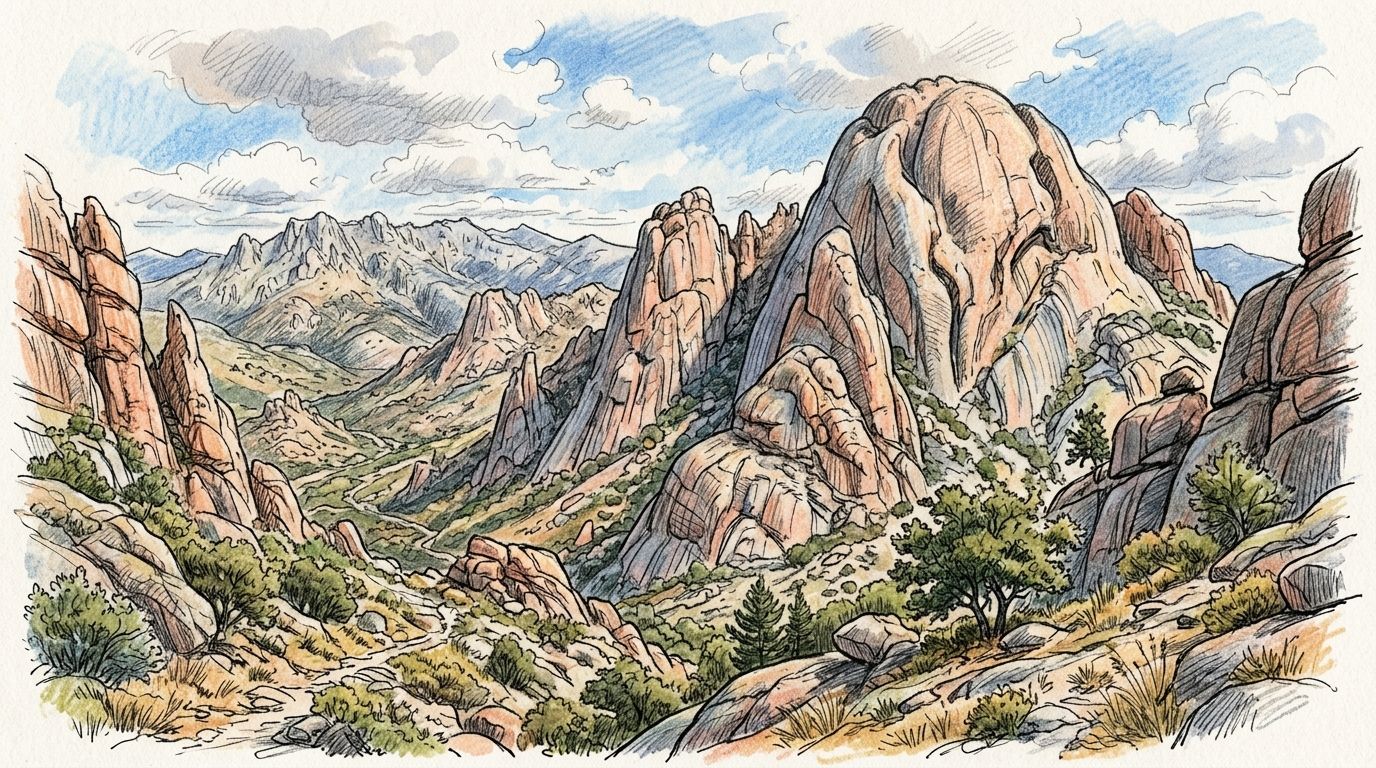
La Pedriza is Spain's best-known granite: a maze of domes, slabs and towers in the Sierra de Guadarrama, about an hour north of Madrid. It's famous for friction climbing on run-out slabs, with cracks and chimneys that take gear, and routes from single pitches to six-pitch climbs. It's also an autumn-to-spring destination: the lower crags stay in condition through the winter, and only the high crags work in summer. We modelled the lower crags and El Yelmo, the big trad dome above them, to find out when to book.
We took 30-year climate averages from two AEMET stations, one below La Pedriza and one on the ridge above it, and adjusted them to the height of the lower crags (1,200 m) and of El Yelmo (1,700 m). From them we simulated 30 years of daily weather and ran every day through the climbingforecast drying model. Here's what the data says.
When is the best time to climb in La Pedriza?
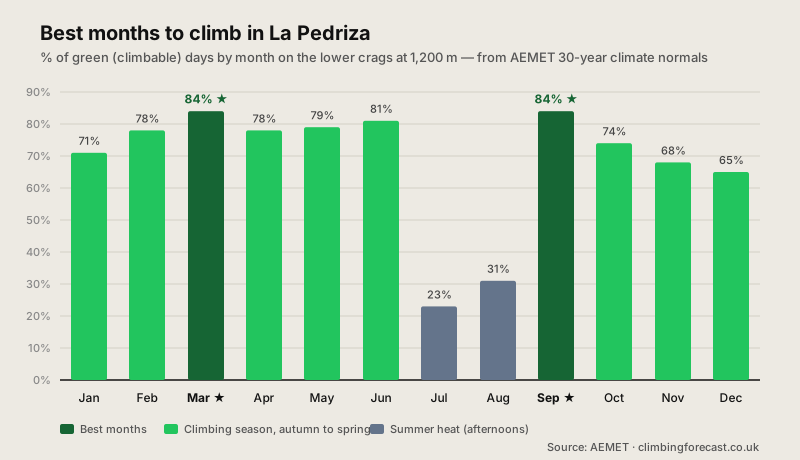
Autumn to spring, with March and September the best months. On the lower crags above Canto Cochino, March and September both score 84% green days. Every month from September to June scores 71% or more, apart from November (68%) and December (65%). There's no single short peak to catch: book when it suits you, and avoid July and August.
Winter holds up well. December scores 65%, January 71% and February 78%. Winter days are short and cool rather than wet: the days lost are mostly drying time after rain and damp, cloudy weather, and snow costs only about a day a month in January. That's what makes La Pedriza worth a winter trip.
Summer belongs to El Yelmo. Low down, July (23%) and August (31%) collapse in the heat. On El Yelmo, 500 m higher, June to September score 84–88%. More on both below.
La Pedriza climbing conditions month by month
| Month | Green Days | Amber Days | Red Days | % Green | Green + Amber |
|---|---|---|---|---|---|
| Jan | 21.9 | 7.2 | 1.8 | 71% | 94% |
| Feb | 21.7 | 5.7 | 0.5 | 78% | 98% |
| Mar ★ | 26.0 | 4.5 | 0.5 | 84% | 98% |
| Apr | 23.4 | 6.3 | 0.3 | 78% | 99% |
| May | 24.4 | 6.3 | 0.3 | 79% | 99% |
| Jun | 24.4 | 5.3 | 0.3 | 81% | 99% |
| Jul | 7.2 | 23.7 | 0.1 | 23% | 100% |
| Aug | 9.6 | 21.3 | 0.1 | 31% | 100% |
| Sep ★ | 25.2 | 4.8 | 0.0 | 84% | 100% |
| Oct | 23.0 | 7.7 | 0.3 | 74% | 99% |
| Nov | 20.5 | 8.2 | 1.3 | 68% | 96% |
| Dec | 20.3 | 9.0 | 1.7 | 65% | 95% |
Based on 30 simulated years for La Pedriza's lower crags (1,200 m), built from AEMET climate normals for Colmenar Viejo (station 3191E, 1982–2010, 1,004 m) and Puerto de Navacerrada (station 2462, 1981–2010, 1,892 m), scored at each day's afternoon high. Factors in rain, drying time, wind, humidity and cloud, snow and heat. Información elaborada utilizando, entre otras, la obtenida de la Agencia Estatal de Meteorología.
Is La Pedriza good for climbing in winter?
Yes, on the lower crags. At around 1,200 m, January afternoons average about 7°C and nights hover just above freezing. December to February score 65–78% green. In the model, almost all of the lost days are AMBER rather than RED: the granite is still drying after rain, or the air is damp and cloudy enough to spoil the friction. Granite dries quickly in La Pedriza's dry continental air: in the model, nine in ten winter spells of bad conditions last only one or two days. On clear, cold days the slab friction is at its best.
Not on El Yelmo. At 1,700 m, January afternoons average only about 3.5°C. El Yelmo scores 55% in December, 53% in January and 60% in February. Snow puts it out of action on about 8 days in January and 5 in February, and cloud and damp air take many more. Treat it as a bonus on a sunny, dry winter day.
Winter isn't free of restrictions. The bird-nesting closures start on 1 January, not in spring. In 2026 they include the routes on the east face of Peña Sirio and four routes on the west edge of Cueva de la Mora, as well as other sectors across La Pedriza (see below).
Can you climb in La Pedriza in summer?
Not low down. On the lower crags, July drops to 23% green and August to 31%. Afternoons at 1,200 m average about 28°C, and the model's heat warning (27°C) trips on about 20 days a month. Low-lying granite slabs in the summer sun have no friction to speak of.
El Yelmo is the summer option. At 1,700 m, July and August afternoons average about 24°C in the air, rain is rare, and El Yelmo scores 87% in June, 85% in July, 88% in August and 84% in September. The model reads air temperature, though, not rock temperature. El Yelmo's big south face gets the full summer sun, and granite slabs in direct sun get much hotter than the air around them. Climb in the morning.
Summer access is restricted. From 1 June to 30 September, cars can only drive in through the barrier on the road to Canto Cochino from 7:30 to 10:30 and 18:30 to 22:30 on weekdays, and from 7:00 to 9:30 and 18:30 to 22:30 at weekends and on public holidays. Once 270 vehicles are inside, the barrier stays shut. You can leave at any time until 23:00, but no vehicle may stay overnight. From October to May the only limit is at weekends and on public holidays, when cars can't drive in between 10:30 and 16:00.
Trad climbing in La Pedriza: what to expect
La Pedriza climbing is mostly friction: delicate, often run-out padding on granite slabs, with bolts that can be a long way apart, especially on the easier routes. The cracks, chimneys and offwidths take gear. A typical rack is a set of quickdraws plus a single set of cams and nuts. The granite is very abrasive, so tape up for the cracks. Slab friction is very sensitive to temperature and humidity, so it pays to choose your days carefully.
Above Canto Cochino, Peña Sirio is the big dome that dominates the view, with multi-pitch routes of up to about 185 m, and Cueva de la Mora sits just beside it. Higher up, El Yelmo's south face is a big granite wall with routes of up to about 150 m to its 1,717 m summit. The walk-in takes more than an hour. Check our live Canto Cochino and El Yelmo forecasts the week you go: they run the same drying model on the live weather.
Are there climbing restrictions in La Pedriza?
Yes. La Pedriza is inside the Sierra de Guadarrama National Park, and climbing is regulated in two ways:
- Closed all year. The park's management plan bans climbing in some areas, including the Charca Verde slabs and edges, Las Torres, La Cara, El Acebo and most of Los Aljibes.
- Closed during the nesting season, from 1 January to 31 July. Each year the Comunidad de Madrid publishes an order closing further sectors, or individual routes, to protect nesting golden eagles, griffon vultures, peregrine falcons and kestrels. In 2026 it covers well-known formations such as all of Peña Cagás and routes on the east faces of El Pájaro and Peña Sirio. El Yelmo is not on the list.
The list changes every year, so check the current national park order and map before you go, and look out for the signs at the car parks and at the restricted sectors and routes.
Best: March & September
84% green days on the lower crags. Every month from September to June scores 65% or more, so there's no short peak to catch.
Winter Works
65–78% green from December to February low down, with cool, crisp friction. Nesting closures start on 1 January, so check the list.
Summer Heat
July and August drop to 23–31% low down. Go high instead: El Yelmo scores 85–88%, but start early.
How we calculated this
There's no long, freely available daily weather record from inside La Pedriza, so we started from AEMET's published 30-year climate averages for two stations either side of it: Colmenar Viejo (1,004 m), about 10 km south-east of Canto Cochino, and Puerto de Navacerrada (1,892 m), on the main ridge about 12 km to the west. We interpolated every monthly value by altitude to the lower crags (1,200 m) and El Yelmo (1,700 m). That gives a mean annual temperature of about 12°C and 700 mm of rain a year for the lower crags, and about 8°C and 1,080 mm for El Yelmo. Published figures for La Pedriza give 11–12°C in the lowest parts, 9–10°C at 1,200–1,600 m and 800–1,500 mm of rain a year, so the lower crags may be slightly cooler and wetter than our figures, and the table slightly generous.
From those averages we drew 30 years of daily weather and ran every simulated day through the drying model behind our live Canto Cochino and El Yelmo forecasts. Each day gets a GREEN, AMBER or RED rating based on recent rain, drying time, wind, humidity and cloud, snow and heat, scored at the day's afternoon high. The table is the average over the 30 years.
Simulated weather has a weakness: it doesn't reproduce real runs of wet or dry weeks. So we also ran six years (2020–2025) of real daily observations from the Comunidad de Madrid's weather sensors at Colmenar Viejo (905 m) and Puerto de Cotos (1,870 m), adjusted the same way. For the lower crags they gave the same shape: September 81%, May 78%, February 75%, and July and August 31–32%. Winter and spring came out lower, with December at 55%, January 59% and March 62%, because several recent springs and early winters were very wet: Puerto de Cotos averaged 158 mm in March over those six years. If anything, treat the winter and spring figures in the table as the optimistic end.
Climate data: AEMET (Agencia Estatal de Meteorología), normals retrieved 6 October 2026. Check data: Comunidad de Madrid, Red de Calidad del Aire, hourly weather data from 2020 (CC BY 4.0), retrieved 6 October 2026. It won't replace checking the forecast the week you go, but it's an honest answer to "when should I book?". For other Spanish winter destinations, see our Albarracín guide and the Spain region-by-region guide.
Good luck and enjoy the climbing!