Albarracín's Font-style pine-forest sandstone is one of Europe's great winter bouldering destinations — but with sub-zero mornings, spring rain, and summers that bake the rock, when should you actually book?
We ran our Albarracín-specific climbingforecast.co.uk model with 30 years of AEMET climate normals to find out when the odds are stacked in your favour. Here's what the data says.
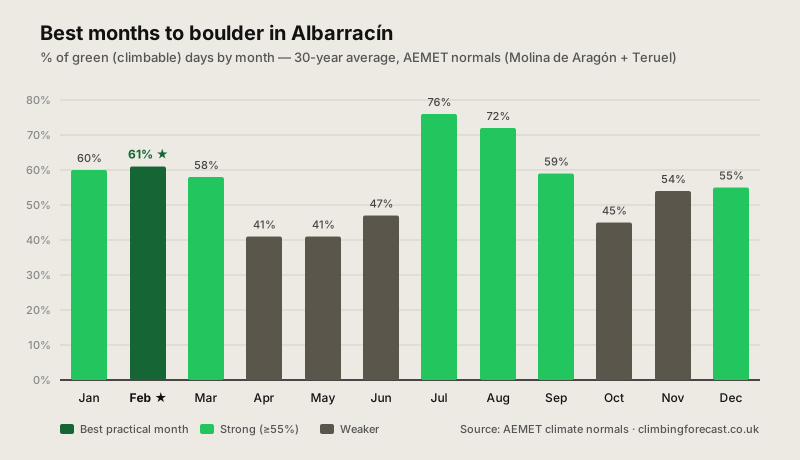
When is the best time to climb in Albarracín?
The sweet spot: February. 61% chance of climbable conditions, and by then the worst of the mid-winter cold has broken but the rock is still cool enough for the friction Albarracín is famous for. March (58%) and January (60%) are close behind. Locals and Font-refugee Brits alike book Feb and March for good reason.
When to avoid: the spring and autumn shoulder. April, May and October are the wettest months on the Sierra de Albarracín. Because Albarracín is soft sandstone — the same "never climb damp" rule that applies at Font, Harrison's or Northumberland — every rain event costs a day RED and two days AMBER while the subsurface moisture clears. Trip odds drop to 41–45% green.
Month-by-month conditions
| Month | Green Days | Amber Days | Red Days | % Green | Green + Amber |
|---|---|---|---|---|---|
| Jan | 18.5 | 7.8 | 4.7 | 60% | 85% |
| Feb ★ | 17.0 | 6.9 | 4.2 | 61% | 85% |
| Mar | 17.9 | 7.9 | 5.1 | 58% | 83% |
| Apr | 12.4 | 9.9 | 7.7 | 41% | 74% |
| May | 12.8 | 10.3 | 8.0 | 41% | 74% |
| Jun | 14.0 | 9.2 | 6.8 | 47% | 77% |
| Jul | 23.6 | 4.8 | 2.6 | 76% | 92% |
| Aug | 22.4 | 5.5 | 3.1 | 72% | 90% |
| Sep | 17.6 | 7.5 | 4.9 | 59% | 84% |
| Oct | 13.9 | 9.8 | 7.4 | 45% | 76% |
| Nov | 16.3 | 8.2 | 5.6 | 54% | 81% |
| Dec | 16.9 | 8.8 | 5.3 | 55% | 83% |
Based on 30 simulated years using AEMET climate normals for Molina de Aragón (station 3013, 1981–2010, 1,063 m) and Teruel (station 8368U, 1986–2010, 915 m), averaged across the five Albarracín sectors. Factors in rain, wind, humidity and the sandstone "never climb damp" rule enforced by our drying model.
Should you climb Albarracín in summer or winter?
Summer looks great in the data — don't trust it. July and August score 76% and 72% green respectively because they're the driest months of the year. But daytime highs regularly hit 30°C+ and bake the sandstone. Friction dies, sweat runs, and the practical bouldering window collapses to dawn and dusk. The model doesn't know about heat-death of friction on soft rock — you do. Skip summer.
Winter delivers, with one caveat. Cold-dry Iberian meseta weather is why Albarracín works when Font, Peak grit and everywhere else in northern Europe is a washout. But mornings can hit −8°C and colder in Jan and Feb, and frozen sandstone is not safe to climb — moisture inside the rock expands and permanently damages holds. Wait until the rock has thawed properly (usually mid-morning on Sol y Sombra, later on shaded sectors) before touching anything.
Which sector for which conditions?
All five Albarracín sectors share the same weather but have genuinely different microclimates:
- El Arrastradero — open hillside, dispersed pine cover. Fastest-drying sector; two clear dry days minimum after rain.
- Sol y Sombra — open south-facing slabs and walls. Warms fastest in winter sun, but bakes in summer. The winter go-to.
- Tierra Media — mid-forest, deep concentration of Font 7 classics. Expect an extra day after rain vs Arrastradero.
- Masico Pino — dense pine canopy, slowest-drying. Plan for 2–3 dry days minimum before this sector's climbable.
- Las Espadas — hard north-facing testpieces. Slow to dry, bitter cold on winter mornings.
The forecast at climbingforecast.co.uk runs the drying model per-sector, so once you're on the ground you can see which one's actually in condition rather than guessing.
Peak Potential
February leads the practical climbing season at 61% green days. Cold mornings, but the rock warms fast on south-facing Sol y Sombra and the trip odds are the best you'll get without leaving Europe.
Rainy Shoulder
May and April are the wettest months on the Sierra — 8.0 and 7.7 red days respectively. Every rain event costs a day RED and two days AMBER on Albarracín sandstone, so wet weeks compound fast.
The Sweet Spot
November through March offers the most consistent conditions — the "Green + Amber" percentage never drops below 81% across this window, and the temperatures suit the friction the rock is famous for.
How we calculated this
We took published 30-year climate normals from two nearby AEMET stations — Molina de Aragón (1,063 m, north of Albarracín) and Teruel (915 m, south-east) — and blended them to represent Albarracín's ~1,150 m altitude band. From each month's normals for temperature, rain frequency, humidity and wind, we drew 30 synthetic years of daily weather and ran every simulated day through our drying model for all five Albarracín sectors. Each day gets a GREEN, AMBER or RED status based on rain, drying time, wind and the sandstone-specific "never climb damp" rule. The table above is the average across 30 years and five sectors — 150 sector-years of simulated conditions.
The same methodology powers our Fontainebleau, Peak District and Spain regional data pieces. It's not a substitute for checking the actual forecast the week you're going — but it's the honest answer to "when should I book?"
Good luck and enjoy the climbing!