Red Rocks is America's big winter trad destination: long, varnished sandstone walls 27 km (17 miles) west of the Las Vegas Strip, from single-pitch cragging to 500 m multi-pitch routes in the canyons of the Red Rock escarpment. Mountain Project lists nearly 3,000 routes. The season is the cool half of the year, but Red Rock has a catch other desert crags don't: wet Aztec sandstone breaks, so every storm closes the rock for days. We ran 30 years of weather from inside Red Rock Canyon through our drying model to find out exactly when to go.
Red Rock has a weather station among the climbing: the Red Rock RAWS (a Remote Automatic Weather Station, run for fire weather), at 1,146 m (3,760 ft) by the visitor centre, about 1.5 km from Calico Basin. We took its daily temperatures for 30 years (1994–2023) from NOAA, and rain and humidity for each crag from Daymet, NASA's 1 km daily weather grid. Then we ran every day through the climbingforecast drying model for the four big trad canyons on the escarpment: Willow Springs, Pine Creek, Oak Creek and Black Velvet. They came out within a few points of each other every month, so the numbers below are their average. We also ran Calico Basin, the lower, warmer area by the visitor centre, on its own.
When is the best time to climb in Red Rocks?
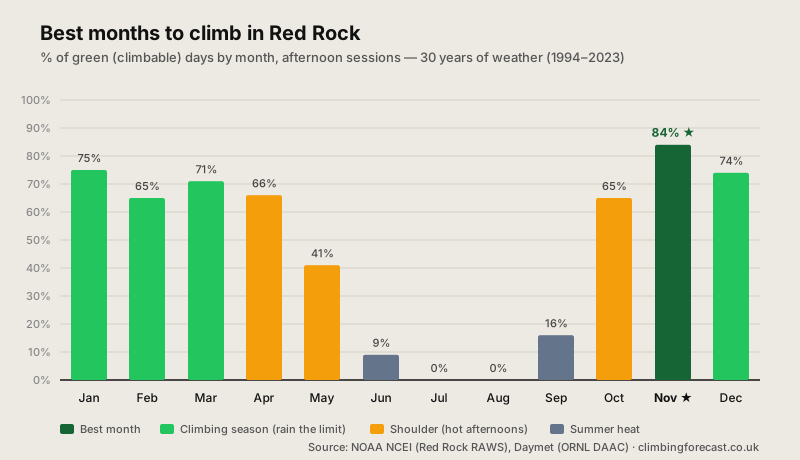
November is the best month. It scores 84% green afternoons, and 70% or more in 24 of the 30 years. It's the sweet spot: the summer heat has gone, highs in the canyons average 16°C (61°F), and the winter storms haven't started. Its worst year was 50%.
December to March are good, between storms. January scores 75%, December 74% and March 71%. February, the wettest month, scores 65%. In winter it's rain, not cold, that costs you days, and how many depends on the year: February went from 100% green in its best years to under 20% in its worst.
The shoulder seasons are late October and early April. Over the whole month, October scores 65% and April 66%, but the halves are very different. The first half of October scores 53%, and the second half 74%. The first half of April scores 70%, and the second half 61%. In both cases the problem is heat: the canyons pass 27°C (80°F) on about 7 days in an average October, and 15 in May.
From May to September, afternoons are too hot. May scores 41%, and June to September just 0–16%. More on summer below.
Red Rocks climbing conditions month by month
| Month | Afternoon | Dawn | Calico Basin | High | Rain |
|---|---|---|---|---|---|
| Jan | 75% | 75% | 75% | 12°C / 53°F | 42 mm |
| Feb | 65% | 65% | 66% | 13°C / 55°F | 49 mm |
| Mar | 71% | 72% | 68% | 17°C / 63°F | 30 mm |
| Apr | 66% | 78% | 57% | 21°C / 69°F | 14 mm |
| May | 41% | 86% | 28% | 26°C / 79°F | 6 mm |
| Jun | 9% | 91% | 4% | 32°C / 90°F | 3 mm |
| Jul | 0% | 77% | 0% | 35°C / 95°F | 21 mm |
| Aug | 0% | 81% | 0% | 34°C / 93°F | 20 mm |
| Sep | 16% | 85% | 8% | 30°C / 86°F | 18 mm |
| Oct | 65% | 85% | 50% | 23°C / 73°F | 19 mm |
| Nov ★ | 84% | 84% | 86% | 16°C / 61°F | 15 mm |
| Dec | 74% | 74% | 75% | 11°C / 52°F | 32 mm |
Average of Willow Springs, Pine Creek, Oak Creek and Black Velvet canyons (1,250–1,360 m / 4,100–4,460 ft), 30 years (1994–2023) of daily weather: temperatures from the Red Rock RAWS station (NOAA NCEI GHCN-Daily, USR0000NRER), adjusted to each canyon's height; rain and humidity from Daymet V4 R1 (ORNL DAAC); wind from Las Vegas airport. Afternoon and Dawn are the % of green (climbable) days, scored at the day's high and at the day's low. Calico Basin (1,097 m / 3,600 ft) is scored in the afternoon. High is the average daily high, and Rain the monthly average, in the canyons. Factors in rain, the wait for wet sandstone to dry, wind, humidity, snow and heat. Cold days count as green. Source: NOAA NCEI; Daymet (ORNL DAAC).
How long should you wait to climb after rain in Red Rocks?
Wet Aztec sandstone breaks. Red Rock's cliffs are Aztec sandstone: Jurassic sand dunes, about 180 million years old, cemented mostly by iron oxide. When it's wet, the cement weakens, and holds that are solid when dry can snap off. Mountain Project's Red Rock page puts it bluntly: holds rip off, and climbs have been permanently damaged. The rock can look dry long before it is.
The rule: wait 24 to 48 hours, or longer. The Bureau of Land Management, which runs Red Rock Canyon, suggests waiting 24 to 48 hours after major rain or snow. After a heavy storm the rock can stay wet for several days, especially in shaded canyons. The test locals use: if the sand at the base of your climb is at all damp, rather than powdery and bone-dry, don't climb.
So every wet day costs about four days. Our model follows that rule: red for 48 hours after any rain, then amber for up to four days while the rock dries inside. That's why Red Rock's winter scores are lower than those of other desert crags. It only rains (1 mm or more) on about 3 days a month from December to February, and 4 in February, and the canyons get about 270 mm (10.5 in) a year. But each of those rain days takes out two red days and two amber ones. If it rains during your trip, use the days for the gym, the hiking or the Strip, and check the live forecasts for the canyons and Calico Basin before you go back out.
Is Red Rocks good for climbing in winter?
Yes, between storms. December and January score 74–75% green, and in a dry winter almost every day is climbable. Winter is the wettest part of the year, though, and a stormy week can close the rock for most of a trip, so plan a few spare days if you can.
Winter is cold and short. Our model doesn't mark days down for cold, and Red Rock in winter is cold. Highs in the canyons average 11–13°C (52–55°F) from December to February, the temperature drops below freezing on about 12 to 17 nights a month, and December has less than 10 hours of daylight. Walls in the deep canyons can stay in the shade for much of a winter day. Climb sunny walls, and bring warm layers for the belays.
On long routes, watch the clock. The Scenic Drive, the one-way loop road to Willow Springs, Pine Creek and Oak Creek, closes at 5 p.m. from November to February. If you might finish late, get a late exit permit (free, with a small processing fee, on Recreation.gov), which lets you stay up to two hours after closing. On the coldest days, many climbers drop down to Calico Basin, which is about 1–2°C warmer than the canyons, has short approaches and scores 75% in January.
Spring and autumn: when does the season start and end?
Autumn starts in late October. The first half of October is still too hot on many afternoons, at 53%. The second half scores 74%, and November is the best month of the year. The dry, cool weather of autumn is ideal for the long routes.
March is the best spring month. It scores 71%, with highs around 17°C (63°F) and much longer days than in winter. The first half of April is almost as good, at 70%, before the heat builds. By May, the canyons pass 27°C (80°F) on about 15 days a month.
The shade helps. The heat days in April, May and October are mostly amber rather than red: 89–93% of afternoons in those months are green or amber. The model reads the air temperature, not the rock, so shaded walls in the canyons will be better than these numbers suggest and sunny ones worse. In spring and autumn, follow the shade.
Calico Basin works the other way round. Because it's warmer, Calico Basin is worse than the canyons in spring and autumn: 57% in April, 50% in October and 28% in May. Save it for the coldest months.
Can you climb in Red Rocks in summer?
Not in the afternoon. From June to September only 0–16% of afternoons in the canyons are green. The average high is 35°C (95°F) in July and 34°C (93°F) in August, and it reaches 35°C (95°F) on 16 to 20 days in an average July. Calico Basin, lower down, averages 37°C (99°F) in July.
Dawn starts work better, but watch for storms. Scored at the day's low, summer comes out 77–91% green: dawn in the canyons is about 21°C (70°F) in July. But the low comes just before sunrise, the heat builds quickly once the sun is up, and July and August are also the season of monsoon thunderstorms. They bring about 20 mm (0.8 in) of rain a month, and each one shuts the sandstone for days. The Red Rock Campground is also closed for the summer. Most climbers come back in the autumn.
Trad climbing in Red Rocks: what to expect
Red Rocks is best known for long trad routes: cracks, corners and varnished face climbing up the canyon walls, at every grade from easy to very hard. Two famous examples: Solar Slab in Oak Creek Canyon (5.6, nine pitches and 370 m on Mountain Project), and Epinephrine on the Black Velvet Wall (5.9, about 13 pitches with a 60 m rope, with long chimneys). The long routes come with long approaches, long descents and the drive's closing time, so start early. There's also plenty of single-pitch climbing, and the sport crags at Calico Basin and along the Calico Hills.
The main trad canyons are reached from different places. Willow Springs, Pine Creek and Oak Creek are on the Scenic Drive. Black Velvet Canyon is reached by a dirt road off Highway 160 to the south, outside the Scenic Drive, and Calico Basin by its own road from the east, so neither needs a timed-entry reservation. Placing new bolts on the main escarpment, which is wilderness, is illegal.
Timed entry. From 1 October to 31 May, you need a timed-entry reservation on Recreation.gov to enter the Scenic Drive between 8 a.m. and 5 p.m., on top of the normal entry fee. Entering before 8 a.m. needs no reservation. The drive opens at 6 a.m. and closes at 5 p.m. from November to February, 7 p.m. in March and October, and 8 p.m. from April to September.
Camping. The BLM's Red Rock Campground is usually open from early September to the start of June and closed for the summer. It has no hookups, and drinking water is limited.
Best: November
84% green afternoons, and 70%+ in 24 of the 30 years. December, January and March are next, at 71–75%.
Rain Closes the Rock
Wet Aztec sandstone breaks. Wait at least 24–48 hours after rain, and don't climb if the sand at the base is damp.
Summer Heat
June to September afternoons score 0–16%. Highs average 35°C (95°F) in July. Dawn starts only, and watch for monsoon storms.
How we calculated this
Temperatures come from the Red Rock weather station, by the visitor centre, for 1994–2023. We moved them to each canyon's height using the temperature difference between that station and the Mountain Springs station, 560 m higher in the Spring Mountains, 10 km to the south-west. Rain and humidity come from Daymet, NASA's 1 km weather grid, at each crag. Its rain matches NOAA's rain gauge at Spring Mountain Ranch, between Oak Creek and Black Velvet, closely: 227–254 mm a year at the nearby crags against the gauge's 231 mm (1994–2016). Wind comes from Las Vegas airport. Every day is rated on rain, the 48-hour and four-day sandstone waits, wind, humidity, snow and heat, at the day's high (afternoon) and low (dawn).
The model reads air temperature, not rock temperature, and doesn't count cold, wind chill or short winter days, so sunny faces will feel warmer than the numbers suggest and shady ones colder. It also can't see the sand at the base of your route: after rain, that test always comes first.
Data retrieved 7 October 2026: NOAA NCEI GHCN-Daily (Red Rock, USR0000NRER; Mountain Springs, USR0000NMOU; Red Rock Canyon - Spring Mountain Ranch, USC00266691); Daymet V4 R1, ORNL DAAC (doi:10.3334/ORNLDAAC/2129); Iowa Environmental Mesonet. Access rules from the BLM's Red Rock Canyon recreation page. For other trad and winter trips, see our Joshua Tree, Indian Creek and La Pedriza guides, and our Hueco Tanks guide for winter bouldering.
Good luck and enjoy the climbing!