Hueco Tanks is one of American bouldering's true meccas — four rounded Precambrian syenogranite mountains in the Chihuahuan Desert 50km east of El Paso, pockmarked with the water-pocket "huecos" that give the park its name and hold some of the hardest, most storied problems in the country. Access here is unlike almost anywhere else: Texas Parks & Wildlife caps North Mountain at 70 people a day and requires a licensed guide or ranger for the other three mountains, to protect the park's ancient pictographs. Guidebooks and locals already point hard at winter. We wanted to know exactly how hard, and what the desert heat actually costs you the rest of the year.
We replayed 30 years of real daily observations from the NOAA NCEI El Paso International Airport station through the climbingforecast drying model, run across all four Hueco Tanks mountains. This piece also uses the model's dry-heat climbability check, so — unlike a rain-only replay — it can tell you exactly when Hueco's famous desert heat crosses the line into "too hot to climb well." Here's what the data says.
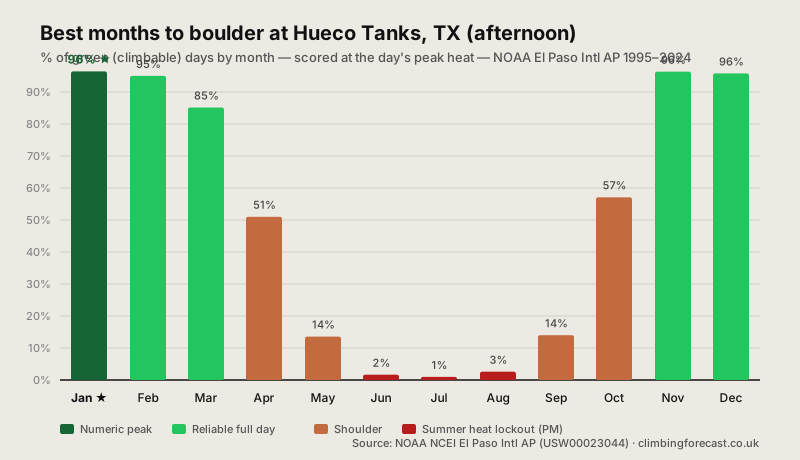
When is the best time to boulder at Hueco Tanks?
The numeric peak is January — 96% green days, narrowly ahead of November (96%) and December (96%). February (95%) and March (85%) hold up well behind it, so the reliable full-day season runs a clean five months, November through March. That's exactly the window Hueco's own guided-tour operators and the North Mountain reservation system are busiest — the data backs up what the park's booking calendar already tells you.
Summer afternoons, by contrast, are a genuine lockout, not a comfort footnote. Scored at each day's peak heat, June collapses to 2% green, July to 1%, and August to 3% — with real RED "too hot to climb well" days appearing on 1.6–4.9 days a month at the site's own AMBER ≥27°C / RED ≥38°C dry-heat thresholds. That's the model doing exactly what it's meant to: El Paso's June afternoons average 36.4°C, and Texas Parks & Wildlife's own heat advisories for the park say the same thing in plainer language — this isn't marginal, it's dangerous.
Month-by-month conditions (afternoon)
| Month | Green Days | Amber Days | Red Days | % Green | Green + Amber |
|---|---|---|---|---|---|
| Jan ★ | 29.8 | 0.8 | 0.3 | 96% | 99% |
| Feb | 26.8 | 1.2 | 0.2 | 95% | 99% |
| Mar | 26.4 | 4.4 | 0.2 | 85% | 99% |
| Apr | 15.3 | 14.4 | 0.3 | 51% | 99% |
| May | 4.2 | 26.7 | 0.1 | 13% | 100% |
| Jun | 0.5 | 24.6 | 4.9 | 2% | 84% |
| Jul | 0.3 | 27.0 | 3.7 | 1% | 88% |
| Aug | 0.8 | 28.6 | 1.6 | 2% | 95% |
| Sep | 4.2 | 25.7 | 0.1 | 14% | 100% |
| Oct | 17.7 | 13.3 | 0.0 | 57% | 100% |
| Nov | 28.9 | 1.0 | 0.1 | 96% | 100% |
| Dec | 29.7 | 0.9 | 0.4 | 96% | 99% |
Based on 30 years of real daily observations (1995–2024) from the NOAA NCEI El Paso International Airport station (1,202m, 33.5km away), lapse-corrected to Hueco Tanks' altitude (1,400–1,420m across the four mountains) and replayed through the climbingforecast drying model. Each day is scored at its recorded maximum temperature, so this table represents an afternoon check — see the early-morning comparison below.
Beat the heat: early starts change everything
Like Hueco's desert neighbours, the aridity that keeps the rock bone-dry also brings a real day/night temperature swing — smaller here than at higher-altitude venues, but still enough to matter. El Paso Airport's June record averages a 36.4°C high and a 21.4°C low. The tables above score every day at its afternoon maximum; re-running the identical 30 years scored at each day's overnight low instead — a proxy for a first-light start — tells a very different story for the shoulder and summer months:
| Month | Afternoon | Early morning |
|---|---|---|
| Apr | 51% | 90% |
| May | 13% | 95% |
| Jun | 2% | 98% |
| Jul | 1% | 98% |
| Aug | 3% | 99% |
| Sep | 14% | 96% |
| Oct | 57% | 98% |
Same 30-year record, same zones, same drying model — the only change is which recorded daily temperature represents "now." This isn't a loophole in the model; it's the same logic serious Hueco locals already use, climbing dawn or dusk through the hot months and treating midday as a write-off.
Reliable Full-Day Season: Nov–Mar
January is the numeric peak (96%) and November, December and February all sit at 95–96%, with March close behind at 85%. No rain-damage restriction on syenogranite, so this is a genuine full-day, any-time-of-day season.
The Permit System Already Points at Winter
North Mountain's 70-person daily cap and the guided-tour requirement on the other three mountains mean the best weather months are also the most contested reservation months. April (51%) and October (57%) are real, workable shoulder windows with an easier booking fight.
Summer Afternoons Are a Real Lockout
June scores 2% green, July 1%, August 3% under the model's dry-heat rule at peak heat — not marginal, a genuine climbability collapse, and it matches Texas Parks & Wildlife's own heat warnings for the park. The fix is free: the same three months score 98–99% at first light.
How we calculated this
30 years of real daily observations (1995–2024) from the NOAA NCEI El Paso International Airport station (USW00023044, 1,202m) — the only long-record NOAA station in the Hueco Tanks catchment with a complete field set. A closer COOP station (roughly 12km from Hueco Tanks) was checked first but its record ends in 2005 and carries no humidity or wind fields at all, so we used El Paso Airport instead, 33.5km away, the same "closer station, too short a record" trade-off made for our Cresciano piece. Station temperatures were lapse-corrected (−6.5°C/km) for the roughly 200m altitude gap to Hueco Tanks' four mountains (1,400–1,420m). Real daily temperature, precipitation and snow depth for the full 30 years; real daily humidity from 2006, with a station-derived monthly climatology filling 1995–2005. Snow depth (rare in this catchment) converts to snow-water-equivalent and feeds the drying model's snow accumulator, same as our Bishop and Squamish pieces. The published tables score each day at its recorded maximum temperature through the model's rain/snow/humidity logic and its dry-heat climbability check (AMBER ≥27°C, RED ≥38°C); the early-morning comparison reruns the identical days scored at each day's recorded minimum instead. Each day gets a GREEN, AMBER or RED status per mountain; the tables are the 30-year average across all four.
The same methodology powers our Bishop, Squamish, Chironico, Cresciano, Magic Wood, Val di Mello, Rocklands, Albarracín and Fontainebleau data pieces. It's not a substitute for checking the actual forecast the week you're going — but it's the honest answer to "when should I book?"
Good luck and enjoy the climbing!