Magic Wood is Europe's summer bouldering refuge — thousands of world-class problems on Alpine gneiss in a shaded conifer valley at 1300 m, where the friction stays honest through July and August while Font and Albarracín are baking. But the season is bracketed hard by snow at one end and hemmed in by Alpine thunderstorms at the other. When should you actually book?
We replayed 30 years of real daily observations — weather AND observed snow depth — from the MeteoSwiss OGD S. Bernardino reference station through the climbingforecast snow-aware drying model. Here's what the data says.
When is the best time to climb in Magic Wood?
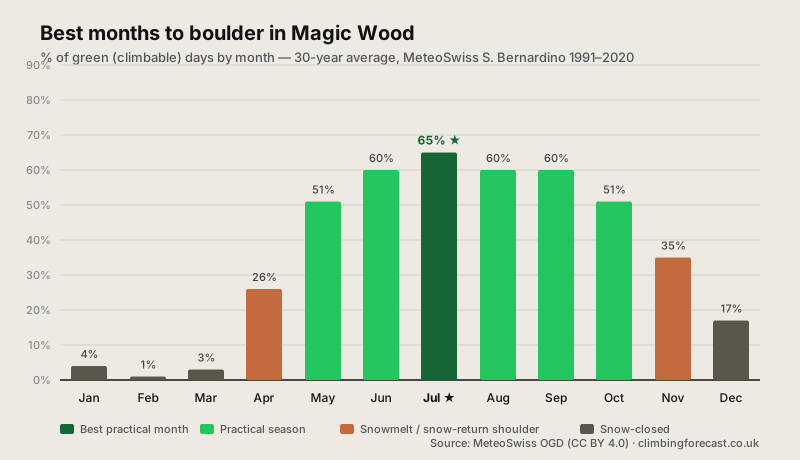
The numeric peak: July. 65% chance of a climbable day. June, August and September all sit right behind at 60% — the practical Magic Wood season is a broad plateau from May through October, with July the top of the arc. This is Europe's hot-weather refuge: the 1300 m altitude and dense conifer forest keep the venue climbable when Font, Albarracín and lowland Europe are baking. Zero days in June through August scored RED for surface conditions in our 30-year run; the summer constraint is Alpine thunderstorms, not heat.
The autumn shoulder: September and October. September (60%) is the friction-peak choice many hard climbers pilgrimage for — thunderstorm season has largely settled, temperatures at 1300 m sit in the 8–14°C friction band, and the low-humidity Alpine air is what Alpine gneiss climbers wait for. October (51%) is the last window before the first serious snow returns; expect cold mornings and shorter days but excellent friction on the crisp days.
When to skip: December through March. Magic Wood is genuinely snow-closed through most of the winter. The observed snow record at our reference station puts real snow on the ground for the vast majority of January and February, and the model returns 1–4% climbable days across January through March. This is not a heuristic — it's what the ground truth says.
Month-by-month conditions
| Month | Green Days | Amber Days | Red Days | % Green | Green + Amber |
|---|---|---|---|---|---|
| Jan | 1.2 | 0.2 | 29.6 | 4% | 4% |
| Feb | 0.2 | 0.0 | 28.0 | 1% | 1% |
| Mar | 1.0 | 0.5 | 29.5 | 3% | 5% |
| Apr | 7.7 | 3.5 | 18.8 | 26% | 37% |
| May | 15.7 | 13.0 | 2.3 | 51% | 92% |
| Jun | 18.0 | 12.0 | 0.1 | 60% | 100% |
| Jul ★ | 20.0 | 11.0 | 0.0 | 65% | 100% |
| Aug | 18.6 | 12.4 | 0.0 | 60% | 100% |
| Sep | 17.9 | 11.8 | 0.3 | 60% | 99% |
| Oct | 15.7 | 12.8 | 2.5 | 51% | 92% |
| Nov | 10.5 | 5.7 | 13.8 | 35% | 54% |
| Dec | 5.1 | 1.0 | 24.8 | 17% | 20% |
Based on 30 years of real daily observations (1991–2020) from the MeteoSwiss OGD S. Bernardino station (1639 m, 20 km NW of Magic Wood on the Passo del San Bernardino), lapse-corrected to Magic Wood altitude (1300 m) and replayed through the climbingforecast snow-aware drying model. Observed daily snow depth is converted to snow-water-equivalent at ρ = 300 kg/m³ (settled Alpine snow) and injected into the model's snow accumulator, so the model's own thresholds (≥ 3 mm SWE → RED, ≥ 1 mm → AMBER) fire against real ground truth rather than a heuristic. S. Bernardino sits 339 m above Magic Wood so its snow record persists slightly longer than it does at the crag itself — April and November are therefore mildly conservative.
Why summer works and winter doesn't
Summer works — this is the whole point. Magic Wood is one of the few genuinely hot-weather-tolerant bouldering venues in Europe. The 1300 m altitude puts summer air temperatures in the 13–17°C daily mean range while lowland Europe is over 30°C, and the narrow shaded valley plus the cold Ferrera river keep the forest interior cooler still. Unlike sandstone destinations (Font, Rocklands, Albarracín) where the constraint is friction death on hot rock, Alpine gneiss is impermeable and high-friction — you can climb it warm without damaging holds. Notice in the table above that June, July and August score essentially zero RED days for surface conditions; the AMBER count (11–12 days/month) is where Alpine afternoon thunderstorms live. Start early, watch the sky, have a bail plan.
Winter is genuinely closed — and now the model knows. Magic Wood sits under an observed Alpine snowpack from December through March. The S. Bernardino station 20 km away records mean snow depth of 68–80 cm through January and February, and even after the lapse-rate correction brings that down toward what actually lies at 1300 m, the drying model's snow accumulator stays firmly over the RED threshold for nearly every day of the deep winter. Our earlier Magic Wood article used a heuristic snow-lock (based on trailing mean temperature); this version replaces that with the observed depth measurement itself, so the winter closure is what the ground actually shows rather than what a temperature threshold guesses. If you need Swiss gneiss in winter, drop south to Cresciano (400 m in Ticino) or Chironico (900 m); same rock character, much lower valleys, sun-exposed sectors climbable through most winters.
Which part of Magic Wood for which conditions?
Magic Wood is one continuous bouldering forest along the Ferrera river below Ausserferrera, but the sectors sit in genuinely different microclimates:
- Riverbed and Forest sectors — deep in the conifer canopy right next to the river. The shadiest and coolest — the go-to on hot summer afternoons — but also the slowest to dry after rain because the canopy blocks sun and the river keeps humidity high. Treat a full clear day as the minimum after real rain.
- Ninja Skills, Sputnik, Utopia — mid-forest sectors on the way up the hillside. Moderate shade, moderate drying. The natural anchor for most sessions.
- One Summer in Paradise, Sun Boulders — up on the sunnier hillside above the river. Warm-up friendly on cold spring and autumn days, and the fastest-drying sectors after a shower. In midsummer these can bake — save them for the shoulder months.
- The Never Ending Story area — mid-canopy, close to the river. This is the pilgrimage line (8B+, extending to 9a via the 1+2+3 link) so friction matters more here than anywhere else. Cool crisp September / October days are what climbers wait for.
The forecast at climbingforecast.co.uk runs the drying model per-zone with the same snow-aware logic, so once you're there you can see whether the whole valley is in condition rather than guessing. Our full destination write-up lives at the Magic Wood crag page.
Numeric Peak
July delivers 65% green days plus zero surface-RED days — the top of a broad Alpine-summer plateau. June, August and September all sit right behind at 60%. September is the friction-peak pick for anyone chasing crisp low-humidity conditions on the hardest problems.
Summer Refuge, With Thunderstorms
May through October sit at 51–65% green — the practical hot-weather refuge when Font and Albarracín are unclimbable. Zero surface-RED days June through August: the AMBER count reflects Alpine afternoon thunderstorm risk, not heat. Start early, watch the sky.
Snow-Closed Winter
December through March return 1–17% climbable days as observed Alpine snowpack sits on the boulders. April (26%) and November (35%) are the shoulder months — season-brackets rather than in-season. Cresciano and Chironico are the winter alternatives.
How we calculated this
We took every day from 1991 to 2020 at the MeteoSwiss OGD S. Bernardino station (1639 m, 20 km NW of Magic Wood on the Passo del San Bernardino) — real weather from the OGD-SMN automatic record and real observed daily snow depth from the OGD-NIME manual record. MeteoSwiss opened its full historical archive under Creative Commons BY 4.0 in January 2025, so we can use it commercially with attribution. S. Bernardino is the closest station to Magic Wood carrying both records with full 30-year coverage; the next-closest snow-depth station is Poschiavo, 50 km south. Temperatures were lapse-corrected using the standard environmental rate (6.5°C per 1000 m) to bring the 1639 m station reading down to Magic Wood at 1300 m, and observed snow depth was converted to snow-water-equivalent at ρ = 300 kg/m³ (settled Alpine snow) and injected as the priorSnow state to our snow-aware drying model, so the model's own thresholds (≥ 3 mm SWE → RED, ≥ 1 mm → AMBER) fire against real ground truth. Each day gets a GREEN, AMBER or RED status; the chart is the 30-year average % GREEN per calendar month.
The station sits 339 m above Magic Wood, so its snow record persists slightly longer than what actually lies at the crag — April and November therefore read mildly conservative. We cross-checked S. Bernardino's rain totals against the closer Andeer station (987 m, 9.8 km, no snow record); the two agree to within 8% on annual rain, confirming the same weather regime. NASA POWER MERRA-2 reanalysis at the same coordinates is unusable for a valley crag of this kind — its grid cell centre elevation is 2036 m, so it samples ridgeline weather and reads systematically too cold and too wet to represent 1300 m Averstal.
The same methodology (real observed weather run through the snow-aware drying model) powers our Val di Mello, Rocklands, Squamish, Albarracín and Fontainebleau data pieces. It's not a substitute for checking the actual forecast the week you're going — but it's the honest answer to "when should I book?"
Good luck and enjoy the climbing!