Cresciano is bouldering history — the wooded hillside above the village where Fred Nicole opened Dreamtime in November 2000, the world's first 8C, and where Sasso della Predarèsc is now a pilgrimage sector. At 400 m it sits noticeably lower and warmer than Magic Wood or Chironico, which makes it one of the best cold-season venues in the Alps. When should you actually go?
We replayed 30 years of real daily observations from the MeteoSwiss OGD Magadino/Cadenazzo reference station through the climbingforecast drying model. Here's what the data says.
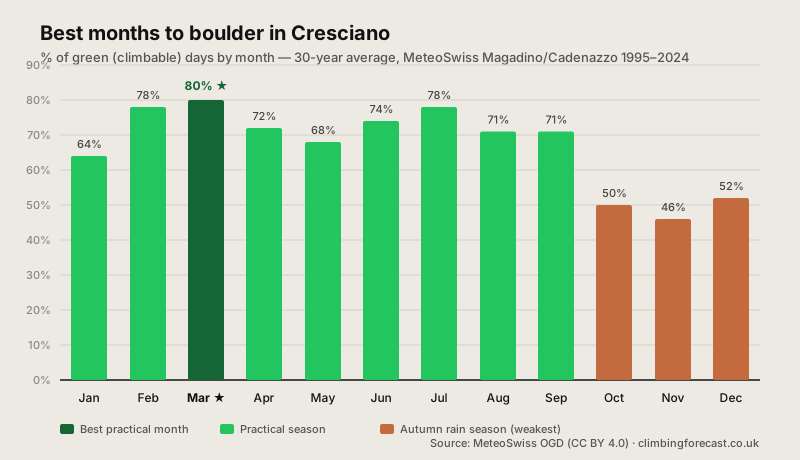
When is the best time to boulder in Cresciano?
The numeric peak: March. 80% chance of a climbable day. But the standout feature of the Cresciano data isn't the peak — it's how flat the good season is. February, April, June, July, August and September all sit in a tight 71–78% band, and January (64%) and May (68%) aren't far behind. Unlike Magic Wood or Val di Mello, there's no single narrow window to book around here — nine months out of twelve return a green-day rate above 60%.
The real headline: winter and spring, when the rest of Europe is out. December (52%), January (64%) and February (78%) hold up well, and March through May keeps climbing to a 68–80% peak. That's the window when most of the continent's climbing options have narrowed hard — Font and Rocklands-style sandstone venues are too wet to touch, the higher Alpine gneiss spots (Magic Wood, Val di Mello) sit under real snowpack, and much of the UK is a mudbath. Cresciano, at 400 m with essentially no snow lock, just keeps working. October (50%) and November (46%, the single weakest month) are the one soft patch, driven by southern Ticino's well-documented autumn rain maximum — a secondary wet season through those two months — but it's a dip, not a closure, and conditions recover fast once December arrives.
Month-by-month conditions
| Month | Green Days | Amber Days | Red Days | % Green | Green + Amber |
|---|---|---|---|---|---|
| Jan | 19.9 | 7.5 | 3.6 | 64% | 88% |
| Feb | 22.2 | 4.5 | 1.6 | 78% | 94% |
| Mar ★ | 24.9 | 5.6 | 0.4 | 80% | 99% |
| Apr | 21.7 | 8.2 | 0.1 | 72% | 100% |
| May | 21.0 | 9.9 | 0.1 | 68% | 100% |
| Jun | 22.2 | 7.8 | 0.0 | 74% | 100% |
| Jul | 24.3 | 6.7 | 0.0 | 78% | 100% |
| Aug | 22.1 | 8.9 | 0.0 | 71% | 100% |
| Sep | 21.4 | 8.5 | 0.1 | 71% | 100% |
| Oct | 15.5 | 14.7 | 0.8 | 50% | 98% |
| Nov | 13.8 | 14.3 | 2.0 | 46% | 93% |
| Dec | 16.2 | 10.9 | 3.9 | 52% | 87% |
Based on 30 years of real daily observations (1995–2024) from the MeteoSwiss OGD Magadino/Cadenazzo station (203 m, 15.4 km from Cresciano along the same Ticino valley), lapse-corrected to Cresciano's altitude (400 m) and replayed through the climbingforecast drying model.
A rare Alpine venue that works through winter and spring
The other Swiss gneiss venues in our data series — Magic Wood (1300 m) and the Val di Mello sectors (900–1000 m) — are constrained by Alpine winter snowpack: real observed snow depth injected into the drying model puts those valleys under 1–36% climbable from December through March. Cresciano at 400 m doesn't have that problem — there's no meaningful snow lock in this dataset, and winter (Dec 52%, Jan 64%, Feb 78%) is a genuinely good season here, climbing steadily better as spring approaches and peaking in March. For anyone based in northern or central Europe wondering where to actually go between November and April, this is a real answer: a proper Alpine gneiss destination, not a compromise, open when the higher venues are buried and the sandstone venues are dripping.
The one soft patch is October and November, driven by southern Ticino's well-documented autumn rain maximum — a real climate feature of the Insubric region south of the Alps, where Mediterranean moisture meets the southern flank of the range and produces some of the heaviest rainfall totals in Switzerland concentrated in those two months. That shows up directly in the data: October and November have the highest AMBER-day counts of any months (14.7 and 14.3 respectively) alongside the lowest GREEN percentages. It's the same weather system that keeps nearby Lugano and Locarno among the wettest lowland spots in the country in autumn — but it eases off well before winter proper sets in.
How we calculated this
We took every day from 1995 to 2024 at the MeteoSwiss OGD Magadino/Cadenazzo station (203 m, in the Magadino plain where the same Ticino river that runs past Cresciano meets Lago Maggiore) and ran each day through our drying model for the Cresciano zone. We checked Biasca first — at 6.9 km it's the closest station of all — but its automatic temperature and wind record only starts in August 2017 (the rain gauge alone goes back to 1900), too short a window for a reliable 30-year climatology. Magadino/Cadenazzo has a complete daily record with zero missing days for temperature, rain and humidity across the full 1995–2024 window, and only 126 missing wind days (1.1%, forward-filled from the prior day). We cross-validated its monthly rain totals against Biasca (r = 0.935) and Acquarossa/Comprovasco (r = 0.914, in the neighbouring Blenio valley) over the same period — all three stations move together.
Temperatures were lapse-corrected using the standard environmental rate (6.5°C per 1000 m) to bring the 203 m station reading up to Cresciano at 400 m. Unlike our Magic Wood and Val di Mello pieces, no MeteoSwiss OGD-NIME snow-depth station exists near Cresciano — but at 400 m in the mild lower Ticino valley, snow is a minor and brief factor rather than a season-defining one, so we didn't force in a proxy. The drying model's own snow accumulator still runs, driven by temperature-partitioned precipitation (precipitation falling on a day with mean temperature at the zone ≤ 1°C is treated as snowfall), which is enough to catch the rare cold snap without overstating how much winter matters here. Each day gets a GREEN, AMBER or RED status; the chart above is the 30-year average % GREEN per calendar month.
The same methodology (real observed weather run through the drying model) powers our Magic Wood, Val di Mello, Rocklands, Squamish, Albarracín and Fontainebleau data pieces. It's not a substitute for checking the actual forecast the week you're going — but it's the honest answer to "when should I book?"
Good luck and enjoy the climbing!