Joshua Tree is America's winter trad destination: thousands of short routes on rough, grippy quartz monzonite, scattered across the high desert of Southern California. The National Park Service counts more than 8,000 climbing routes and 2,000 boulder problems, mostly crack, slab and steep face climbing, and most of them single pitch. The season is famously the cool half of the year. We ran 30 years of weather from inside the park through our drying model to find out exactly when to go.
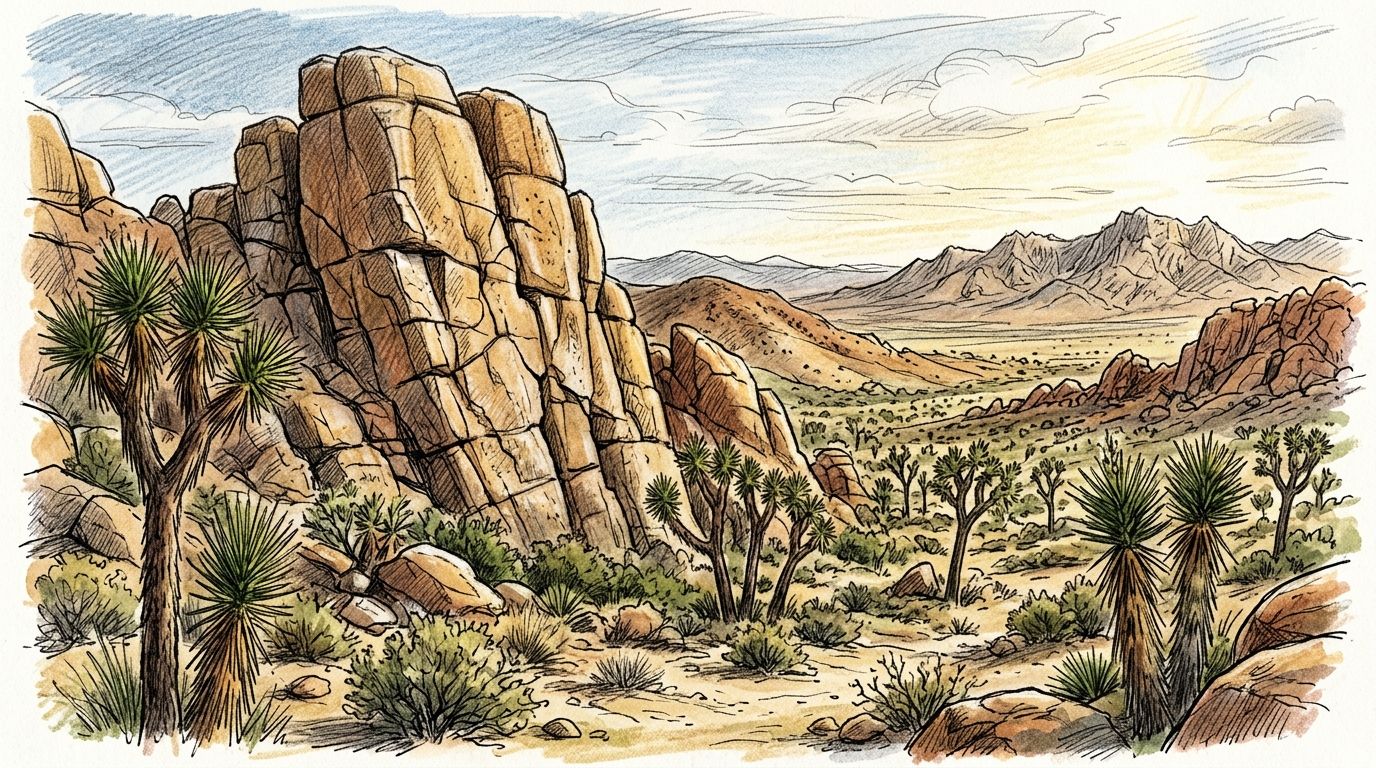
Joshua Tree has a weather station right in the middle of the climbing: the Lost Horse RAWS (a Remote Automatic Weather Station, run for fire weather), at 1,280 m (4,200 ft), about 1 km from Lost Horse Wall and 2.5 km from Hidden Valley Campground. We took its daily temperatures for 30 years (1994–2023) from NOAA, and rain and humidity for each crag from Daymet, NASA's 1 km daily weather grid. Then we ran every day through the climbingforecast drying model for four areas in the main park: Hidden Valley, Lost Horse Wall, Jumbo Rocks and the Wonderland of Rocks. They came out within a few points of each other every month, so the numbers below are their average. We also ran Indian Cove, the lower, warmer area on the north side of the park, on its own.
When is the best time to climb in Joshua Tree?
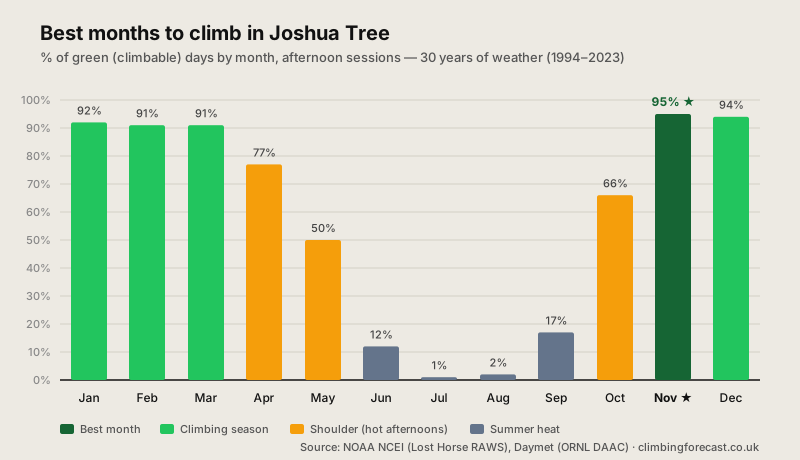
November to March, and November is the best month. November scores 95% green afternoons, December 94%, January 92%, and February and March 91%. November also scored 70% or more in every one of the 30 years, and its worst year was 83%. There's no short peak to catch: in this part of the year, the weather decides very few days.
The shoulder months are late October and early April. Over the whole month, October scores 66% and April 77%, but the halves are very different. The first half of October scores only 55%, and the second half 77%. The first half of April scores 84%, and the second half 70%. What spoils them is heat, not rain: Hidden Valley's afternoons pass 27°C (80°F) on about 10 days in an average October.
From May to September, afternoons are too hot. May scores 50%, and June to September just 1–17%. More on summer below.
Joshua Tree climbing conditions month by month
| Month | Afternoon | Dawn | Indian Cove | High | Rain |
|---|---|---|---|---|---|
| Jan | 92% | 91% | 94% | 14°C / 56°F | 34 mm |
| Feb | 91% | 89% | 92% | 15°C / 58°F | 32 mm |
| Mar | 91% | 93% | 85% | 18°C / 65°F | 14 mm |
| Apr | 77% | 91% | 61% | 22°C / 71°F | 8 mm |
| May | 50% | 95% | 27% | 26°C / 80°F | 1 mm |
| Jun | 12% | 99% | 3% | 32°C / 89°F | 0 mm |
| Jul | 1% | 99% | 0% | 35°C / 94°F | 10 mm |
| Aug | 2% | 100% | 1% | 34°C / 93°F | 8 mm |
| Sep | 17% | 100% | 6% | 31°C / 87°F | 7 mm |
| Oct | 66% | 98% | 47% | 24°C / 76°F | 7 mm |
| Nov ★ | 95% | 97% | 90% | 18°C / 65°F | 9 mm |
| Dec | 94% | 93% | 95% | 13°C / 56°F | 20 mm |
Average of Hidden Valley, Lost Horse Wall, Jumbo Rocks and the Wonderland of Rocks (1,250–1,340 m / 4,100–4,400 ft), 30 years (1994–2023) of daily weather: temperatures from the Lost Horse RAWS station (NOAA NCEI GHCN-Daily, USR0000CLHO), rain and humidity from Daymet V4 R1 (ORNL DAAC), wind from Twentynine Palms airport. Afternoon and Dawn are the % of green (climbable) days, scored at the day's high and at the day's low. Indian Cove (971 m / 3,190 ft) is scored in the afternoon. High is the average daily high, and Rain the monthly average, at Hidden Valley. Factors in rain, drying time, wind, humidity, snow and heat. Cold days count as green. Source: NOAA NCEI; Daymet (ORNL DAAC).
Is Joshua Tree good for climbing in winter?
Yes. December to February score 91–94% green. Winter is the wettest part of the year, but in desert terms that's still dry: Hidden Valley averages about 2 to 3 days a month with 1 mm or more of rain from December to February, and about 150 mm (6 in) for the whole year. The rock dries quickly, and snow at this height is rare: the model put snow on the ground for well under a day a month, even in January.
Winter is cold and short, though. Our model doesn't mark days down for cold, and Joshua Tree in winter is cold. Highs at Hidden Valley average 13–15°C (56–58°F) from December to February, the temperature drops below freezing on 9 to 15 nights a month, and December has less than 10 hours of daylight. Climb in the sun and bring warm layers for the belays. On cold days, many climbers drop down to Indian Cove, which at 971 m (3,190 ft) is about 2°C (4°F) warmer than Hidden Valley. It has about half as many frosty nights in January, and scores 94–95% from December to January.
Spring and autumn: when does the season start and end?
March is the best spring month. It scores 91%, with highs around 18°C (65°F) and much longer days than in winter. The first half of April is almost as good, at 84%, before the heat builds. By May, afternoons pass 27°C (80°F) on about 15 days a month.
Autumn starts in late October. Early October is still too warm for many afternoons, and the second half of October is when the season really starts. From November it's reliably cool.
Indian Cove works the other way round. Because it's warmer, Indian Cove is worse than the main park in spring and autumn: 61% in April, 47% in October and 27% in May. Save it for the coldest months.
Can you climb in Joshua Tree in summer?
Not in the afternoon. From June to September, only 1–17% of afternoons in the main park are green. At Hidden Valley the average high is 34.5°C (94°F) in July and 34°C (93°F) in August, and the afternoon reaches 35°C (95°F) on 12–14 days a month. Indian Cove, lower down, is hotter still. The quartz monzonite's friction depends on cool rock, and in that heat it's gone.
Dawn sessions are possible, but short. Scored at the day's low, every summer month comes out 99–100% green: in July, dawn at Hidden Valley is still about 19°C (66°F). But the low comes just before sunrise, and the heat builds quickly once the sun is up. The National Park Service puts summer days in the park at over 100°F (38°C), and the lower parts of the park are hotter than the climbing areas. Most climbers come back in the autumn.
Trad climbing in Joshua Tree: what to expect
Joshua Tree climbing is mostly single-pitch trad and top-roping: cracks, slabs and steep faces on domes and blocks a short walk from the road, with a few multi-pitch routes on the bigger walls such as Lost Horse Wall. The quartz monzonite is very coarse. Friction is excellent when it's cool, the cracks are hard on hands, so tape up, and the grades have a reputation for feeling stiff. Many routes have no fixed anchors at the top, so expect to build your own from gear.
Hidden Valley is the historic centre, with formations right around the campground. Lost Horse Wall, Real Hidden Valley, Echo Rock and the Wonderland of Rocks are all within a few kilometres, and Jumbo Rocks and Split Rocks are further east along the park road. Check the live Hidden Valley and Indian Cove forecasts the week you go: they run the same drying model on the live weather.
Camping. Hidden Valley Campground (44 sites, 4,200 ft) is first-come, first-served and open all year. Jumbo Rocks, Ryan, Indian Cove and Black Rock take reservations. The park's busy season runs from October to May, which is also the climbing season, so book early or arrive early. Only Black Rock and Cottonwood campgrounds have water, so bring your own.
Are there climbing restrictions in Joshua Tree?
Yes, a few:
- Seasonal closures for nesting birds. Some formations and routes are closed from about late February to July. In 2026 they include the chimney routes on Saddle Rocks and the Freak Brothers area, which are closed through June.
- Year-round closures. A handful of formations, routes and boulder problems are closed all year.
- Fixed anchors. About 85% of the park is wilderness. Placing, replacing or removing a bolt or fixed anchor needs a permit anywhere in the park, a power drill needs one too, and some areas, such as Barker Dam, are free of fixed anchors altogether. A new Climbing Management Plan is in preparation and may change the rules.
Check the park's climbing closures page before you go: the seasonal list changes every year.
Best: November
95% green afternoons, and 70%+ in every one of the 30 years. December to March are almost as good, at 91–94%.
Shoulder: Late Oct & Early Apr
The second half of October scores 77%, the first half of April 84%. The rest of those months is too often too hot.
Summer Heat
June to September afternoons score 1–17%. Highs average 34.5°C (94°F) in July. Only short sessions at first light are possible.
How we calculated this
Temperatures come from the Lost Horse weather station, inside the park, for 1994–2023, adjusted to each crag's height. Rain and humidity come from Daymet, NASA's 1 km weather grid, and match the station's own rain gauge and humidity readings closely. Wind comes from Twentynine Palms airport. Every day is rated on rain, drying time, wind, humidity, snow and heat, at the day's high (afternoon) and low (dawn).
The model reads air temperature, not rock temperature, and doesn't count cold, wind chill or short winter days, so sunny faces will feel warmer than the numbers suggest and shady ones colder.
Data retrieved 6 October 2026: NOAA NCEI GHCN-Daily (Lost Horse, USR0000CLHO); Daymet V4 R1, ORNL DAAC (doi:10.3334/ORNLDAAC/2129); Iowa Environmental Mesonet. For other trad and winter trips, see our La Pedriza and Hueco Tanks guides, and our Bishop guide for the Buttermilks' quartz monzonite.
Good luck and enjoy the climbing!