Indian Creek is the world capital of crack climbing: a canyon of Wingate sandstone cliffs in south-east Utah, split by hundreds of parallel cracks, from finger cracks to offwidths. It's almost all trad, and almost all single-pitch. The Creek sits at 1,650–1,800 m (5,400–5,900 ft) on the high desert, so the season is short at both ends: too hot in summer, too cold in winter, and closed for days after every storm. We ran 30 years of weather through our drying model to find out exactly when to go.
The nearest long weather record is NOAA's station at the Needles visitor centre in Canyonlands National Park, about 24 km (15 miles) west along the same road (Highway 211), at 1,495 m (4,905 ft). We took its daily temperatures for 30 years (1996–2025) from NOAA and moved them up to each wall's height, and took rain and humidity for each wall from Daymet, NASA's 1 km daily weather grid. Then we ran every day through the climbingforecast drying model for five walls: Supercrack Buttress, Battle of the Bulge, Way Rambo, Cat Wall and Reservoir Wall. They came out within a few points of each other every month, so the numbers below are their average.
When is the best time to climb at Indian Creek?
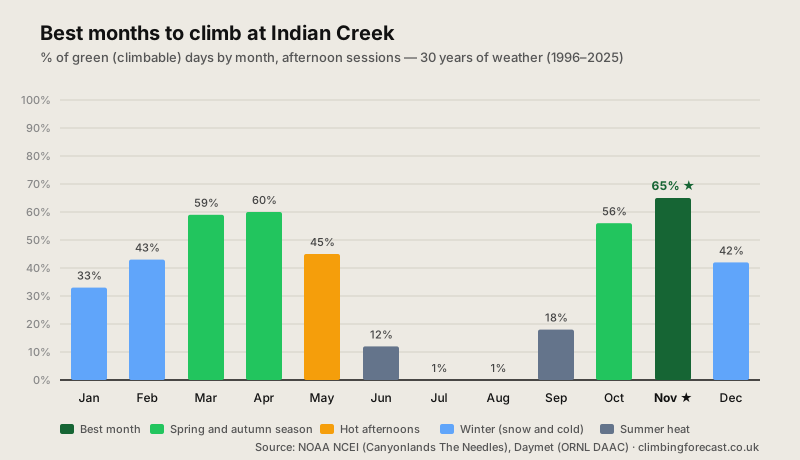
November is the best month. It scores 65% green afternoons, and 70% or more in 14 of the 30 years. Highs at the walls average 11°C (52°F), it's one of the driest months of the year, and the summer storms are over. It's cold in the shade, though, and the nights are below freezing, so climb in the sun.
Spring is just as good: March and April. April scores 60% and March 59%. March is the colder of the two, with highs around 13°C (55°F), and the second half of March (61%) is better than the first (56%). April, at 17°C (63°F), is the classic Creek month. By the second half of May the heat is back: it falls to 37%.
In autumn, go in late October. October scores 56% over the whole month, 50% in the first half and 62% in the second. The first half still has hot afternoons, and the tail end of the summer storms.
Winter is cold and snowy, and summer is too hot. December to February score 33–43%, and June to September just 1–18%. More on both below.
Even in the best months, about one afternoon in three isn't green: on average it rains (1 mm or more) on about 4 days a month in spring and autumn, and every wet day closes the sandstone for two days, then leaves it amber for two more. Plan a few spare days if you can.
Indian Creek climbing conditions month by month
| Month | Afternoon | Dawn | High | Low | Rain |
|---|---|---|---|---|---|
| Jan | 33% | 33% | 5°C / 40°F | −8°C / 17°F | 27 mm |
| Feb | 43% | 43% | 7°C / 45°F | −6°C / 22°F | 25 mm |
| Mar | 59% | 59% | 13°C / 55°F | −2°C / 29°F | 25 mm |
| Apr | 60% | 61% | 17°C / 63°F | 2°C / 35°F | 18 mm |
| May | 45% | 68% | 23°C / 74°F | 7°C / 44°F | 17 mm |
| Jun | 12% | 78% | 30°C / 86°F | 12°C / 54°F | 11 mm |
| Jul | 1% | 58% | 33°C / 92°F | 17°C / 62°F | 29 mm |
| Aug | 1% | 53% | 31°C / 88°F | 15°C / 59°F | 34 mm |
| Sep | 18% | 56% | 27°C / 80°F | 10°C / 50°F | 32 mm |
| Oct | 56% | 62% | 19°C / 66°F | 3°C / 38°F | 32 mm |
| Nov ★ | 65% | 65% | 11°C / 52°F | −3°C / 27°F | 22 mm |
| Dec | 42% | 42% | 5°C / 40°F | −7°C / 19°F | 25 mm |
Average of Supercrack Buttress, Battle of the Bulge Buttress, Way Rambo Wall, Cat Wall and Reservoir Wall (1,659–1,804 m / 5,440–5,920 ft), 30 years (1996–2025) of daily weather: temperatures from NOAA's Canyonlands The Needles station (NOAA NCEI GHCN-Daily, USC00421168), adjusted to each wall's height; rain and humidity from Daymet V4 R1 (ORNL DAAC); wind from Moab's Canyonlands airport. Afternoon and Dawn are the % of green (climbable) days, scored at the day's high and at the day's low. High, Low and Rain are monthly averages at the walls. Factors in rain, the wait for wet sandstone to dry, wind, humidity, snow and heat. Cold days count as green. Source: NOAA NCEI; Daymet (ORNL DAAC).
How long should you wait to climb after rain at Indian Creek?
Wet Wingate is weak. The Creek's cliffs are Wingate sandstone, petrified sand dunes around 200 million years old. When the sandstone is wet, it loses strength. The Bureau of Land Management, which manages Indian Creek as part of Bears Ears National Monument, warns that wet sandstone can mean weakened anchors, cams slipping, and routes changed for good. At a crag where almost all the protection is cams, that matters twice over.
The rule: wait 24 to 48 hours, or longer. The BLM asks climbers to wait at least 24 to 48 hours after rain. Mountain Project adds that after a heavy storm the rock can stay wet for several days. The test locals use: if the sand at the base of your climb is at all damp, don't climb.
So every wet day costs about four days. Our model follows that rule: red for 48 hours after any rain, then amber for up to four days while the rock dries inside. The Creek gets about 300 mm (12 in) of rain a year, about a third more than the Needles visitor centre, about 260 m lower. That's why even the best months score 60–65%, not 90%. If it rains during your trip, use the days for Moab, the hiking in Canyonlands, or rest, and check the live forecasts for Supercrack Buttress and the other walls before you go back out.
Is Indian Creek good for climbing in winter?
Only on fine spells. December scores 42%, January 33% and February 43%. Highs at the walls average 4–7°C (40–45°F) from December to February, the temperature drops below freezing almost every night, and most winters bring snow. Our model doesn't mark days down for cold, but it does count days with snow lying around the crag, and that's what costs most of winter's days.
Sunny walls help. Our numbers are probably on the cautious side in winter: the Needles station is a cold spot at night, so the snow lies a little longer in our replay than it may at the walls. On a calm, sunny day, a west-facing wall like Supercrack can be pleasant in the afternoon. But the days are short, the shade is cold, and the dirt roads and campgrounds have no services, so most climbers wait for March.
Spring and autumn: when does the season start and end?
Spring runs from March to mid-May. March scores 59% and April 60%, with 10–11 years in 30 scoring 70% or more. The first half of May still scores 54%, before the heat arrives: by the second half it's 37%, and the walls pass 27°C (80°F) on about 8 days in an average May.
Autumn runs from October to November. The second half of September is still hot and stormy, at 30%. The first half of October is better, at 50%, the second half better again at 62%, and November is the best month of the year, at 64–66% in both halves.
Follow the shade, or the sun. Most of the heat days in spring and autumn are amber, not red: 73–80% of afternoons from March to May and in October are green or amber. The model reads the air temperature, not the rock, so shaded walls will be better than these numbers suggest on warm days and sunny ones worse. East-facing walls like Way Rambo and Cat Wall go into the shade in the afternoon; west-facing ones like Supercrack get the afternoon sun. In late May and early October, pick the shade; in November and March, pick the sun.
Can you climb at Indian Creek in summer?
Not in the afternoon. From June to September only 1–18% of afternoons are green. The average high at the walls is 33°C (92°F) in July and 31°C (88°F) in August, and it passes 27°C (80°F) on 24 to 30 days a month from June to August. In July it reaches 35°C (95°F) on about 10 days.
Dawn starts work better, but the storms don't stop. Scored at the day's low, summer comes out 53–78% green. But the low comes just before sunrise, the heat builds quickly, and July to October is the wettest part of the year: the summer monsoon brings thunderstorms, about 30 mm (1.2 in) of rain a month, and each one shuts the sandstone for days. June is the driest month, at 11 mm, but also the start of the heat. Most climbers come back in October.
Trad climbing at Indian Creek: what to expect
Indian Creek is crack climbing, and very little else: Mountain Project lists more than 1,700 routes, and most of them follow a single crack up a vertical wall, often of the same width from bottom to top. That's why Creek climbers carry many cams of the same few sizes, rather than one of each. Most routes are a single pitch, ending at fixed anchors, and the Creek has little easy climbing.
The Creek's modern history began with Supercrack of the Desert (5.10), a perfect hand crack on Supercrack Buttress, first climbed in November 1976 by Earl Wiggins, Ed Webster and Bryan Becker, before camming devices existed: they protected it with nuts and hexes. Supercrack Buttress, a short walk from the road, is still the place most people start.
Raptor closures. Golden eagles and peregrine falcons nest in the Creek's cliffs. Each spring the BLM asks climbers to avoid walls with historic nest sites, including Cat Wall and Reservoir Wall, from March. Biologists check which nests are in use, and walls without an active nest usually reopen by late April or early May; walls with one stay closed until late summer. Check the current list before you go, with the BLM's Monticello Field Office or on Mountain Project.
Camping. The BLM runs three first-come, first-served campgrounds in Indian Creek: Hamburger Rock, Superbowl and Creek Pasture, at $15 a night with a 14-day limit. Creek Pasture has 32 sites with vault toilets, but there is no drinking water at the campgrounds, wood collection isn't allowed (bring your own firewood), and there's no phone signal. Dispersed camping is allowed within 150 feet (45 m) of designated roads, in previously disturbed spots. Pack out your human waste: desert soil doesn't break it down.
Getting there. Indian Creek is on Highway 211, which leaves US-191 between Moab and Monticello, past Newspaper Rock. It's part of Bears Ears National Monument, and the walls are reached by short approaches from the road. Don't park on, or walk across, the dark cryptobiotic soil crust: it takes decades to recover.
Best: November
65% green afternoons, and 70%+ in 14 of the 30 years. April, March and late October are next, at 59–62%.
Rain Closes the Rock
Wet Wingate is weak. Wait at least 24–48 hours after rain, and don't climb if the sand at the base is damp.
Summer Heat
June to September afternoons score 1–18%. Highs average 33°C (92°F) in July, and the monsoon storms close the rock.
How we calculated this
Temperatures come from NOAA's Canyonlands The Needles station for 1996–2025. We moved them up to each wall's height (165–310 m higher) using the monthly temperature difference between that station and NOAA's La Sal station, 574 m higher, over the same 30 years. Rain and humidity come from Daymet, NASA's 1 km weather grid, at each wall. We checked Daymet against NOAA's Climate Reference Network station that stood in the Indian Creek valley from 2010 to 2014: over the same days, Daymet's rain there totalled 790 mm against the station's 769 mm, within 3%. Wind comes from Moab's Canyonlands airport. Every day is rated on rain, the 48-hour and four-day sandstone waits, wind, humidity, snow and heat, at the day's high (afternoon) and low (dawn). Replays with the Needles station's own rain, a standard lapse rate, or Daymet's temperatures move the spring and autumn months by no more than 4 points.
The model reads air temperature, not rock temperature, and doesn't count cold, wind chill or short winter days, so sunny walls will feel warmer than the numbers suggest and shady ones colder. Raptor closures are not included. And the model can't see the sand at the base of your route: after rain, that test always comes first.
Data retrieved 7 October 2026: NOAA NCEI GHCN-Daily (Canyonlands The Needles, USC00421168; La Sal 1 SW, USC00424947; Monticello 24 NW, USW00053010); Daymet V4 R1, ORNL DAAC (doi:10.3334/ORNLDAAC/2129); Iowa Environmental Mesonet. Access and camping rules from the BLM's Indian Creek page and Recreation.gov; geology from the National Park Service. For other desert trad trips, see our Red Rocks and Joshua Tree guides, and for more sandstone, our Annot guide.
Good luck and enjoy the climbing!