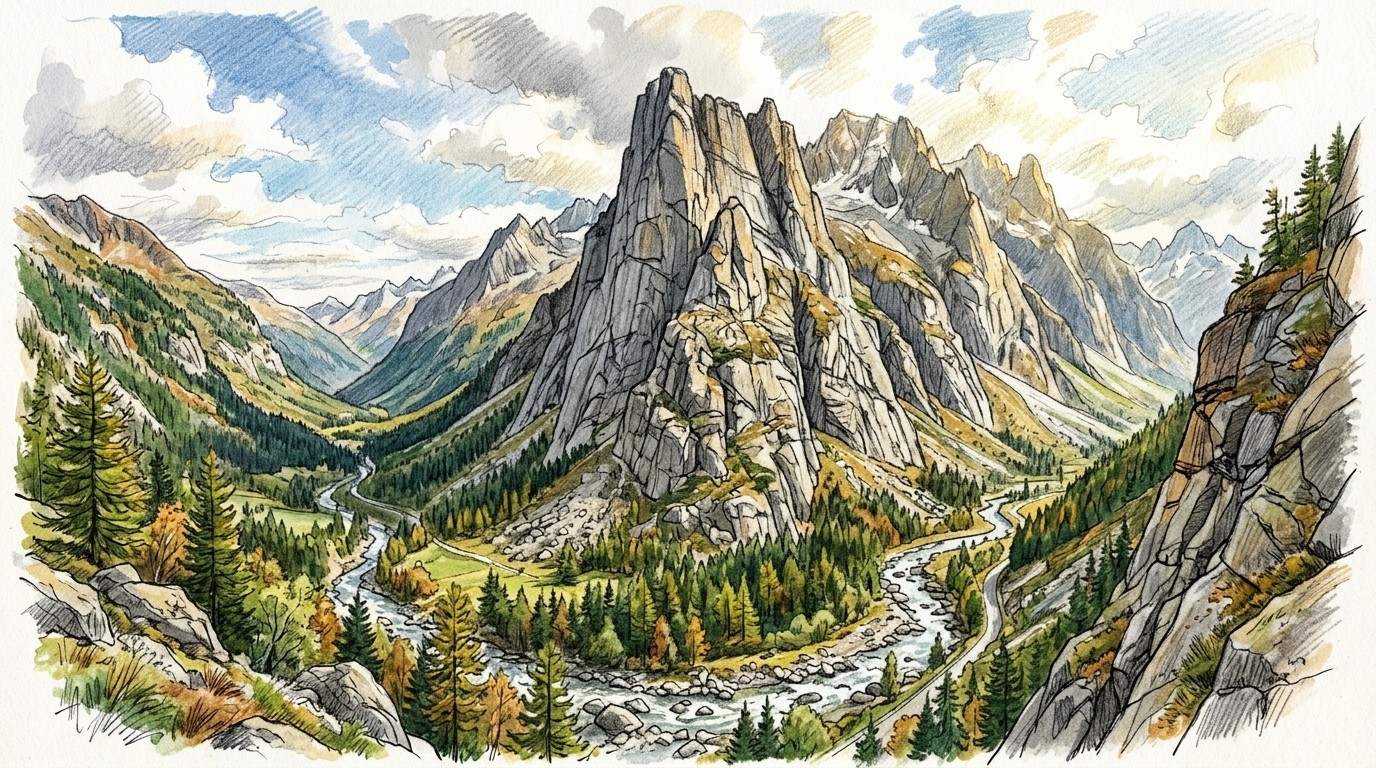
Valle dell'Orco, the Orco Valley, is Italy's home of crack climbing: walls of gneiss split by cracks of every size, in the Gran Paradiso National Park, north of Turin. It's where the Turin climbers of the Nuovo Mattino ("New Morning") brought Yosemite-style free climbing to Italy in the 1970s, on two walls they nicknamed, in a nod to Yosemite's El Capitan, the Caporal and the Sergent. But the foot of the walls is at about 1,400 m, so the weather is alpine. We ran 30 years of weather through our drying model to find out when the rock is most often dry and climbable.
We took 30 years (1996–2025) of daily weather from Arpa Piemonte's station at Bertodasco, 10 km down the Orco valley, and adjusted it to 1,400 m, the height of the foot of the Caporal and Sergent, using Arpa Piemonte's station at Noasca, 3 km from the Caporal. Then we ran every day through the climbingforecast drying model, with the same gneiss rules as our live Caporal forecast. Each day is scored for an afternoon session, and again at the day's low for an early start.
When is the best time to climb in Valle dell'Orco?
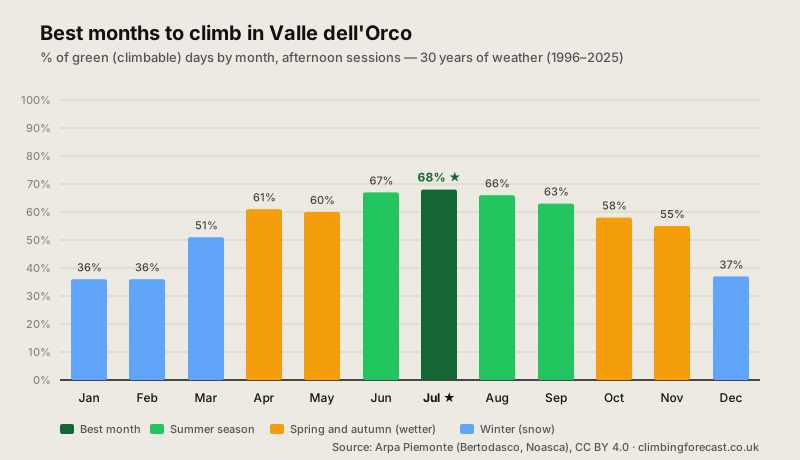
Summer: July is the best month. It scores 68% green afternoons, just ahead of June (67%) and August (66%). September scores 63%. The best fortnight of the year is the second half of June, at 76%. At 1,400 m the summer is cool: July afternoons average 21°C (70°F) at the foot of the walls, and they reach 27°C (81°F) on less than one day a month, so heat is almost never the problem it is at lower crags.
What costs summer days is damp air, not rain. Gneiss dries fast, so a shower doesn't cost much. But Alpine summers bring storms, and on the muggy days around them the air is humid enough to leave the rock greasy: in July, about one afternoon in four is lost to humidity, and only a few to wet rock. July gets 83 mm of rain, on about 9 days.
Every summer is different. June and July scored 70% green or more in 18 of the 30 years, August in 16 and September in 14. But a wet summer can be poor: July's worst year scored 13%, and its best 97%. Plan a few spare days if you can, and check the forecast before you go.
Valle dell'Orco climbing conditions month by month
| Month | Afternoon | Morning | High | Rain | Rain Days |
|---|---|---|---|---|---|
| Jan | 36% | 36% | 3°C / 37°F | 55 mm | 5.6 |
| Feb | 36% | 36% | 4°C / 39°F | 47 mm | 4.5 |
| Mar | 51% | 51% | 8°C / 46°F | 72 mm | 6.9 |
| Apr | 61% | 57% | 11°C / 51°F | 139 mm | 9.4 |
| May | 60% | 55% | 15°C / 58°F | 166 mm | 12.2 |
| Jun | 67% | 66% | 19°C / 66°F | 116 mm | 10.6 |
| Jul ★ | 68% | 73% | 21°C / 70°F | 83 mm | 8.6 |
| Aug | 66% | 72% | 21°C / 69°F | 90 mm | 8.9 |
| Sep | 63% | 62% | 16°C / 61°F | 101 mm | 7.3 |
| Oct | 58% | 57% | 11°C / 52°F | 128 mm | 7.3 |
| Nov | 55% | 54% | 5°C / 42°F | 144 mm | 7.7 |
| Dec | 37% | 37% | 3°C / 37°F | 48 mm | 4.9 |
The foot of the Caporal and Sergent (1,400 m), 30 years (1996–2025) of real daily observations from Arpa Piemonte's station at Bertodasco, adjusted to the walls with its station at Noasca. Afternoon and Morning are the % of green (climbable) days, scored at the day's high and at the day's low. High is the average daily high at the walls, Rain the monthly average (rain and melted snow), and Rain Days the days with 1 mm or more. Factors in rain, drying time, wind, humidity, snow and heat. Cold, dry days count as green. Fonte: Arpa Piemonte, www.arpa.piemonte.it (CC BY 4.0), adjusted by climbingforecast.
Is Valle dell'Orco good for climbing in summer?
Yes: it's the season. June to September score 63–68% green afternoons, and July and August mornings score 73% and 72%. Summer highs of 19–21°C (66–70°F) at 1,400 m are cool enough for good friction on most days, which makes the valley a good escape from the heat of the plains below.
Start early on muggy days. Our model marks warm, humid afternoons amber for gneiss, because friction suffers, especially on slabs. July and August mornings score 5–6 points better than afternoons, and an early start also gets you off long routes before the afternoon storms that are common in the Alps in summer. Late June and July are the most reliable weeks.
Spring and autumn: the wet seasons
Spring is the wettest time of year. April scores 61% and May 60%, but May gets 166 mm (6.5 in) of rain, on about 12 days, more than any other month. Snow can still lie at the foot of the walls on about 3 days in April. Between the rains, the cool spring days give good friction, and the second half of May (65%) is better than the first (55%).
Autumn has good friction and more rain. September scores 63%, the first half of October 57% and November 55%. October and November are wet, at 128 mm and 144 mm, and in the second half of November snow starts to return. But cool, dry autumn days are prime crack-climbing weather: the BMC's international trad meet in the valley was held in September 2012, and Jacopo Larcher made two hard first ascents here in October 2021.
Can you climb in Valle dell'Orco in winter?
Rarely. December to February score 36–37%, and in our replay snow lies at the foot of the walls on 17 to 19 days a month. Afternoon highs average 3–4°C (37–39°F), and nights drop below freezing on 24 to 27 nights a month. A dry, sunny spell can still give climbable days on the south-facing walls, but our model doesn't count the cold against you, so treat winter green days as cold ones.
Winter is the least certain part of our numbers. Whether snow lies or not depends on a degree or two, and our checks move December to February by up to 17 points. March improves to 51%, and the second half of March to 59%, as the snow melts.
How long should you wait to climb after rain in Valle dell'Orco?
Not long, on the faces. Orco gneiss is hard and doesn't soak up water, so open faces in the sun dry within hours once the rain stops. In our model, even a big overnight storm leaves the rock dry by the next day. Most of the valley's rain falls in spring and autumn: it gets about 1,190 mm (47 in) a year, on about 94 days with 1 mm or more.
Cracks and corners take longer. Water drains down the crack systems that the climbing follows, so they can stay wet after the faces around them are dry. Wet gneiss is slippery, and a damp hand jam or foot smear can fail without warning, so check the line you want to climb, not just the wall. Humid, still days after rain dry slowly, even when it isn't raining.
Trad climbing in Valle dell'Orco: what to expect
The walls. The Caporal and the Sergent face south above the old road between Noasca and Ceresole Reale, part of the Balma Fiorant, a complex of gneiss walls. The Sergent, the closer to Ceresole, is the valley's most popular wall, with slabs, multi-pitch routes and dozens of single-pitch cracks; Via Locatelli is often recommended as its easiest crack climb. Around the walls are many more crags and boulders, including more than 70 boulder problems at the foot of the Sergent.
The history. The Turin climbers of the Nuovo Mattino, whose leading voice was Gian Piero Motti, renamed the walls of Balma Fiorant the Caporal in 1972, inspired by Yosemite's El Capitan. The first route up it, Via dei Tempi Moderni, was climbed on 4 November 1972 by Ugo Manera, Motti and friends, and Via della Rivoluzione followed in 1973. The short, famous Fessura Kosterlitz, at the foot of the Sergent, is named after its first ascensionist, Mike Kosterlitz, the British physicist who later shared the 2016 Nobel Prize in Physics.
The rock and the rack. The rock is the high-quality gneiss of the Gran Paradiso: compact slabs and cracks of every size. Climbers usually call it granite. Local climbers keep a traditional approach and avoid bolts where they aren't needed, so bring a full rack of cams and nuts. Versante Sud publishes the current guidebook to the valley.
Getting there. The valley road leaves the plain at Cuorgnè and Pont Canavese and climbs through Locana and Noasca to Ceresole Reale, about two hours' drive from Milan. The approaches are short: the Sergent is about 15 minutes' walk from the road just before Ceresole. The valley is in the Gran Paradiso National Park, so follow the park's rules.
Best: July
68% green afternoons, with June and August close behind. The second half of June scores 76%.
Watch the Humidity
Gneiss dries in hours, but muggy days around summer storms leave it greasy. Start early.
Winter Snow
December to February score 36–37%: snow lies at the foot of the walls on most days.
How we calculated this
There's no long weather record from the walls themselves, so we used the nearest Arpa Piemonte station with 30 years of daily rain, temperature and humidity: Bertodasco (1,137 m), in the Orco valley at Locana, 10 km downstream of the Caporal. A few gaps, mostly in 1996, 1997 and 2000, were filled from Arpa Piemonte's station at Piamprato. We moved the temperatures to the main valley at Noasca (1,055 m), using the 19 years both stations have records for, then up to 1,400 m. Noasca also gets about 2% more rain than Bertodasco over the year, more in the cool season and less in summer, so we scaled the rain to match it month by month. Humidity rises a little with height, so we raised it by the amount Arpa Piemonte's station at Piamprato (1,555 m) shows over Bertodasco. There's no long wind record in the valley, so the wind comes from Arpa Piemonte's station at the Rifugio Gastaldi, scaled to the anemometer installed at Ceresole Reale in 2023.
As a check, we replayed 2007–2025 directly from the Noasca and Ceresole Reale stations, which sit either side of the walls. From April to November it agrees with our main replay to within 5 points; December and January differ by up to 13 points, because of the snow. The summer numbers depend most on the humidity at the walls: using Bertodasco's humidity as measured would add up to 8 points from June to September. Assuming the air at the walls holds the same water as the air at Bertodasco would take up to 24 points off, but the stations show the higher air is drier than that, so we didn't. Read the summer numbers as a guide, not a guarantee.
Every day is rated on recent rain, drying time, wind, humidity, snow and heat, at the day's high (afternoon) and low (morning). The model reads the air temperature, not the rock temperature, and it doesn't know which walls are in the sun, so use the numbers to choose your month and the live forecast to choose your day.
Data retrieved 7 October 2026. Fonte: Arpa Piemonte, www.arpa.piemonte.it, daily data from the regional weather network (stations Bertodasco, Noasca, Piamprato, Ceresole Villa and Rifugio Gastaldi), licensed under CC BY 4.0; adjusted to the walls by climbingforecast as described above, and not endorsed by Arpa Piemonte. Crag history from PlanetMountain, Mountain Project and the BMC. For granite bouldering nearby, see our Val di Mello guide; for other trad trips, our Annot, Indian Creek and Red Rocks guides; and for summer in the French Alps, Céüse.
Good luck and enjoy the climbing!