The Costa Blanca is one of Europe's best-known winter sport climbing destinations, and Sella is its biggest crag. The valley sits inland from Benidorm, between the Aitana range and the Castellets ridge, almost in the shadow of Puig Campana. Hundreds of bolted routes line its limestone walls, from easy slabs to the steep 8s of the Wild Side. Everyone agrees it's a winter venue. We wanted to know which winter months are actually best, how much the rain really costs, and whether summer is a write-off.
We replayed 15 years of real daily observations from the SiAR agroclimatic network station at Callosa d'en Sarrià through the climbingforecast drying model. Callosa sits 13 km from Sella, inland, below the same mountains. There are longer records on the coast, but the coast is a different climate: over the same years, Callosa got 1.8 times as much rain as Vila Joiosa, and hotter, calmer summers. The model's dry-heat check lets this piece separate the two things that stop you climbing at Sella: the storms that roll in from autumn to spring, and the heat of summer.
When is the best time to sport climb on the Costa Blanca?
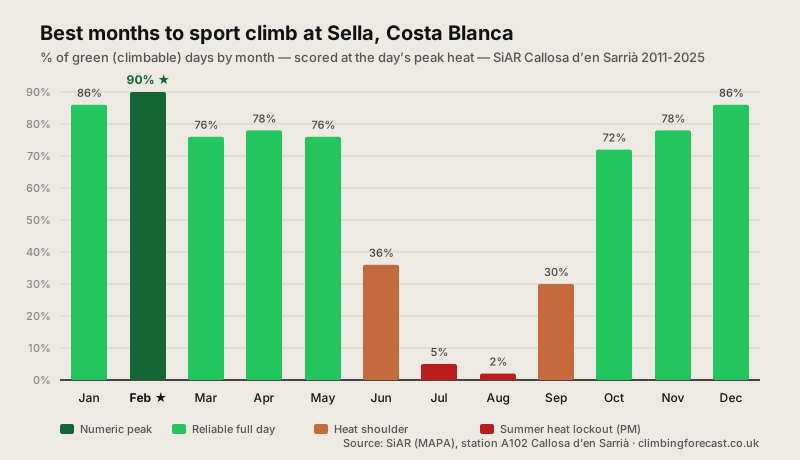
The numeric peak is February, with 90% green days for a full afternoon session. January and December (86%) are close behind. February wins because it's the driest month of the winter: in 15 years it averaged just 16 mm of rain across two wet days.
The season is long. April and November sit at 78%, March and May at 76% and October at 72%. From October to May, at least seven afternoons in ten are climbable. Spring and autumn aren't as reliable as midwinter, but they're far from a gamble, and they're warmer if you like climbing in a T-shirt.
Month-by-month conditions
| Month | Green Days | Amber Days | Red Days | % Green | Green + Amber |
|---|---|---|---|---|---|
| Jan | 26.7 | 1.4 | 2.9 | 86% | 91% |
| Feb ★ | 25.4 | 1.3 | 1.5 | 90% | 95% |
| Mar | 23.6 | 2.3 | 5.1 | 76% | 84% |
| Apr | 23.4 | 2.8 | 3.8 | 78% | 87% |
| May | 23.7 | 4.9 | 2.5 | 76% | 92% |
| Jun | 10.9 | 18.1 | 0.9 | 36% | 97% |
| Jul | 1.4 | 28.5 | 1.1 | 5% | 97% |
| Aug | 0.7 | 27.7 | 2.5 | 2% | 92% |
| Sep | 9.0 | 17.6 | 3.4 | 30% | 89% |
| Oct | 22.5 | 5.1 | 3.4 | 72% | 89% |
| Nov | 23.5 | 2.7 | 3.9 | 78% | 87% |
| Dec | 26.7 | 1.5 | 2.7 | 86% | 91% |
Based on 15 years (2011–2025) of real daily observations from the SiAR station at Callosa d'en Sarrià (A102, 165 m), lapse-corrected to Sella's 380 m and scored at each day's peak heat. Factors in rain, drying time, wind, seepage and the dry-heat rule enforced by our drying model. Información elaborada utilizando, entre otras, la obtenida del Sistema de Información Agroclimática para el Regadío. Ministerio de Agricultura, Pesca y Alimentación.
The rain comes in a few big storms — and the biggest hit in winter
Callosa averages 515 mm of rain a year, much more than the coast. But it doesn't rain often. There are only about 41 days a year with 1 mm or more, and 61% of all the rain falls on days with 20 mm or more. When it rains here, it pours, and then the sun comes back.
Most people link Costa Blanca downpours with the autumn gota fría, and September to November does bring almost a third of the year's rain. But the three biggest events in this record all came in winter. There were two days of more than 100 mm in January 2017. Storm Gloria dropped 194 mm in a single day in January 2020. And March 2022 was a month of storms that added up to 587 mm, more than the station's average for a whole year.
That's why March has the most red days in the table (5.1) and is the least predictable month. In 2012 and 2019, 94% of March afternoons were green; in 2022, only 29% were. January's 86% also has two storm years in it. If one big storm hits your trip, it usually costs a day or two, not a week. Sella's main walls face south and have little seepage, so they're back in condition quickly once the sun returns.
Summer afternoons collapse — but shade and dawn genuinely work
Scored at the day's peak heat, June drops to 36% green, July to 5% and August to 2%. September is barely better at 30%. At the crag's 380 m, July and August average highs of about 30.5°C, and almost every day reaches 27°C. That's warm enough to kill the friction, so nearly every summer afternoon is AMBER. Days at 35°C or more, when the model turns a day RED for heat, are much rarer than at El Chorro: fewer than two a month even in August.
Scored at the day's low instead, as a proxy for a first-light start or a wall that never sees the sun, the same months jump to 93% (June), 97% (July), 93% (August) and 82% (September). Heat is a problem you can dodge. Start at dawn, stick to the shade, and be off the rock before the afternoon.
Winter works the other way round, but only just: scored at the day's low, January drops slightly, from 86% to 84%. Sella is also less of a winter sun-trap than its south-facing walls suggest. The tall walls around the valley keep the low winter sun off the crag outside the middle of the day. In midwinter, there's no need to rush out at dawn.
Peak Potential
February leads at 90% green days, with January and December at 86%. It's the driest month of the winter, and cool enough for good friction on the south-facing walls.
Summer Furnace
July and August drop to 2–5% green in the afternoon. It barely rains, but the heat kills the friction. If you go in summer, climb at dawn and stick to shaded walls.
The Sweet Spot
October to May is the reliable window: 72–90% green every month, with Green + Amber never below 84%. Storms are rare but heavy, so keep a spare day in the plan.
How we calculated this
We ran 15 years of real daily weather (2011–2025) from the SiAR station at Callosa d'en Sarrià, inland below the same mountains as Sella, through the drying model behind the live Sella forecast. Temperatures are adjusted up to the crag's 380 m. Each day is rated GREEN, AMBER or RED on recent rain, drying time, wind and heat, scored once at the day's high and once at its low. As a check, we also ran the longer coastal record from Vila Joiosa: it shows the same January–February peak, but it flatters the heat of June and September. Data retrieved September 2026. Información elaborada utilizando, entre otras, la obtenida del Sistema de Información Agroclimática para el Regadío. Ministerio de Agricultura, Pesca y Alimentación.
It won't replace checking the forecast the week you go, but it's the honest answer to "when should I book?" For the rest of Spain, see our Spain regional guide.
Good luck and enjoy the climbing!