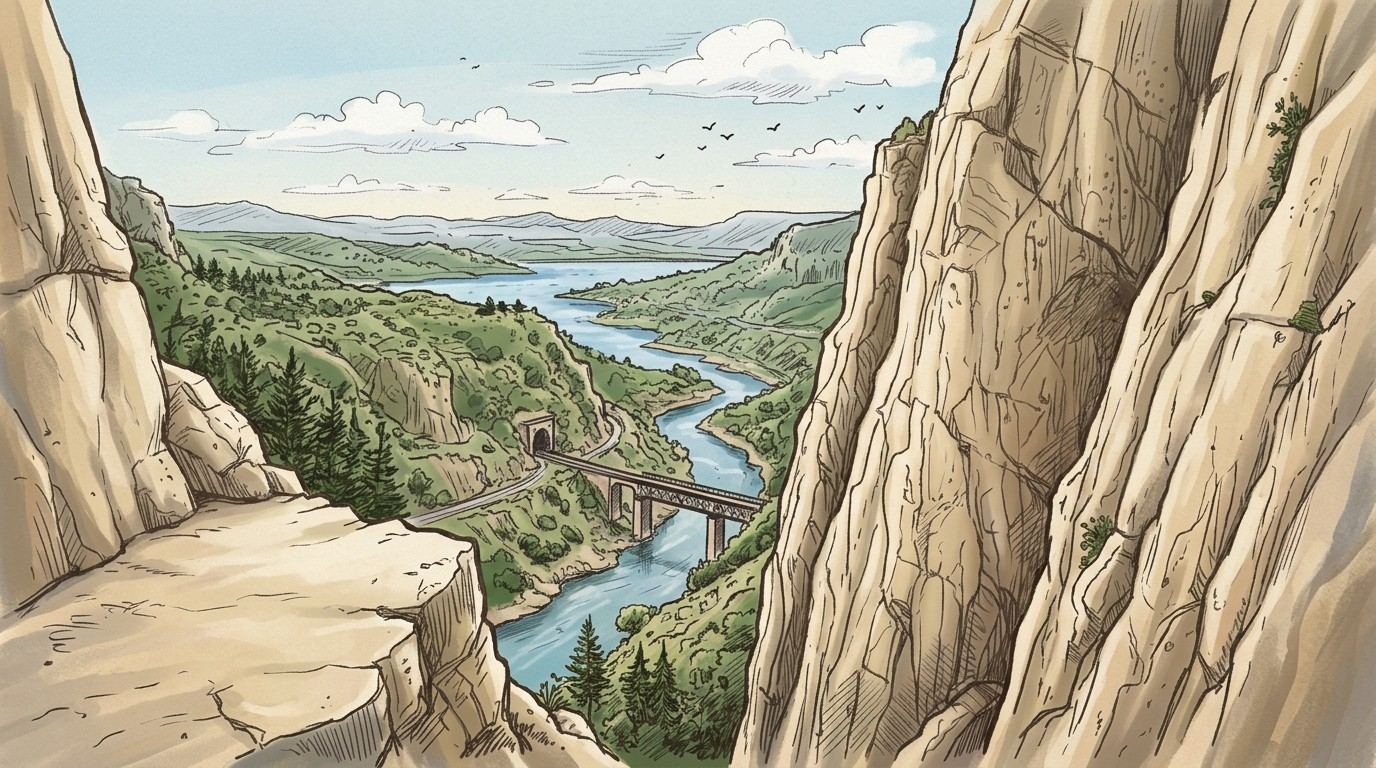
El Chorro is one of Europe's classic winter sport climbing destinations. The Guadalhorce river has cut a deep gorge through the limestone of the Desfiladero de los Gaitanes, an hour inland from Málaga. Around it are long multi-pitch walls on Frontales, single-pitch crags above the village, and the famously steep tufa caves of the Makinodromo. Everyone agrees it's a winter venue. We wanted to know which winter months are actually best, how much the spring rain costs, and whether summer is really a write-off.
We replayed 25 years of real daily observations from the Junta de Andalucía agroclimatic network station at Pizarra through the climbingforecast drying model. Pizarra sits 17 km down the same valley from the gorge. The model's dry-heat climbability check lets this piece separate the two things that stop you climbing at El Chorro: the rain that falls between October and April, and the heat that takes over from June to September.
When is the best time to sport climb at El Chorro?
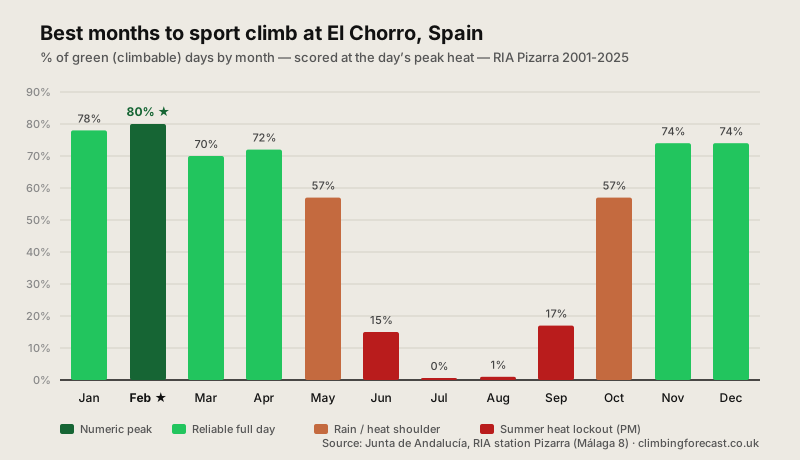
The numeric peak is February, with 80% green days for a full afternoon session. January (78%), November and December (74%), April (72%) and March (70%) are all close behind. That's a six-month window in which roughly three days in four are climbable in the afternoon. Few sport climbing destinations in Europe can say that about their winter.
The shoulders are weaker than you might expect. Guidebooks often call spring and autumn the nicest time to be here, and on a good day they are. But May and October both drop to 57% green. May's afternoons are already warming past 27°C on ten days a month, so the friction starts to go. October gets hit twice: the tail of the summer heat, plus the first big autumn rains.
Month-by-month conditions
| Month | Green Days | Amber Days | Red Days | % Green | Green + Amber |
|---|---|---|---|---|---|
| Jan | 24.1 | 2.2 | 4.7 | 78% | 85% |
| Feb ★ | 22.6 | 1.6 | 4.0 | 80% | 86% |
| Mar | 21.6 | 2.8 | 6.6 | 70% | 79% |
| Apr | 21.6 | 3.8 | 4.6 | 72% | 85% |
| May | 17.6 | 11.2 | 2.1 | 57% | 93% |
| Jun | 4.4 | 23.3 | 2.3 | 15% | 92% |
| Jul | 0.1 | 22.7 | 8.2 | 0% | 74% |
| Aug | 0.2 | 23.6 | 7.2 | 1% | 77% |
| Sep | 5.0 | 22.5 | 2.5 | 17% | 92% |
| Oct | 17.8 | 8.5 | 4.7 | 57% | 85% |
| Nov | 22.2 | 2.9 | 4.9 | 74% | 84% |
| Dec | 22.9 | 2.9 | 5.2 | 74% | 83% |
Based on 25 years (2001–2025) of real daily observations from the Junta de Andalucía RIA station at Pizarra (Málaga station 8, 71 m), lapse-corrected to El Chorro's 250 m and scored at each day's peak heat. Factors in rain, drying time, wind, seepage and the dry-heat rule enforced by our drying model. Información obtenida del Portal de la Junta de Andalucía.
March is the wettest month — and it's the caves that pay
Rain at El Chorro falls between October and April, and more of it falls in March than in any other month. The Pizarra record averages about 80 mm across seven wet days, close to double February's 48 mm. March also has the most heavy-rain days (20 mm or more) of the year. That's why March has the most red days in the table (6.6) and slips to 70% green, below the months either side of it.
The headline number actually flatters March if you've come for the steep stuff. Open faces like Frontales drain within hours of the rain stopping. The big tufa sectors don't: tufas carry water down from the hillside above, and the Makinodromo and the deeper caves can drip for two to three days after a proper soaking. If you're booking a trip around a cave project, February is the safer bet.
Summer afternoons collapse — but shade and dawn genuinely work
Scored at the day's peak heat, June drops to 15% green, July to 0% and August to 1%. September is barely better at 17%. At the crag's altitude, July and August average highs of about 33°C, with roughly eight days a month at 35°C or more. That's when the model's dry-heat rule turns a day RED ("too hot to climb well"), and nearly every other summer day is AMBER on friction alone. Rain has nothing to do with it: July averages less than a millimetre.
Scored at the day's low instead, as a proxy for a first-light start or a wall that never sees the sun, the same months jump to 97% (June), 100% (July), 99% (August) and 89% (September). Heat is a problem you can dodge. Rain isn't. Climbers who do spend summer here stick to the high, north-facing walls such as Desplomilandia and Poza de la Mona, start at dawn, and are off the rock before the sun comes round. The south-facing Frontales, perfect in January, is a furnace by midday in summer.
Winter works the other way round. Scored at the day's low, January drops slightly, from 78% to 73%, because cold, damp rock dries more slowly. In winter you want the sun: aim for the south-facing walls and don't rush out before the rock has warmed up.
Which sector for which conditions?
El Chorro has walls facing almost every direction, so picking the right sector matters as much as picking the right month. We model the whole area as one crag, so use this as a rule of thumb alongside a current guidebook:
- Frontales — the huge south-facing wall above the village, with single-pitch and long multi-pitch routes. Full winter sun and quick drainage make it the go-to after rain and on cold days, and a furnace in the heat.
- Makinodromo — south- to south-east-facing, severely overhanging tufa climbing from around 6b+ into the 8s. Too hot in the middle of the day from late spring. It seeps for two to three days after heavy rain.
- Desplomilandia and Poza de la Mona — high, north-facing and well shaded. These are the warm-weather choice for early autumn, late spring and anyone climbing in summer.
- Escalera Árabe and Las Encantadas — popular single-pitch sectors with a good spread of lower and mid grades. Las Encantadas is almost roadside, so it's handy for short days.
Access to parts of the Central Gorge has changed since the Caminito del Rey walkway was restored and reopened, so check the latest guidebook before heading into the gorge itself. The forecast on the El Chorro crag page runs the drying model every four hours. Use it to decide between a sun sector and a shade sector the day before you go.
Peak Potential
February leads at 80% green days, with January close behind at 78%. It's cool enough for good friction on the steep tufas and the winter sun on Frontales makes for warm afternoons.
Summer Furnace
July and August drop to 0–1% green in the afternoon. The rock is bone dry, but the heat kills the friction. If you have to go in summer, climb at dawn on north-facing walls only.
The Sweet Spot
November to April is the reliable window: 70–80% green every month, with Green + Amber never dropping below 79%. March is the wettest month, so leave room in the plan for a rest day.
How we calculated this
We ran 25 years of real daily weather (2001–2025) from the Junta de Andalucía station at Pizarra, inland in the same valley as the gorge, through the drying model behind the live El Chorro forecast. Temperatures are adjusted up to the crag's 250 m. Each day is rated GREEN, AMBER or RED on recent rain, drying time, wind and heat, scored once at the day's high and once at its low. Información obtenida del Portal de la Junta de Andalucía.
It won't replace checking the forecast the week you go, but it's the honest answer to "when should I book?" For the rest of the region, see our Spain regional guide.
Good luck and enjoy the climbing!