Happy Boulders
GoodNo recent rain
Temp46°F
Wind3 mph
Humidity41%
Rain 48hdry
RockDry
CALIFORNIA · GRANITE & VOLCANIC TUFF · 5 AREAS
Bishop, in California's Owens Valley under the Eastern Sierra, is one of the world's great bouldering destinations: the giant quartz-monzonite highballs of the Buttermilks and the pocketed volcanic tuff of the Happy and Sad Boulders, plus sport climbing in the Owens River Gorge and granite in Pine Creek Canyon. The town sits in a deep rain shadow, so heat, cold, wind and snow decide more days than rain. We forecast five areas and compare them side by side, updated every four hours.
Best today: the Happy Boulders, the Sad Boulders and the Owens River Gorge. Poor at the Buttermilks and Pine Creek Canyon (no recent rain).
Updated Sun 22 Nov, 19:33 · refreshed every 4 hours
No recent rain
No recent rain
No recent rain
No recent rain
No recent rain
Each day is judged on the 10:00–16:00 climbing window. Tap a name for hourly detail.
| Area | Today | Mon | Tue | Wed | Thu | Fri | Sat | Sun |
|---|---|---|---|---|---|---|---|---|
| The Buttermilks | Good | Good | Good | Good | Good | Good | Poor | Good |
| Happy Boulders | Good | Good | Good | Good | Good | Good | Good | Good |
| Sad Boulders | Good | Good | Good | Good | Good | Good | Good | Good |
| Owens River Gorge | Good | Good | Good | Good | Good | Good | Good | Good |
| Pine Creek Canyon | Good | Good | Good | Good | Good | Good | Poor | Good |
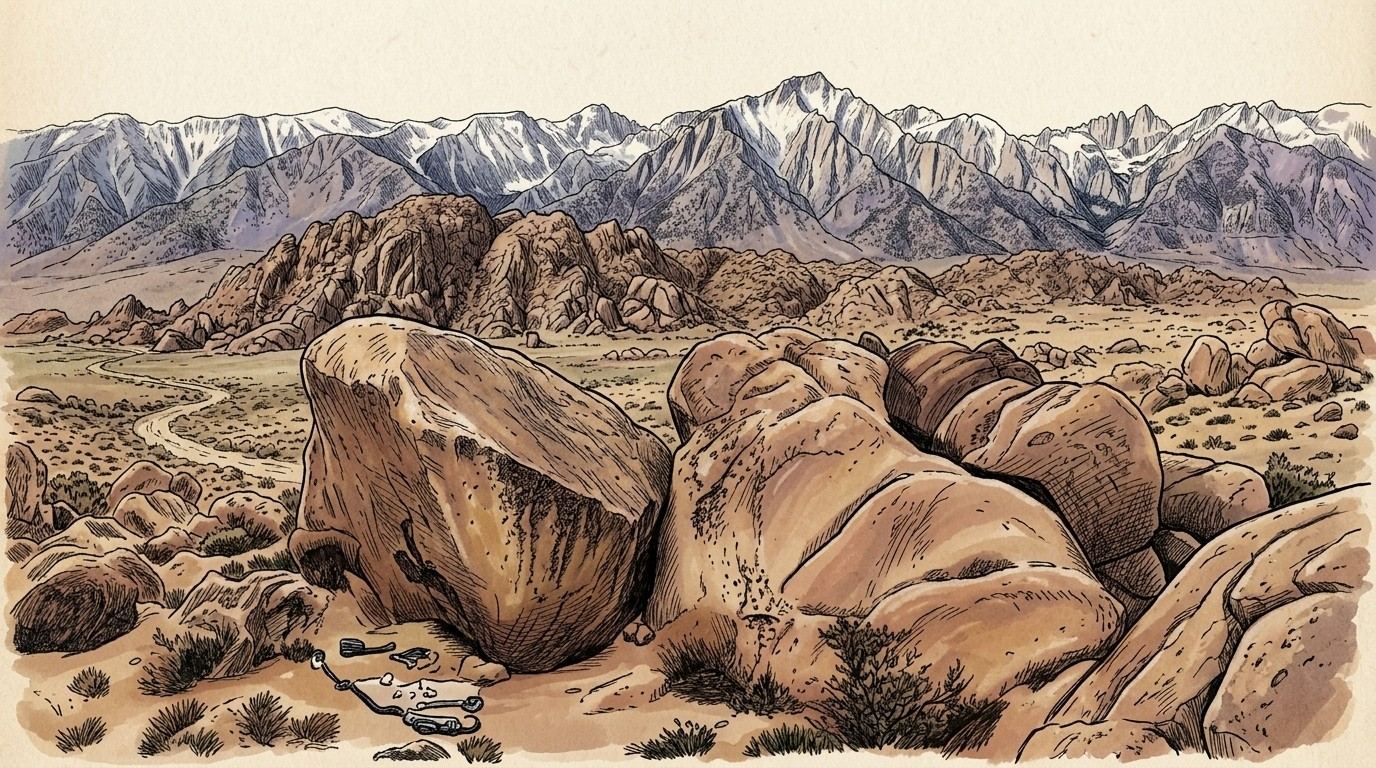
Bishop's areas sit at very different heights, and that is what decides where to climb on a given day. The Buttermilks are on a bench below the Sierra at about 1,950m (6,400ft). The Happy and Sad Boulders are on the Volcanic Tableland north of town at about 1,280m (4,200ft), around 670m (2,200ft) lower and several degrees warmer.
So on cold winter days, or when snow is lying at the Buttermilks, head down to the Happies and Sads. On warm spring and autumn days, go up to the Buttermilks, where the cooler air gives better friction on the polished crimps and slopers. The canyon walls of the Happies and Sads also give shade and shelter from the wind, and the Sads' caves stay cool when it's warm. The Owens River Gorge, about 200m deep, has shaded and sheltered walls for both summer and winter, and Pine Creek Canyon, higher up in the Sierra, is a summer crag.
October to April. In our model run on 30 years of weather from the Bishop Airport station, November is the best month, with 96% green (climbable) days at both the Buttermilks and the Happy/Sad Boulders. From October to April the Buttermilks stay at 87% or more. The lower, warmer Happies and Sads score 91% or more from November to March, but warm afternoons pull October down to 63% and April to 74%, so in the shoulder months the Buttermilks are the better bet.
Summer afternoons are too hot. Bishop's July highs average about 37°C (99°F), and from June to September the Buttermilks fall to 3–38% green in the afternoon and the Happies and Sads to 0–13%. Our forecast marks a day amber when it passes 27°C (80°F) and red at 35°C (95°F). The big daily temperature swing helps, though: summer mornings at first light are cool enough to climb well. See the full tables in Best Time to Boulder in Bishop.
Bishop gets only about 130mm (5 inches) of rain a year, and both quartz monzonite and welded tuff dry within hours. Snow is the bigger winter problem at the Buttermilks: after a storm it can lie on the bench and the approach for days, while the lower Tableland clears much sooner. Our model tracks snow on the ground and marks today's verdict red while the rock is likely to be covered; the days further ahead don't account for lying snow, so check the Buttermilks after a storm.
The Buttermilks bench is very exposed, and strong winds are common, especially in spring. Wind dries the rock but can make highballs dangerous and pads hard to manage, so our forecast flags gusty days. Even a little humidity makes the Buttermilks' polished holds noticeably harder to grip: cold, dry, clear days are the ones to save your projects for.
Check the area comparison at the top of this page. It shows today's verdict for the Buttermilks, the Happy and Sad Boulders, the Owens River Gorge and Pine Creek Canyon, with the reason for any amber or red, and updates every four hours.
November is best, with 96% green days at both the Buttermilks and the Happy/Sad Boulders in our 30-year model. The Buttermilks stay at 87% or more from October to April; the lower, warmer Happies and Sads are best from November to March. Summer afternoons are too hot, but summer mornings at first light can still be good.
Go by temperature. The Happies and Sads are about 670m (2,200ft) lower and several degrees warmer, so they are better on cold winter days or when there's snow at the Buttermilks. On warm days, the higher Buttermilks have cooler air and better friction.
No. Bishop is in the rain shadow of the Sierra Nevada and gets only about 130mm (5 inches) a year, and the local rock dries within hours. Snow, wind and heat cost more climbing days than rain.
Only on Inyo National Forest land: the Buttermilks are a mix of national forest, private and utility land, and camping isn't allowed on the private and utility parcels. In winter many climbers stay at the BLM's Pleasant Valley Pit Campground near the Happy and Sad Boulders.