Chulilla has become one of Europe's favourite winter sport climbing destinations. The village sits on a rock above the Turia gorge, about an hour inland from Valencia, and the gorge walls below it are lined with long, steep limestone routes, many of them 30 m or more. Everyone agrees it's a winter venue. We wanted to know which months are actually best, when the rain comes, and whether summer is a write-off.
We replayed 15 years of real daily observations from the SiAR agroclimatic network station at Chulilla through the climbingforecast drying model. For once there's no need to borrow a station from down the valley: this one is in the municipality itself, about 5 km from the sectors, at 375 m, almost the same height as the crags. The model's dry-heat check lets this piece separate the two things that stop you climbing here: the storms of spring and autumn, and the heat of summer.
When is the best time to sport climb in Chulilla?
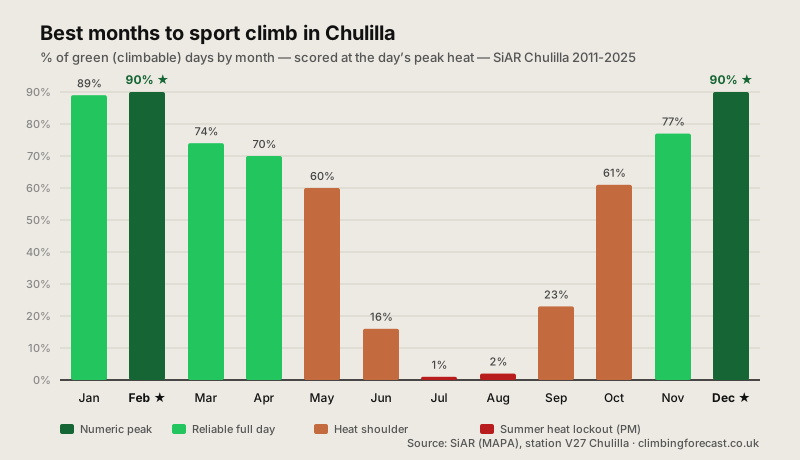
The peak is midwinter. December and February share the top spot at 90% green days for a full afternoon session, with January a whisker behind at 89%. It's also the most dependable time of year. Across 15 winters, no December, January or February dropped below 68% green, and in most years they were above 85%.
Spring and autumn are good, but a gamble. November sits at 77%, March at 74% and April at 70%. These are Chulilla's wet months, and one bad storm can wreck a week. May and October (60–61%) lose their afternoons to warmth more than rain: in the morning they're both close to 80%.
Month-by-month conditions
| Month | Green Days | Amber Days | Red Days | % Green | Green + Amber |
|---|---|---|---|---|---|
| Jan | 27.5 | 1.3 | 2.1 | 89% | 93% |
| Feb ★ | 25.5 | 1.1 | 1.7 | 90% | 94% |
| Mar | 23.1 | 2.3 | 5.7 | 74% | 82% |
| Apr | 20.9 | 3.8 | 5.3 | 70% | 82% |
| May | 18.6 | 9.1 | 3.3 | 60% | 89% |
| Jun | 4.7 | 21.4 | 3.9 | 16% | 87% |
| Jul | 0.4 | 25.3 | 5.3 | 1% | 83% |
| Aug | 0.5 | 24.7 | 5.8 | 2% | 81% |
| Sep | 7.0 | 18.5 | 4.5 | 23% | 85% |
| Oct | 18.9 | 7.7 | 4.3 | 61% | 86% |
| Nov | 23.0 | 2.9 | 4.1 | 77% | 86% |
| Dec ★ | 28.0 | 1.3 | 1.7 | 90% | 94% |
Based on 15 years (2011–2025) of real daily observations from the SiAR station at Chulilla (V27, 375 m), scored at each day's peak heat. Factors in rain, drying time, wind, seepage and the dry-heat rule enforced by our drying model. Información elaborada utilizando, entre otras, la obtenida del Sistema de Información Agroclimática para el Regadío. Ministerio de Agricultura, Pesca y Alimentación.
Winter is the dry season — the rain comes in spring and autumn
The Chulilla station averages 404 mm of rain a year, on about 43 days with 1 mm or more. That's less than Sella on the Costa Blanca, and it falls at a different time of year. December to February brings only 12% of Chulilla's rain. Spring (37%) and autumn (36%) bring almost all the rest.
March is the wettest month, with 67 mm on nearly six wet days, and it has the most red days in the table (5.7). It's also the least predictable. In 2014 and 2016, 97% of March afternoons were green; in 2022 and 2025, only 32% were. April has the same problem: 87% in a good year, 47% in 2020 and 2021.
Autumn is when the biggest storms hit. The largest in the record was the DANA of October 2024, which dropped 147 mm on Chulilla on 29 October and made it the wettest month in 15 years (288 mm). That October only 35% of afternoons were green. November 2016 and November 2020 also topped 170 mm. If you're booking a spring or autumn trip, keep a spare day or two in the plan.
Summer afternoons collapse — but dawn genuinely works
Scored at the day's peak heat, June drops to 16% green, July to 1% and August to 2%. September is barely better at 23%. Chulilla gets hotter than Sella: July and August highs average 32°C, about 1.5°C more, almost every day passes 27°C, and about four days a month reach 35°C. The hottest day in the record, 43°C on 10 August 2023, was the same day Valencia set its all-time record.
Scored at the day's low instead, as a proxy for a first-light start, the same months jump to 83% (June), 92% (July), 89% (August) and 78% (September). Summer is a heat problem, not a rain problem. Start at first light and be off the rock before the gorge heats up.
Winter: mild afternoons, cold nights
Winter works the other way round. Scored at the day's low, the midwinter months barely move (87–89%), so there's no need to rush out at dawn. The afternoons are mild: January highs average 15°C, much the same as Sella. The nights are not. January lows average 4°C, and there are three or four frosty nights in January, against almost none at Sella. Chulilla is an hour inland, and inland nights are colder.
Most of the popular sectors face north, so they don't get the winter sun. Cold rock is good for friction but hard on fingers and belayers. Bring a warm belay jacket, and save the shadiest walls for the middle of the day.
Peak Potential
December and February lead at 90% green days, with January at 89%. Winter is Chulilla's driest season, and no midwinter month in 15 years dropped below 68%.
Summer Furnace
July and August drop to 1–2% green in the afternoon. It barely rains, but highs average 32°C. If you go in summer, climb at first light and be off the rock by late morning.
Watch the Shoulders
March, April and November are 70–77% green on average, but they're the wet months. A good year can be over 90%, a stormy one under 50%, so keep a spare day in the plan.
How we calculated this
We ran 15 years of real daily weather (2011–2025) from the SiAR station at Chulilla through the drying model behind the live Chulilla forecast. The station sits at 375 m, about the same height as the crags, so no temperature adjustment was needed. Each day is rated GREEN, AMBER or RED on recent rain, drying time, wind and heat, scored once at the day's high and once at its low. The model doesn't mark days down for cold, so the winter section above is based on the temperature record, not the ratings. As a check, we also ran the Pedralba station, lower down towards the plain: it shows the same December–February peak (86–88%) and the same summer collapse. Data retrieved September 2026. Información elaborada utilizando, entre otras, la obtenida del Sistema de Información Agroclimática para el Regadío. Ministerio de Agricultura, Pesca y Alimentación.
It won't replace checking the forecast the week you go, but it's the honest answer to "when should I book?" For the other big Valencian winter venue, see our Costa Blanca article, and for the rest of Spain, our Spain regional guide.
Good luck and enjoy the climbing!