Ten Sleep Canyon, in the Bighorn Mountains of north-central Wyoming, is one of the best sport climbing areas in the United States. Tiers of pocketed Bighorn Dolomite line the canyon above US Highway 16, east of the small town of Ten Sleep, with around 1,000 bolted routes from 5.10 to 5.14, most of them within 15 minutes' walk of the road. It's a summer crag: the main walls sit at 2,000 to 2,500 m (6,500 to 8,200 ft), and snow covers them in winter. We used 30 years of weather data to find out which months are best, when the snow melts, and how wet the shoulder seasons really are.
We replayed 30 years (1996–2025) of real daily observations through the climbingforecast drying model. The data comes from two public weather stations either side of the crags: NOAA's station at the mouth of the canyon (1,447 m, 4,750 ft), and the NRCS SNOTEL station at Powder River Pass (2,890 m, 9,480 ft), about 11 km (7 miles) east. The walls sit between the two, so we adjusted the temperature and rain to each wall's height. We also kept track of the snow from one day to the next, so the winter snow builds up and melts as it would on the crag. The headline numbers are for the south-facing Downpour Wall, at 2,352 m (7,720 ft), scored for an afternoon session. The other main walls come out within a few points of it. Tensleep Canyon (as the map spells it) is in the Bighorn National Forest, and the walls are on public land.
When is the best time to climb in Ten Sleep?
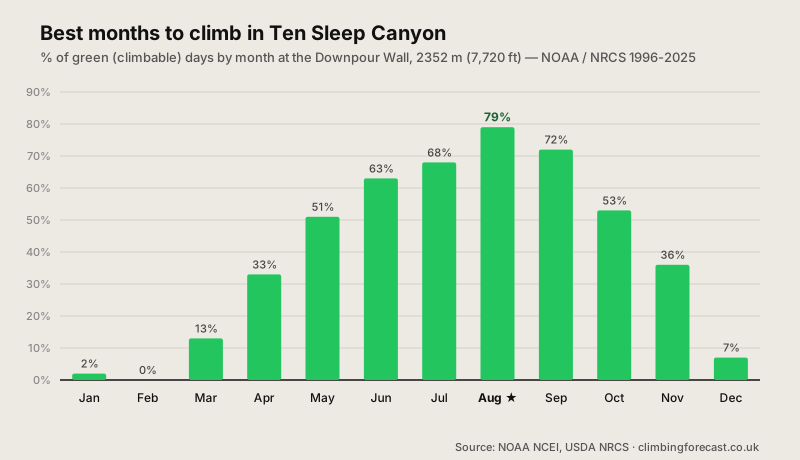
July to September, and August is best. August scores 79% green days, September 72%, July 68% and June 63%. Midsummer is the driest time of year in the Bighorns, and at this height it's rarely too hot, so there's little to stop you apart from the afternoon thunderstorms.
August is the most dependable month. It reached 70% green or more in 25 of the 30 years, and never dropped below 61% (2003 and 2023). September reached 70% in 17 years and July in 15, and both have had poor years: September 1997 scored 43%, and July 1997 only 32%. If you're flying in for a week, August is the safest bet, but keep a rest day or two in the plan whenever you go.
May and October are shoulder months. May scores 51% and October 53%. In May, the last of the snow and the wettest weather of the year get in the way. In October, it's the cold and the first snow. Both can be very good in a dry year, but neither is a safe bet.
Winter is snow season. From December to March, the upper canyon is under snow on almost every day, and April, at 33%, is mostly about waiting for it to melt.
Ten Sleep climbing conditions month by month
| Month | Green | Red Days | High |
|---|---|---|---|
| Jan | 2% | 30 | −2°C / 28°F |
| Feb | 0% | 28 | −2°C / 28°F |
| Mar | 13% | 25 | 4°C / 39°F |
| Apr | 33% | 17 | 8°C / 46°F |
| May | 51% | 10 | 12°C / 54°F |
| Jun | 63% | 6 | 19°C / 66°F |
| Jul | 68% | 2 | 24°C / 76°F |
| Aug | 79% | 2 | 23°C / 73°F |
| Sep | 72% | 4 | 17°C / 63°F |
| Oct | 53% | 10 | 8°C / 47°F |
| Nov | 36% | 16 | 3°C / 37°F |
| Dec | 7% | 27 | −2°C / 28°F |
Downpour Wall (south-facing, 2,352 m / 7,720 ft), 30 years (1996–2025) of real daily observations from NOAA's Tensleep 4 NE station and the NRCS Powder River Pass SNOTEL station, adjusted to the wall's height. Green is the % of green (climbable) days, and Red Days are per month; the rest are amber. High is the average daily high at the wall. Factors in rain, drying time, wind, humidity, snow and heat. Cold, dry days count as green. Source: NOAA NCEI, USDA NRCS.
When does the snow melt in Ten Sleep Canyon? Late May
From December to March, snow covers the upper canyon on almost every day of our replay, and it plays a part in about 18 days in November. In a typical year, the snow at the height of the Downpour Wall melts out around 20 May. In 27 of the 30 years it lasted into May, and in four (1998, 1999, 2008 and 2009) into June, as late as 12 June in 2008. In the earliest years, such as 2000 and 2020, it had gone in April.
Height makes a big difference. French Cattle Ranch, at 2,503 m (8,210 ft), holds its snow a few days longer than the Downpour Wall. Circus Wall, lower down the canyon at 1,978 m (6,490 ft), is usually clear by the end of April, and scores 44% in April against 33% at the Downpour Wall. At Powder River Pass, near the top of the range, the snow usually lasts until about the start of June. Our model rates the snow lying on the crag, and steep, sunny walls shed it sooner, so a south-facing overhang can be dry a little earlier than these dates. But the meltwater from the slopes above can keep some walls seeping for a while afterwards.
Is Ten Sleep too hot in summer? Rarely, on the upper walls
At the Downpour Wall, July highs average about 24°C (76°F), and August's about 23°C (73°F). A day of 27°C (81°F) or more, the point where our model starts to flag the heat, happens on about five days in July and two in August, and the hottest day in our record, 13 July 2005, reached about 33°C (91°F). Summer nights average about 8–9°C (47–49°F), so bring a warm layer for the evenings. Starting early makes little difference here: scored at the day's low, July rises from 68% to 75%, and August doesn't change.
The lower canyon is a different story. At Circus Wall, July highs average about 27.5°C (81°F), and a day of 27°C or more happens on about 19 days in July. Circus Wall faces north, so it's in the shade for most of the day, but on the sunny walls lower in the canyon, summer is a matter of following the shade or climbing early.
Some walls also have voluntary closures in summer. The Munitions and Oblivion walls, in the Valhalla area, are usually closed until 15 August while raptors nest. Check the signs at the trailheads and the latest news from the Bighorn Climbers' Coalition before you go.
How much does it rain in Ten Sleep? Spring is the wet season
The data averages about 560 mm (22 in) of rain and snow a year at the height of the Downpour Wall, against about 345 mm (13.6 in) in the valley at the mouth of the canyon. Unlike Céüse, where summer is the dry season, the Bighorns are wettest in late spring: spring brings 35% of the year's rain and snow, autumn 23%, summer 22% and winter 20%. May (84 mm, 3.3 in) is the wettest month, on about 15 days with 1 mm or more. That's why May scores only 51% even in years when the snow has gone. The wettest day in our record, 24 May 2010, brought about 40 mm (1.6 in).
July and August are the driest months, at about 30 mm (1.2 in) and 28 mm (1.1 in), on about seven wet days each. Most of that rain comes from afternoon thunderstorms, which build over the mountains on hot days. The weather station at the pass records nearly three times as many stormy days in July and August as the one in the valley, and most of the storms that soak the mountain never reach the valley at all. So the weather in town isn't a reliable guide to the weather at the crag. Our data is daily, so it can't tell a morning shower from an afternoon storm. Start early, keep an eye on the sky, and check the forecast each morning.
The good news is that Ten Sleep's dolomite is steep and clean, and dries quickly after a summer storm. Our model treats it like limestone: a light shower on dry rock doesn't count, but after a proper downpour it waits most of a day before rating the rock dry.
Can you climb in Ten Sleep in September and October? September, yes
September is still part of the season, at 72%. Highs average about 17°C (63°F), good weather for hard routes, but nights average about 4°C (38°F), with frost on about six nights. The best Septembers, such as 2015 and 2024, scored 97%.
October is a gamble, at 53%. Highs average about 8°C (47°F), there's frost on about 22 nights, and the first snow plays a part on about nine days. It varies a lot from year to year: 90% in 2014, but only 19% in 2009. On a sunny, dry day, the south-facing walls can be excellent for projecting in the cold. The lower walls, such as Circus Wall, keep in condition later, at 55% in October and 48% in November, but that's cold, shady climbing. Our model counts cold, dry days as green, so these numbers are for climbers happy to climb in the cold.
Summer Is the Season
August leads at 79% green days, then September 72%, July 68% and June 63%. On the upper walls it's rarely too hot.
Wet Late Spring
The snow melts around 20 May, and May is the wettest month of the year. If you can only go early, aim for late June.
Afternoon Storms
Summer thunderstorms build over the mountains and often miss the valley. Start early and keep an eye on the sky.
How we calculated this
We ran 30 years (1996–2025) of daily weather from NOAA's Tensleep 4 NE station, at the mouth of the canyon, and the NRCS SNOTEL station at Powder River Pass, above the crags, through the drying model behind the live Downpour Wall forecast. We adjusted the temperature and rain to each wall's height between the two stations, took the humidity and wind from Worland airport, adjusted to the mountain's humidity with two SNOTEL stations at the crags' height, and tracked the snow building up and melting from day to day. Each day is rated on recent rain, drying time, wind, humidity, snow and heat, at the day's high. Cold, dry days count as green.
Data retrieved 2 October 2026 from NOAA NCEI's GHCN-Daily dataset (stations USC00488852 and USC00488858), the USDA NRCS SNOTEL network (Powder River Pass, Big Goose and Soldier Park) and the Iowa Environmental Mesonet (Worland airport). Source: NOAA National Centers for Environmental Information; USDA Natural Resources Conservation Service.
It won't replace checking the forecast the week you go, but it's an honest answer to "when should I book?". Before you go, check the live Downpour Wall, Superratic Pillar, French Cattle Ranch and Circus Wall forecasts. For more summer limestone, see our Céüse article, and for more US sport climbing, our Red River Gorge article.
Good luck and enjoy the climbing!