Joe's Valley is one of American bouldering's great sandstone playgrounds — Left Fork and Right Fork's historic core, developed by Boone Speed, Jason Kehl and others through the early-to-mid 1990s, and New Joe's newer, steeper testpieces up Cottonwood Canyon, all set on the west flank of the San Rafael Swell in central Utah's high desert. The rock is Cretaceous Blackhawk Formation and Star Point Sandstone: golden-brown, pebbly-featured, and softer and more wet-fragile than the Wingate sandstone at Indian Creek a few hours south. We wanted to know what the calendar actually looks like here — including the part that makes Joe's Valley different from most other US desert bouldering: it isn't just a heat story.
We replayed 30 years of real daily observations from the NOAA NCEI Ferron station (temperature, rain, snow) and the Price-Carbon County Airport ASOS record (humidity, wind) through the climbingforecast drying model, run for Joe's Valley's soft-sandstone bucket. This piece uses the model's dry-heat climbability check and its real-snow-depth accumulator, so it can separate two things that guidebooks usually blur together: a genuine winter snow problem, and a genuine summer heat problem, with a wide, better-than-you'd-guess window between them.
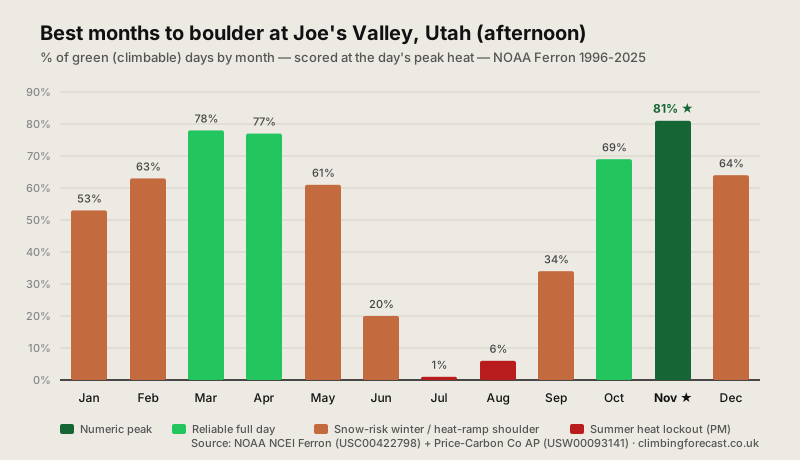
When is the best time to boulder at Joe's Valley?
The numeric peak is November — 81% green days for a full afternoon session — with March (78%) and April (77%) close behind and October (69%) a solid fourth. That's the reliable core of the season: two shoulder windows bracketing both the winter cold and the summer heat, exactly where you'd expect from a 1,950-1,990m high-desert boulder field.
What's less obvious is how different the two off-seasons are from each other. Winter (December-February, 53-64% green) is held back by real observed snow sitting on the boulders — a genuine accumulation problem that doesn't care what time of day you show up. Summer (June-August, 1-20% green in the afternoon) is a heat problem instead, and heat problems respond to an early alarm the way snow doesn't (see below). Treating "winter is bad" and "summer is bad" as the same kind of bad is the mistake this data corrects.
Month-by-month conditions (afternoon)
| Month | Green Days | Amber Days | Red Days | % Green | Green + Amber |
|---|---|---|---|---|---|
| Jan | 15.6 | 0.7 | 13.0 | 53% | 56% |
| Feb | 17.8 | 0.9 | 9.4 | 63% | 66% |
| Mar | 23.9 | 1.6 | 5.2 | 78% | 83% |
| Apr | 22.1 | 2.0 | 4.5 | 77% | 84% |
| May | 18.2 | 5.7 | 5.7 | 61% | 81% |
| Jun | 5.7 | 18.3 | 4.8 | 20% | 83% |
| Jul | 0.4 | 21.4 | 8.2 | 1% | 73% |
| Aug | 1.8 | 18.6 | 9.3 | 6% | 69% |
| Sep | 10.2 | 11.6 | 7.9 | 34% | 73% |
| Oct | 21.2 | 3.0 | 6.5 | 69% | 79% |
| Nov ★ | 24.2 | 1.4 | 4.3 | 81% | 86% |
| Dec | 19.2 | 0.7 | 10.0 | 64% | 67% |
Winter's problem is snow, not rain — and an early start doesn't fix it
January, February and December sit in the 53-64% range, and the red days behind that number are overwhelmingly a snow story: real station-observed snow depth, converted to water-equivalent and run through the drying model's snow accumulator, not a "recent rain hasn't dried yet" story. That distinction matters for trip planning. Scored at dawn instead of the afternoon, January barely moves — 54% versus 53% green — because a boulder field under snow is under snow regardless of the hour. If you're planning a winter session, the lever that actually works is picking a clear stretch after a storm has cleared, not shifting your start time.
Summer afternoons collapse — but dawn patrol genuinely works
Scored at peak heat, June drops to 20% green, July to a near-total 1%, and August to 6%, with real RED "too hot to climb well" days appearing on top of the amber haze — the site's dry-heat rule (AMBER from 27°C, RED from 38°C) catching genuine high-desert afternoon heat on sun-baked sandstone. Scored at the day's low instead — a proxy for a first-light start — the same three months jump to 78%, 62% and 56% green. Unlike winter's snow problem, this is a heat problem, and heat problems respond to timing: climb before the sandstone has baked all morning and Joe's Valley's summer looks like its spring.