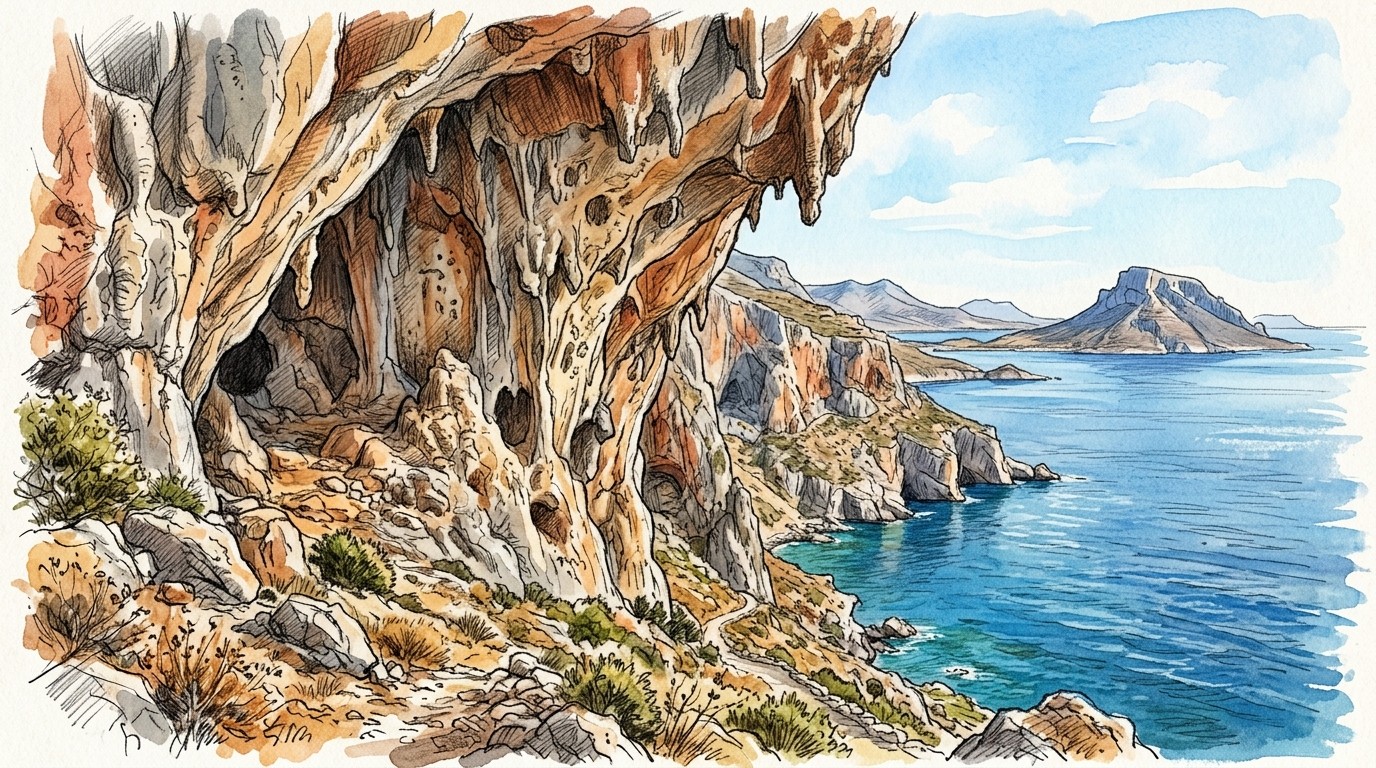
Kalymnos, a small island in the Dodecanese close to the Turkish coast, is the most famous sport-climbing island in the world. Since the first routes were bolted in the late 1990s, its grey and orange limestone has gained more than 3,500 sport routes, many of them on tufas, stalactites and cave roofs above the sea. Most climbers say autumn is the best season, from mid-September to November, with October the busiest month, and that April and May come a close second. Summer is said to be too hot. We used 30 years of weather data to check.
We replayed 30 years (1990–2019) of daily weather through the climbingforecast drying model. Rain and temperature come from CLIMADAT-GRid, a 1 km grid for Greece from the National Observatory of Athens, built from hundreds of Greek weather stations and rain gauges. Humidity and wind come from ERA5, the European climate reanalysis. Together they give about 705 mm of rain a year over the Masouri cliffs, close to the island's published average of 730 mm. We ran the model for four crags: Grande Grotta and Odyssey above Masouri, Arhi high on the Armeos ridge, and the North Cape on Telendos. They came out within a few points of each other in most months, so the numbers below are their average. We scored every day twice: once for an early-morning session, and once for an afternoon session.
When is the best time to climb in Kalymnos?
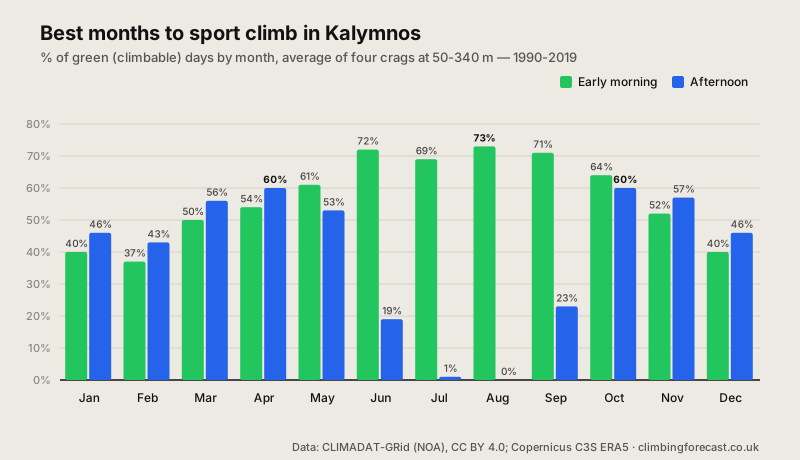
Late April and October are the best. Scored for an afternoon session, April and October tie at 60% green days, and the second half of April is the best fortnight of the year, at 65%. Both months get only seven or eight wet days, and highs at Grande Grotta are about 18–19°C in April and 23°C in October.
March, May and November are next. November scores 57% and March 56%, a little wetter than April and October but cool and good for friction. May starts well, at 58% in its first half, but drops to 47% in the second as the heat builds and the sea air gets more humid.
Mid-September is too early for afternoons. The traditional autumn season starts in mid-September, but in the afternoon, the second half of September scores only 32%. It's still too hot. Early mornings in September are good, at 69–74%.
In summer, climb at dawn. From June to August, afternoons are a write-off, at 0–19%, but early mornings score 69–73%.
Winter is better than its reputation. From December to February, 43–46% of afternoons are green, with highs of 13–15°C. The caves make it better still (see below).
Kalymnos climbing conditions month by month
| Month | Morning | Afternoon | High | Rain |
|---|---|---|---|---|
| Jan | 40% | 46% | 13°C | 115 mm |
| Feb | 37% | 43% | 13°C | 100 mm |
| Mar | 50% | 56% | 15°C | 78 mm |
| Apr ★ | 54% | 60% | 19°C | 48 mm |
| May | 61% | 53% | 24°C | 34 mm |
| Jun | 72% | 19% | 29°C | 10 mm |
| Jul | 69% | 1% | 31°C | 4 mm |
| Aug | 73% | 0% | 32°C | 3 mm |
| Sep | 71% | 23% | 28°C | 17 mm |
| Oct ★ | 64% | 60% | 23°C | 51 mm |
| Nov | 52% | 57% | 19°C | 107 mm |
| Dec | 40% | 46% | 15°C | 138 mm |
Average of Grande Grotta, Odyssey, Arhi and Telendos North Cape (50–340 m), 30 years (1990–2019) of daily weather: rain and temperature from CLIMADAT-GRid (National Observatory of Athens), humidity and wind from ERA5 (Copernicus Climate Change Service). Morning and Afternoon are the % of green (climbable) days, scored at the day's low and at the day's high. High is the average daily high at Grande Grotta (170 m); Rain is the monthly average over the Masouri cliffs. Factors in rain, drying time, wind, humidity and heat. Data: CLIMADAT-GRid, CC BY 4.0; contains modified Copernicus Climate Change Service information [2026].
Is October the best month in Kalymnos?
It's joint best. October scores 60% in the afternoon and 64% in the morning, the same as April in the afternoon and well ahead of April's 54% in the morning. Year by year, it's close: October beat April in 16 of the 30 years in our replay, and April won the other 14. Both reached 60% or more in 16 of the 30 years.
The difference is the trend through the month. April gets better as it goes, from 55% in the first half to 65% in the second, as the rain dies away. October holds steady at about 60% all month. The first half of November is almost as good, at 59%.
October is also when everyone else is there. It's the busiest month on the island, and the classic sectors above Masouri get crowded. If you can choose, late April gives you the same chance of good conditions with fewer people on the routes.
Is September too hot to climb in Kalymnos?
In the afternoon, yes. Grande Grotta's average high in September is 28°C, and it reaches 27°C or more, the point where our model starts to flag the heat, on about 20 days of the month. The first half of September scores 13% in the afternoon, and the second half 32%. By October, that drops to about three hot days a month.
The mornings are a different story: scored at the day's low, September holds 71%, one of the best scores of the year. In September, start early, choose a crag that's in the shade until the afternoon, such as the north-west-facing Grande Grotta and Odyssey, and stop when the sun arrives.
Can you climb in Kalymnos in summer?
Yes, but only early in the day. At Grande Grotta, July and August highs average 31–32°C, and in our 30 years, almost every afternoon in July and August was over 27°C. That's why the afternoon scores fall to 0–1%. It almost never rains, though: about 3–4 mm a month. Scored at the day's low, for a first-light session, June to August hold 69–73%.
The morning score is the best case, since it's scored at the coolest moment of the day, and by mid-morning the rock is warming up. Climbers who go in summer climb from first light until about 11am, choose north-facing or cave sectors, and rest through the heat. The Meltemi, the strong north wind that blows for days at a time in July and August, keeps the island cooler than the Greek mainland and makes summer climbing far more bearable. A south wind brings the opposite: heat, humidity and haze.
Can you climb in Kalymnos in winter?
Yes, and more often than its reputation suggests. From December to February, 43–46% of afternoons are green, with highs of 13–15°C, which is good for friction. The problem is rain: it rains on about 15 or 16 days a month, and December is the wettest month, at about 140 mm. Winter also varies most from year to year. December has ranged from 15% green to 94% in our 30 years.
Our model scores the rock as if rain falls on it. In reality, the deepest caves, such as Grande Grotta and Sikati Cave, stay dry through most rain, so you'll climb on more days than the numbers suggest, especially if you're happy to spend wet days in a cave.
The bigger limits in winter are practical ones. Most of Masouri's hotels and restaurants close from mid-November to late March, although a supermarket and some places to stay and eat stay open. Ferries from Kos run about nine times a week in winter, against about 21 in summer, and strong winds can cancel both the ferry and the flights from Athens to Kalymnos's small airport.
Peak Potential
Late April is 65% green, October 60%. Both get only seven or eight wet days a month.
Hot Start to Autumn
September afternoons are 23% green, with about 20 days of 27°C or more. Start early, or wait for October.
Summer Afternoons
July and August afternoons are 0–1% green. Climb from first light until late morning.
How we calculated this
We ran 30 years (1990–2019) of daily weather through the drying model behind the live Grande Grotta forecast. Rain and daily high and low temperatures come from CLIMADAT-GRid: we averaged the 19 land cells within 2 km of Grande Grotta, and adjusted the temperature to each crag's height. Humidity and wind come from ERA5's grid point over Kalymnos. Its grid cell is mostly sea, and wind over open sea is stronger than over land, so we scaled ERA5's wind to match the published average at Kos airport (about 9 knots), using a factor of 0.64. Each day is rated on recent rain, drying time, wind, humidity and heat, once at the day's low, for an early-morning session, and once at the day's high, for an afternoon session.
The model has two known limits here. It doesn't know which crags are caves, so it understates how much you can climb in wet weather. And ERA5's humidity is sea air, a little damper in late spring and summer than the air at the crags, so the May and June numbers are, if anything, slightly pessimistic.
Data retrieved 3 October 2026. Rain and temperature: CLIMADAT-GRid, National Observatory of Athens (doi:10.5281/zenodo.14637536), licensed under CC BY 4.0; we averaged and height-adjusted it. Humidity and wind: ERA5 hourly data on single levels, read from the NSF NCAR copy on AWS Open Data, licensed under CC BY 4.0; contains modified Copernicus Climate Change Service information [2026]. Neither the European Commission nor ECMWF is responsible for any use of this information.
It won't replace checking the forecast the week you go, but it's an honest answer to "when should I book?". Before you go, check the live Grande Grotta, Odyssey, Arhi, Sikati Cave and Telendos North Cape forecasts. For more European sport climbing, see our Siurana and Frankenjura articles.
Good luck and enjoy the climbing!