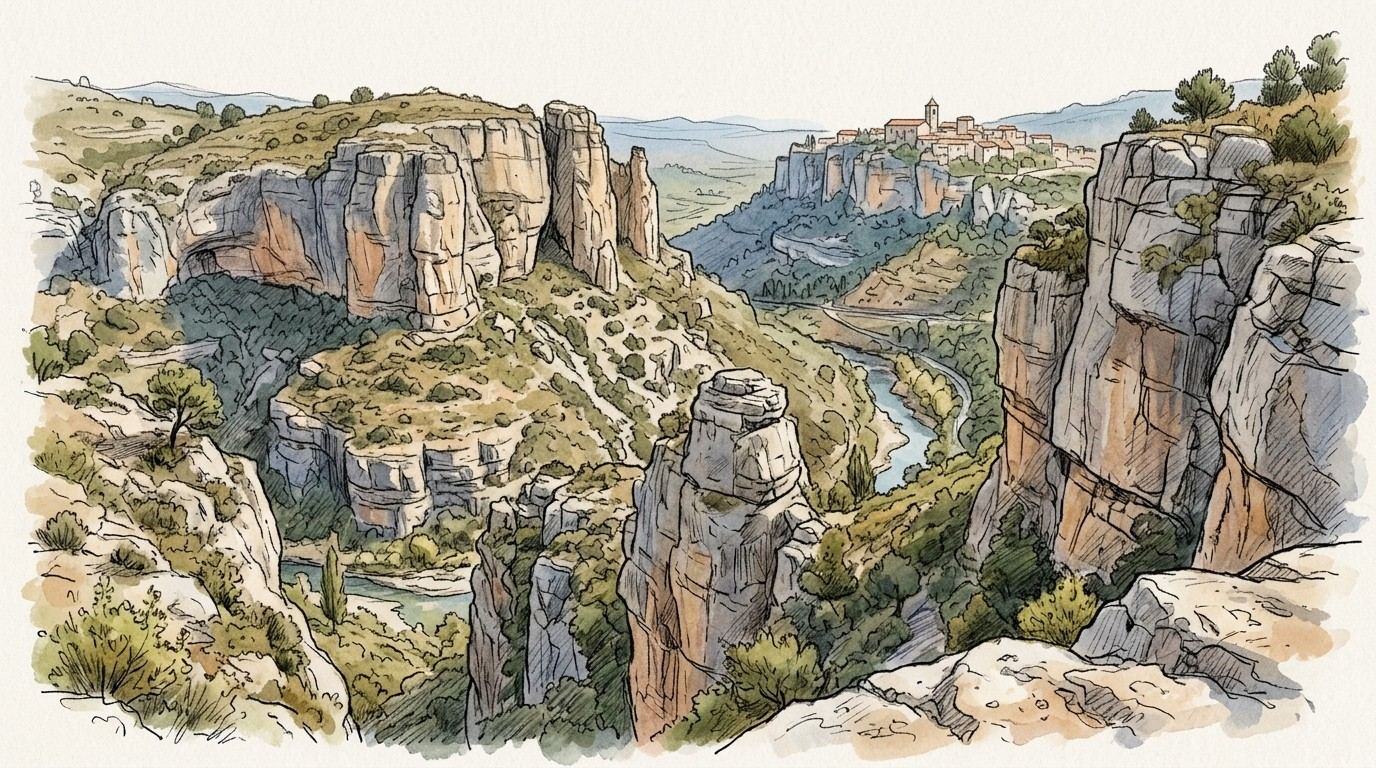
Siurana is one of the best sport climbing areas in the world. The village sits on a limestone clifftop in the Prades mountains, under an hour from Reus, and the walls around it hold hundreds of routes on sharp, grey and orange limestone, from 6a up to La Rambla (9a+). Guidebooks call it a winter venue, but they don't agree on which months are best. We used 30 years of weather data to find out which months are best, when the rain comes, how cold the winter gets and whether summer is worth it.
We replayed 30 years (1996–2025) of real daily observations from the Servei Meteorològic de Catalunya (Meteocat) station at Ulldemolins, about 8 km west of Siurana, through the climbingforecast drying model. It's the closest station with a long record, and over the last decade it has recorded almost exactly the same rain and humidity as the station at the Siurana reservoir, right below the crag. The model's dry-heat check lets us separate the three things that stop you climbing here: autumn and spring storms, summer heat, and, now and then, winter snow.
When is the best time to climb in Siurana?
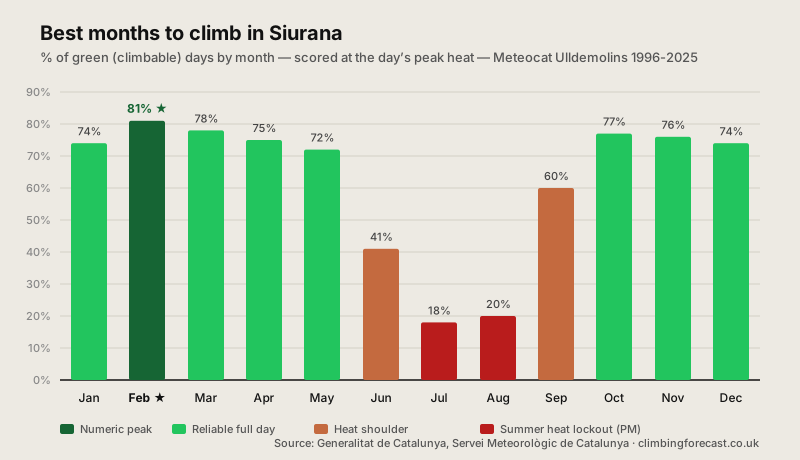
Anytime from October to May, and February is best. February leads at 81% green days for a full afternoon session. It's also the most dependable month: in 16 of the 30 years it was 80% or better. But Siurana's real strength is how long the season lasts. March (78%), October (77%), November (76%), April (75%), December and January (74%) and May (72%) are all within ten points of the peak. There's no single season you have to catch.
What costs you days is rain, not a bad month. From October to May, most non-green days come from rain and the time the rock takes to dry afterwards. In a dry year most of these months reach 90% or more. In a stormy year even the good months can drop to about 50% or below. Autumn and spring vary the most, so if you're booking then, keep a spare day or two in the plan.
June and September are shoulder months. June (41%) and September (60%) lose their afternoons to heat rather than rain. In the morning they're both above 80%.
Siurana climbing conditions month by month
| Month | Green Days | Amber Days | Red Days | % Green | Green + Amber |
|---|---|---|---|---|---|
| Jan | 22.8 | 3.9 | 4.3 | 74% | 86% |
| Feb ★ | 23.0 | 2.5 | 2.8 | 81% | 90% |
| Mar | 24.2 | 2.8 | 4.0 | 78% | 87% |
| Apr | 22.6 | 2.5 | 4.8 | 75% | 84% |
| May | 22.3 | 5.2 | 3.5 | 72% | 89% |
| Jun | 12.2 | 15.4 | 2.4 | 41% | 92% |
| Jul | 5.6 | 23.4 | 2.1 | 18% | 93% |
| Aug | 6.3 | 21.8 | 2.9 | 20% | 91% |
| Sep | 18.0 | 9.5 | 2.4 | 60% | 92% |
| Oct | 24.0 | 3.2 | 3.8 | 77% | 88% |
| Nov | 22.8 | 3.4 | 3.8 | 76% | 87% |
| Dec | 23.1 | 3.9 | 4.0 | 74% | 87% |
Based on 30 years (1996–2025) of real daily observations from the Meteocat station at Ulldemolins, adjusted to Siurana's 730 m and scored at each day's peak heat. Factors in rain, drying time, wind, seepage, snow and the dry-heat rule enforced by our drying model. Font: Generalitat de Catalunya. Servei Meteorològic de Catalunya.
When does it rain in Siurana? Autumn and spring
The data averages 504 mm of rain a year, on about 53 days with 1 mm or more. Autumn brings 33% of it and spring 32%, against 22% in winter and only 13% in summer. October is the wettest month (69 mm), followed by April (63 mm) and November (57 mm). February is the driest month of the climbing season, with 26 mm on three or four wet days. That's why it tops the table.
The worst storms can hit at any time between autumn and late winter. On 22 October 2019, the storm that flooded the Francolí valley dropped 213 mm at Ulldemolins in a single day, the wettest day in 30 years. Three months later, Storm Gloria made January 2020 the wettest month on record, with 239 mm. October 2018 and October 2024 were also among the wettest months. October 2024 was the worst October for climbing, at 48% green. Late spring can be stormy too: May 2008 brought 200 mm.
Siurana's limestone is clean and fairly compact, so most walls dry within a day or two of normal rain. After one of these big storms, give the crag a few days.
Is Siurana cold in winter? Yes, but it's still climbable
Siurana is higher and colder than most Spanish winter venues. At 730 m, January highs average about 10°C and lows about 1°C, and there are around 12 frosty nights in January, 10 in February and 9 in December. That's colder than Chulilla (January highs 15°C), where the crags are only about 400 m up. On the coldest nights the temperature has dropped below −8°C, for example in February 2012.
Snow is rare but it happens. Over 30 years, snow put the crag out of action on 32 days, about one a year. Examples include January and March 2010, February 2013 and 2018, and Storm Filomena in January 2021. It usually melts within a day or two.
The cold doesn't cost you many days: winter afternoons still score 74–81% green. Scored at the day's low, as a proxy for starting at dawn, December and January barely move (71–72%). There's nothing to gain by starting early, so wait for the sun. Most of Siurana's walls face south, and on cold, windy days the sunny, sheltered sectors are the ones to head for, such as La Reina Mora, Can Toni Gros and El Solarium. Cold rock gives great friction on Siurana's small crimps, but bring a warm belay jacket.
Can you climb in Siurana in summer? Only at dawn
Scored at the day's peak heat, June drops to 41% green, July to 18% and August to 20%. Siurana's height helps. July and August highs average about 29.5°C, cooler than Chulilla (32°C), and only one or two days a month reach 35°C. But the dry-heat rule kicks in at 27°C, and Siurana passes that on about 24 days a month in July and August. The hottest day in the record, 18 July 2023, reached about 40°C.
Scored at the day's low instead, as a proxy for a first-light start, the summer months jump to 86% (June), 92% (July), 91% (August) and 83% (September). Summer is a heat problem, not a rain problem. Climb early on the shady walls: El Pati is in shade in the morning, and Siuranella East across the valley gets shade in the afternoon. Be off the sunny walls by late morning.
Long Season
February leads at 81% green days, and every month from October to May scores 72–78%. There's no single peak season to catch: book when it suits you.
Watch the Rain
October, April and November are the wettest months. A dry year can be 90%+, a stormy one under 50%, so keep a spare day in the plan.
Summer Heat
July and August drop to 18–20% green in the afternoon, even at 730 m. If you go in summer, start at first light on the shady walls.
How we calculated this
We ran 30 years of real daily weather (1996–2025) from the Meteocat station at Ulldemolins (687 m) through the drying model behind the live Siurana forecast. Temperatures are adjusted to Siurana's 730 m. Each day is rated GREEN, AMBER or RED on recent rain, drying time, wind, snow and heat, scored once at the day's high and once at its low. The model doesn't mark days down for cold, so the winter temperatures above come from the weather record, not the ratings.
The station moved within the village in 2008. The old site was a frost hollow with hotter days and colder nights, so we adjusted its readings to match the current site, using two nearby stations that never moved as a reference. About 3% of days were missing at Ulldemolins and were filled from the nearest station with data for that day. No station nearby recorded wind from 2004 to 2009, so those years use Ulldemolins' average wind for the month. As a check, we also ran the Pantà de Siurana station, right below the crag, for 2015–2025: it gives the same October–April numbers to within a few points, and a hotter summer, because it sits in the valley bottom.
Data retrieved 30 September 2026 from the Generalitat de Catalunya's open-data portal. Font: Generalitat de Catalunya. Servei Meteorològic de Catalunya.
It won't replace checking the forecast the week you go, but it's an honest answer to "when should I book?". Before you go, check the live Siurana, Margalef and Montsant forecasts. For other Spanish sport climbing, see our Chulilla and Costa Blanca articles, or the Spain regional guide.
Good luck and enjoy the climbing!