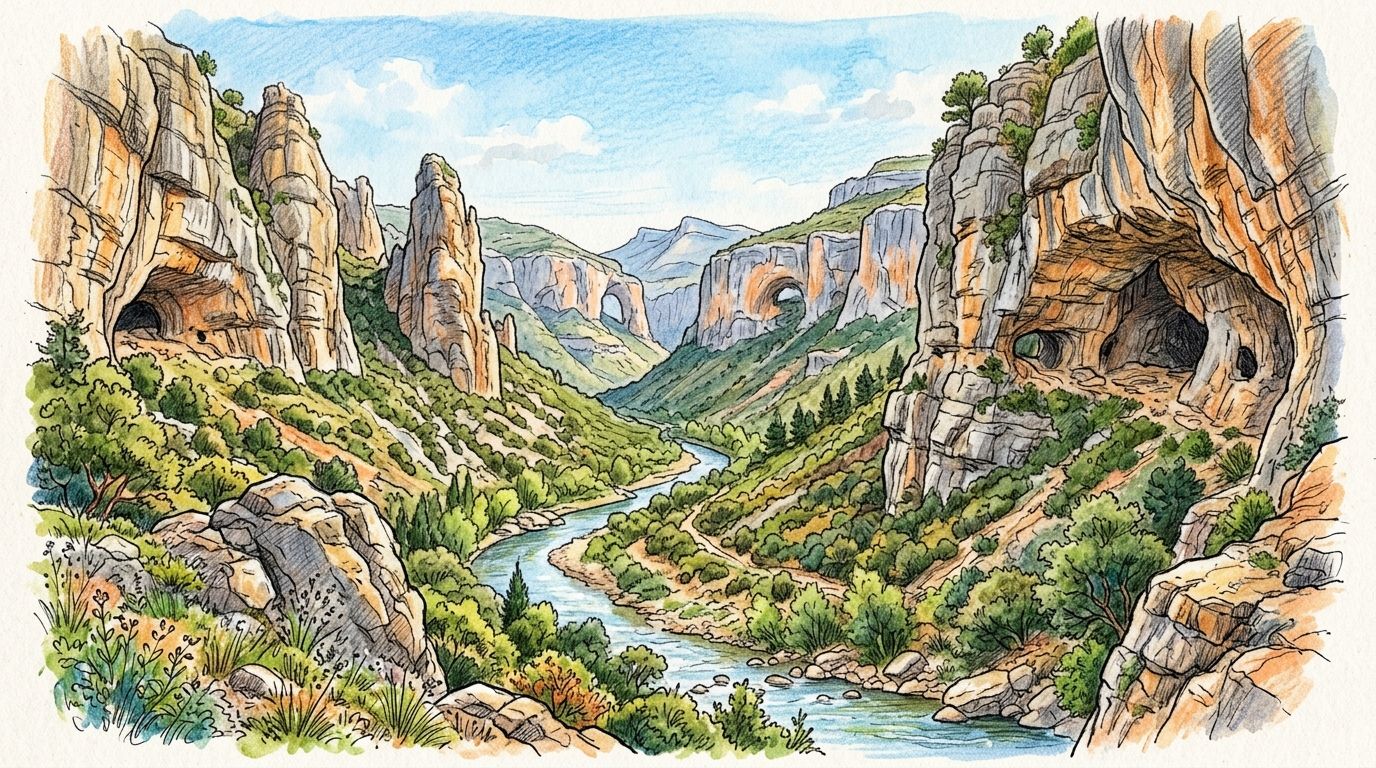
Rodellar is one of the best sport climbing areas in Europe. The village sits above the Mascún canyon in the Sierra de Guara, in Aragón, about an hour north-east of Huesca. The canyon walls are steep, orange and grey limestone, covered in tufas, with hundreds of routes, most of them between 7a and the 9s. Everyone says it's a summer crag, but guidebooks also say spring and autumn are best and that the tufas seep. We used 22 years of weather data to find out which months are best, when the tufas are likely to be wet, and how summer really works.
We replayed 22 years (2004–2025) of real daily observations from the SiAR agroclimatic station at Huesca, on the same side of the Sierra de Guara as Rodellar, through the climbingforecast drying model. We corrected the temperatures to the crag's height and scaled the rain up to match the wetter foothills around Rodellar. Each day was scored twice: at the day's peak heat, for a full afternoon session, and at the day's low, as a proxy for a dawn start or a wall in full shade. In a canyon like Rodellar, the second number matters as much as the first.
When is the best time to climb in Rodellar?
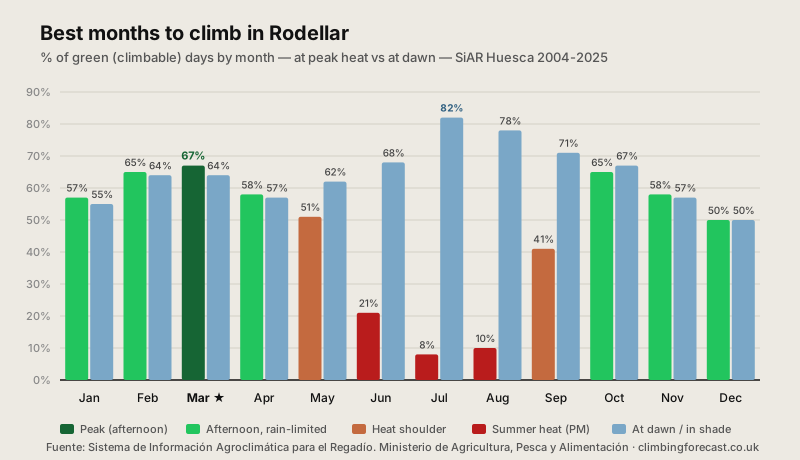
Spring and autumn for a full day, and March is best. Scored at the day's peak heat, March leads at 67% green days, with February and October at 65%. April, November and January follow at 57–58%. In these months, what costs you days is rain and the time the rock needs to dry afterwards, not the temperature.
Summer works if you climb early or in the shade. Summer afternoons are too hot on the sunny walls: 21% green in June, 8% in July and 10% in August. But summer is also the driest time of year. Scored at the day's low instead, July jumps to 82%, the best score of the year, and August to 78%. That's why Rodellar has its reputation as a summer crag: the canyon gives you shade on one side or the other all day, and a river to cool off in.
Every month varies from year to year. March has been anywhere from 26% green (2018) to 100% (2021), and October from 26% (2023) to 97% (2010). February is the most dependable month, at 70% or better in 10 of the 22 years. October reached 70% in 9 years and March in 8. Whenever you go, keep a spare day or two in the plan.
Rodellar climbing conditions month by month
| Month | Green Days | Amber Days | Red Days | % Green | Green + Amber | % Green at Dawn |
|---|---|---|---|---|---|---|
| Jan | 17.5 | 4.7 | 8.8 | 57% | 72% | 55% |
| Feb | 18.3 | 3.9 | 6.1 | 65% | 78% | 64% |
| Mar ★ | 20.7 | 2.5 | 7.8 | 67% | 75% | 64% |
| Apr | 17.5 | 3.8 | 8.7 | 58% | 71% | 57% |
| May | 15.8 | 8.1 | 7.1 | 51% | 77% | 62% |
| Jun | 6.3 | 17.0 | 6.8 | 21% | 77% | 68% |
| Jul | 2.5 | 22.0 | 6.5 | 8% | 79% | 82% |
| Aug | 3.2 | 20.0 | 7.8 | 10% | 75% | 78% |
| Sep | 12.3 | 12.7 | 5.0 | 41% | 83% | 71% |
| Oct | 20.0 | 4.5 | 6.5 | 65% | 79% | 67% |
| Nov | 17.4 | 5.1 | 7.5 | 58% | 75% | 57% |
| Dec | 15.5 | 6.4 | 9.1 | 50% | 71% | 50% |
Based on 22 years (2004–2025) of real daily observations from the SiAR station at Huesca, adjusted to Rodellar's 700 m and to the rainfall of the Guara foothills. Days are scored at each day's peak heat, with the last column scored at the day's low. Factors in rain, drying time, wind, seepage, humidity, snow and the dry-heat rule enforced by our drying model. Fuente: Sistema de Información Agroclimática para el Regadío. Ministerio de Agricultura, Pesca y Alimentación.
Can you climb in Rodellar in summer? Yes, at dawn or in the shade
At crag height, July and August highs average about 31°C, and pass the model's 27°C heat line on about 27 days a month. About four days a month reach 35°C, which the model rates too hot to climb at all. The hottest day in the record, 29 June 2019, reached about 41°C. June and September are shoulder months, with 18 and 12 days over 27°C.
That's the air temperature on the Huesca plain, corrected to the crag. It doesn't know that Rodellar is a deep canyon. The walls face mostly east or west, so one side is in the shade in the morning and the other in the afternoon. Start on the walls that are in the morning shade, such as El Camino, and cross to the other side when the sun comes round. North-facing sectors such as La Surgencia, La Fuente and Café Solo stay in the shade for most of the day. Summer is also the driest time of year, so once the heat is out of the way there's little else to stop you: scored at the day's low, July (82%) and August (78%) are the best months of the year. It's also why the river pools below the crags are so busy.
When are the tufas wet? Late spring
Rodellar's tufas are the reason most people go, and seepage is what spoils them. Rain soaks into the limestone above the canyon and comes out through the tufas for days or weeks afterwards, long after the rest of the wall is dry. Our drying model only looks at the last few days of rain, so it can't see this. To get an idea of when it's worst, we looked at how much rain had fallen in the three months before each month.
That total peaks in late spring. In the three months before mid-May and mid-June, the area gets about 190 mm of rain, the most of the year, after the April and May rains. By mid-September it has dropped to about 110 mm, the least of the year, after the dry summer. That matches what climbers report: the tufas seep most in late spring and after wet winters, and are driest in late summer and autumn. After a very wet spring, such as April 2018 or May 2008, expect some tufa routes to stay wet well into summer. If you're going for a tufa project, autumn is the safest bet.
How much does it rain in Rodellar? Mostly in spring and autumn
The data averages about 600 mm of rain a year, on 60 or so days with 1 mm or more. Spring brings 32% of it and autumn 30%, against 19% each in winter and summer. April is the wettest month (77 mm), followed by October (69 mm) and March (64 mm). July is the driest (26 mm).
From October to May, six to nine days a month are red, mostly because of rain and the drying time after it. Rodellar's limestone is steep, and the big overhangs often stay dry in a shower, but the walls are sheltered from the wind and dry slowly, and our model treats Rodellar as a high-seepage crag. After a big storm, give it a few days. The wettest months in our record were November 2016, April 2018 and October 2012, the month of the big floods in the Pyrenees.
Can you climb in Rodellar in winter? On the right days
January highs average about 9°C at crag height, and December's too. Winter is one of the drier seasons, and February, at 65% green, is as good as October. Snow plays a part in two or three days each December and January in the data.
The winter numbers come with a caveat. The Huesca station sits on the plain, which is often under the Ebro valley's winter fog and cold air. That's why, in the data, winter nights average −1.5 to −2.5°C with around 20 frosty nights a month, and why high humidity and fog play a part in about 9 lost days in December, 6 in January and 4 in November. Some of the snow days are the same cold, damp spells. Rodellar is 270 m higher and often above the fog, so winter at the crag is probably a little better than our numbers show. On a clear winter's day, find the walls in the sun, and don't bother starting early: scored at the day's low, the winter months don't improve.
Spring and Autumn
March leads at 67% green days, with February and October at 65%. For a full day on any wall, this is when to go.
Wet Tufas in Spring
Spring is the wettest season, and the rain feeds the tufas for weeks. For tufa projects, autumn is the safest bet.
Summer Heat
Summer afternoons drop to 8–21% green on the sunny walls. At dawn or in the shade, July is the best month of the year at 82%.
How we calculated this
We ran 22 years of real daily weather (2004–2025) from the SiAR station at Huesca (HU09, 429 m) through the drying model behind the live Rodellar forecast. SiAR is the Spanish agriculture ministry's agroclimatic network, and its stations in Aragón opened in 2003, which is why the record starts in 2004. Huesca is the closest SiAR station on the same side of the Sierra de Guara as Rodellar. The one at Aínsa is closer, but it's over the ridge in the much wetter Pyrenees. On the few days when Huesca has no data, we used the SiAR station at Barbastro.
We corrected temperatures to Rodellar's 700 m using the standard lapse rate, about −1.8°C, and converted the station's wind from 2 m to the 10 m the model expects. The Huesca plain is drier than the foothills, so we scaled the rain up month by month, to about 1.4 times the station's own amounts. The scaling uses AEMET's 1981–2010 normals for the three rain gauges nearest to Rodellar on the south side of the range (Panzano, Radiquero and Abiego) and AEMET's record at Huesca airport, published by the Instituto Aragonés de Estadística. Without the scaling the monthly scores move by only one or two points. Each day is rated GREEN, AMBER or RED on recent rain, drying time, wind, humidity, snow and heat, and scored once at the day's high and once at its low.
Data retrieved 30 September 2026. Fuente: Sistema de Información Agroclimática para el Regadío. Ministerio de Agricultura, Pesca y Alimentación. Rain normals: AEMET, via the Instituto Aragonés de Estadística (CC BY 4.0).
It won't replace checking the forecast the week you go, but it's an honest answer to "when should I book?". Before you go, check the live Rodellar, Alquézar and Vadiello forecasts. For other Spanish sport climbing, see our Siurana, Chulilla and El Chorro articles, or the Spain regional guide.
Good luck and enjoy the climbing!