The Dolomites, in north-east Italy, are one of the great rock-climbing ranges of the world: pale towers and walls of dolomite rising straight out of green alpine meadows, with thousands of multi-pitch routes, many reached in minutes from a mountain pass road. The Passo Sella, between Val Gardena and Val di Fassa, is at the heart of it, with the Sella towers, Piz Ciavazes and the Sassolungo all around the pass. It's high mountain climbing, so the season is short. We ran 30 years of weather through our drying model to find out when the rock is most often dry and climbable.
We took 30 years (1992–2021) of daily rain and temperature from the Province of Bolzano's weather station at Selva di Val Gardena (Wolkenstein), 3 km from the Sella pass road, and moved the temperatures to the crags' height with the Province's station on Piz Pisciadù, on the Sella itself. We used it for Piz Ciavazes (2,200 m), the big south face above the Passo Sella road, and for the shady side, the Sassolungo north face (2,500 m). Then we ran every day through the climbingforecast drying model, with the same rules as our live forecasts. Each day is scored for an afternoon session, and again at the day's low for an early start.
When is the best time to climb in the Dolomites?
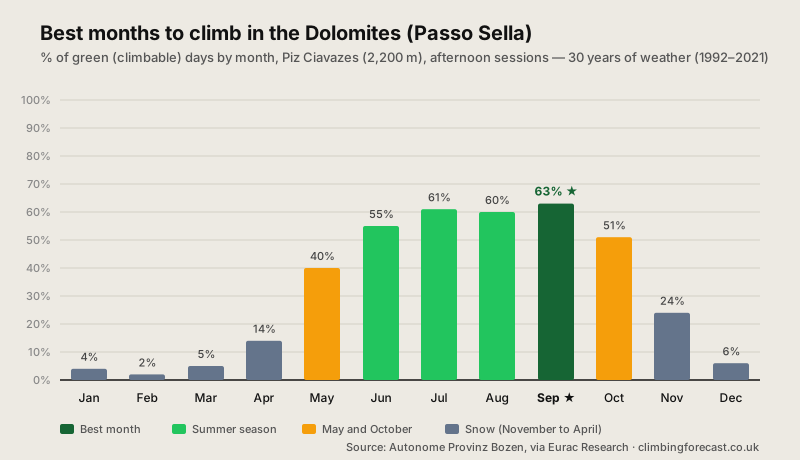
Summer and early autumn: September is the best month. Piz Ciavazes scores 63% green afternoons in September, just ahead of July (61%) and August (60%), with June at 55%. September is the most reliable month too: it reached 70% green in 11 of the 30 years, and its worst year still scored 40%. The second half of July is the best fortnight of the year, at 65%.
Why September? It has fewer storms. July and August are the wettest months of the year at the Sella, with 133–136 mm of rain on 12–13 days a month, much of it in afternoon thunderstorms. September gets 87 mm on about 9 days. The days are shorter and cooler, with highs of about 10°C (50°F) at 2,200 m, against 15°C (59°F) in July, but cool, dry rock is good to climb on.
June is the start. The first half of June scores 47% and the second half 63%, as the last snow melts off the ledges and approaches. Snow can stay longer on north faces and in gullies after a snowy winter.
Dolomites climbing conditions month by month
| Month | Afternoon | Morning | North face | High | Rain | Rain Days |
|---|---|---|---|---|---|---|
| Jan | 4% | 4% | 3% | −3°C / 27°F | 25 mm | 4.9 |
| Feb | 2% | 2% | 0% | −2°C / 29°F | 22 mm | 4.8 |
| Mar | 5% | 5% | 0% | 1°C / 34°F | 39 mm | 6.2 |
| Apr | 14% | 12% | 1% | 4°C / 40°F | 58 mm | 8.4 |
| May | 40% | 34% | 12% | 9°C / 47°F | 99 mm | 12.8 |
| Jun | 55% | 46% | 29% | 13°C / 55°F | 126 mm | 13.5 |
| Jul | 61% | 51% | 37% | 15°C / 59°F | 133 mm | 13.0 |
| Aug | 60% | 50% | 39% | 15°C / 58°F | 136 mm | 12.3 |
| Sep ★ | 63% | 57% | 44% | 10°C / 50°F | 87 mm | 8.9 |
| Oct | 51% | 48% | 37% | 6°C / 43°F | 91 mm | 8.5 |
| Nov | 24% | 23% | 14% | 1°C / 34°F | 77 mm | 7.9 |
| Dec | 6% | 6% | 4% | −3°C / 27°F | 38 mm | 5.9 |
Piz Ciavazes (2,200 m) by the Passo Sella, 30 years (1992–2021) of real daily observations from the Province of Bolzano's station at Selva di Val Gardena (Wolkenstein), with temperatures moved to the crag with its station on Piz Pisciadù. Afternoon and Morning are the % of green (climbable) days at Piz Ciavazes, scored at the day's high and at the day's low. North face is the afternoon score for the Sassolungo north face (2,500 m). High is the average daily high at Piz Ciavazes, Rain the monthly average at Selva (rain and melted snow), and Rain Days the days with 1 mm or more. Factors in rain, drying time, seepage, humidity, snow and heat. Cold, dry days count as green. Source: Autonome Provinz Bozen – Südtirol, via Eurac Research.
Summer storms
The afternoon storm is the Dolomites' main hazard. On a typical summer day, clouds build over the peaks from late morning and storms break in the afternoon. July and August get rain on 12–13 days a month at the Sella, and our model loses most summer days to rain and the time the rock takes to dry afterwards. Sunny faces like Piz Ciavazes dry within hours; long routes are the problem, because a storm can catch you halfway up.
Mornings aren't better here. Early starts score about 10 points lower than afternoons in our replay (51% against 61% in July), because the rock is cold and still drying from the evening before. But on a long route, starting early is still the way to be off the wall before the storms. Check the forecast for storm risk, not just rain.
North faces and big walls
North faces are a different season. The Sassolungo north face (2,500 m) scores at most 44% in September and 37–39% in July and August. North faces hold snow and meltwater into midsummer, seep after rain, and get little sun, so they stay cold and wet for longer. Save them for a long spell of settled weather, and expect wet streaks and snow on the ledges early in the summer.
South faces dry first. Piz Ciavazes faces south, straight above the Passo Sella road, and gets the sun most of the day. It dries within hours after a summer storm, which is why it scores about 20 points above the north faces.
Climbing in the Dolomites: what to expect
Big, steep walls on solid rock. Dolomite is a limestone-like rock, usually solid and covered in small edges and pockets, though often polished on popular routes. Most classic routes are long multi-pitch climbs with old fixed pegs at the belays and some on the pitches; bring a rack of nuts and cams, slings, and a helmet, as loose rock and stonefall are common. There are also many bolted multi-pitch routes, and sport crags such as Frea by the Passo Gardena.
Mountain weather and descents. Even a short route at the pass goes to 2,500 m or more. Carry warm clothes and rain gear, know your descent before you start (many are by abseil or down scrambling gullies), and turn back if a storm is coming.
Getting there. The Passo Sella is reached by road from Val Gardena (Selva) or Val di Fassa (Canazei), and many crags are a short walk from the pass. The passes get busy with traffic and visitors in July and August.
Best: September
63% green afternoons, the fewest storms of the summer, and 70%+ in 11 of the 30 years.
Summer Storms
Rain on 12–13 days a month in July and August, often in afternoon storms. Start early on long routes.
Snow Until June
From November to April, scores fall to 2–24%. North faces hold snow and meltwater into midsummer.
How we calculated this
The Province of Bolzano's station at Selva di Val Gardena (Wolkenstein, 1,594 m), 3 km from the Sella pass road, has daily rain and temperature records back to 1991; its few gaps were filled from the Province's station at Corvara, over the Passo Gardena. To move the temperatures up to the crags, we used the Province's automatic station on Piz Pisciadù (2,985 m), on the Sella massif itself: over the 18 years both stations have, the daily highs fall by 4–9°C per km of height through the year, and the lows by 3–5°C. The record has no humidity or wind, so we estimated the humidity from each day's low and used a steady, moderate breeze. Using the standard rate of 6.5°C per km, or a drier estimate of the humidity, changes the summer results by 6 points or less. The record ends in 2021, as that's where Eurac Research's quality-checked database stops.
Every day is rated on recent rain, drying time, seepage, humidity, snow and heat, at the day's high (afternoon) and low (morning), and the snow on the crag is carried from one day to the next. The model reads the air temperature, not the rock, and doesn't know about storms that arrive in the afternoon after a dry morning, so use the numbers to choose your month and our live forecasts for Piz Ciavazes and the Sassolungo to choose your day.
Data retrieved 8 October 2026. Source: Amt für Meteorologie und Lawinenwarnung, Autonome Provinz Bozen – Südtirol (stations 73500MS Wolkenstein, 61300MS Corvara, 61720WS Piz Pisciadù), published under CC0, via Crespi, A. (2020), Daily meteorological records – Climate Data Base (Version 1.0), Eurac Research. For more Alpine climbing, see our Chamonix and Valle dell'Orco guides, and for limestone towers in Spain, the Naranjo de Bulnes.
Good luck and enjoy the climbing!