The Shawangunks, or "the Gunks", are the home of American trad climbing: a long white cliff of hard quartz conglomerate on a ridge above New Paltz, about two hours north of New York City, with more than a thousand routes on steep faces, horizontal cracks and big roofs. The climate is the north-east's: cold, snowy winters and hot, humid summers. We ran 30 years of weather through our drying model to find out when the rock is most often dry and climbable.
We took 30 years (1996–2025) of daily weather from NOAA's station at Mohonk Lake, on the ridge 4 km from the Trapps, and from Daymet, NASA's 1 km daily weather grid. We used it for the Trapps, the Gunks' main cliff (290 m at the Uberfall, south-east facing). Then we ran every day through the climbingforecast drying model, with the same rules as our live forecasts. Each day is scored for an afternoon session, and again at the day's low for an early start.
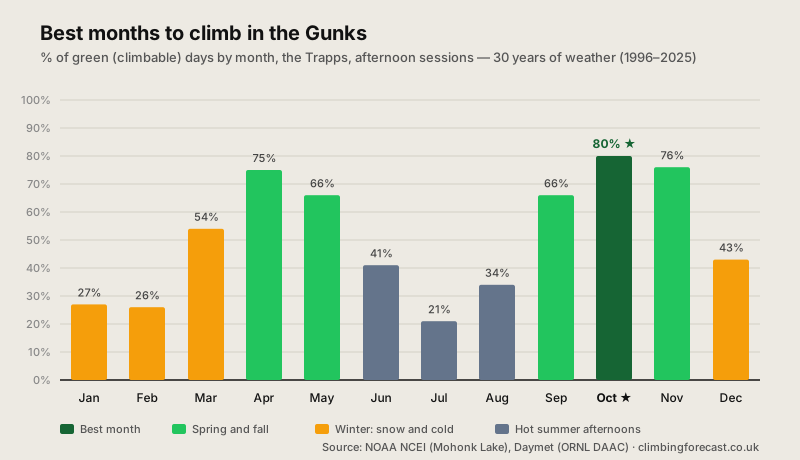
When is the best time to climb in the Gunks?
Fall: October is the best month. It scores 80% green afternoons, ahead of November (76%) and September (66%). The best fortnight of the year is the first half of November, at 82%. October afternoons reached 70% green in 25 of the 30 years: it's the most reliable month as well as the best. Highs average 16°C (62°F), the air is dry and cool, and the leaves turn on the ridge.
Spring is nearly as good. April scores 75% and May 66%. April is cool, with highs of 16°C (60°F), and May brings warmer days and more rain (13 rain days). The second half of March (66%) can be good too, once the snow has gone.
It rains all year. The Gunks get about 1,450 mm (57 in) of rain and snow a year, spread fairly evenly: every month gets 90–140 mm on 9 to 13 days. What changes through the year is the temperature, not the rain. The hard rock dries quickly between showers, which is why spring and fall can score so high.
Gunks climbing conditions month by month
| Month | Afternoon | Morning | High | Rain | Rain Days |
|---|---|---|---|---|---|
| Jan | 27% | 26% | 1°C / 34°F | 102 mm | 10.2 |
| Feb | 26% | 25% | 3°C / 38°F | 91 mm | 9.2 |
| Mar | 54% | 49% | 8°C / 47°F | 114 mm | 10.1 |
| Apr | 75% | 70% | 16°C / 60°F | 118 mm | 11.1 |
| May | 66% | 73% | 22°C / 71°F | 121 mm | 13.0 |
| Jun | 41% | 79% | 26°C / 79°F | 136 mm | 11.5 |
| Jul | 21% | 83% | 28°C / 83°F | 130 mm | 10.8 |
| Aug | 34% | 82% | 27°C / 81°F | 133 mm | 10.9 |
| Sep | 66% | 80% | 23°C / 73°F | 142 mm | 9.0 |
| Oct ★ | 80% | 76% | 16°C / 62°F | 133 mm | 9.8 |
| Nov | 76% | 72% | 10°C / 49°F | 100 mm | 8.7 |
| Dec | 43% | 40% | 4°C / 39°F | 128 mm | 10.9 |
The Trapps (290 m at the Uberfall), 30 years (1996–2025) of daily weather: temperatures from NOAA's Mohonk Lake station, rain and humidity from NASA's Daymet grid. Afternoon and Morning are the % of green (climbable) days at the Trapps, scored at the day's high and at the day's low. High is the average daily high at the Trapps, Rain the monthly average (rain and melted snow), and Rain Days the days with 1 mm or more. Factors in rain, drying time, wind, humidity, snow and heat. Cold, dry days count as green.
Can you climb in the Gunks in summer?
In the morning. July highs at the Trapps average 28°C (83°F), and reach 27°C (81°F) on about 22 days a month, when friction on the rock and rubber falls away. Only 21% of July afternoons and 34% of August's score green. Scored at the day's low, though, June to August come out 79–83% green: summer is about the heat, not the rain.
Start early and find the shade. The cliff faces south-east, so it gets the morning sun and goes into the shade in the afternoon, earlier at the north end of the Trapps than at the Uberfall. Our model reads the air temperature, not the rock, so shady walls will feel better than the summer numbers suggest, and sunny ones worse. Summer thunderstorms are common, and the humid air makes the slick spots slicker.
Can you climb in the Gunks in winter?
On sunny days. January and February score 26–27% green afternoons. Snow lies on the crag on most days in our replay, highs average 1–3°C (34–38°F), and nights freeze on 24–27 nights a month. But the Trapps face south-east, into the winter sun, and a dry, sunny spell can give good days: January has scored up to 81% green in its best year, and February up to 83%. December (43%) and the second half of March (66%) are better bets.
Trad climbing in the Gunks: what to expect
Roofs and horizontals. The Shawangunk conglomerate is white, quartz-rich rock, hard and smooth, cut by horizontal cracks, ledges and roofs. The climbing is steep for its grade, and the protection is mostly in the horizontal cracks: bring a full rack of cams and nuts. Most routes are one to three pitches.
A long history. Fritz Wiessner spotted the cliffs from across the Hudson Valley in 1935 and made the first recorded climbs. With Hans Kraus he went on to climb High Exposure in 1941, with a hemp rope and soft iron pitons, and it's still one of the best-known routes in the Gunks.
Access. The Trapps, the Near Trapps and Millbrook are on land owned by the Mohonk Preserve, which charges climbers for a day pass or a yearly membership. Check the current price on the Preserve's website. Peterskill is in Minnewaska State Park, which has its own permit. Skytop, on Mohonk Mountain House land, has very limited access: check before you go. October weekends are very busy, so arrive early for parking.
Best: October
80% green afternoons, 70% or better in 25 of the 30 years. Early November is the best fortnight, at 82%.
Spring Too
April scores 75% and May 66%. It rains all year, but the hard rock dries fast between showers.
Summer Heat
Only 21% of July afternoons are green, but mornings score 83%. Start early and find the shade.
How we calculated this
NOAA's station at Mohonk Lake (337 m) sits on the Shawangunk ridge 4 km from the Trapps, and is one of NOAA's long-running climate stations. About 11% of its temperature days are missing, so we filled them from Daymet at the Trapps, adjusted to the station, and moved every day to the height of each cliff. Rain and humidity come from Daymet at the Trapps; the Mohonk Lake rain gauge, used as a check, gives the same results within 3 points every month. There's no long wind record on the ridge, so wind is set to a light breeze; it hardly changes the results.
Every day is rated on recent rain, drying time, wind, humidity, snow and heat, at the day's high (afternoon) and low (morning). The model reads the air temperature, not the rock, and doesn't know which routes are in the shade, so use the numbers to choose your month and the live Trapps forecast to choose your day.
Data retrieved 8 October 2026. Temperatures and the rain check from NOAA NCEI GHCN-Daily (station USC00305426, Mohonk Lake), public domain. Rain and humidity from Thornton, M.M., R. Shrestha, Y. Wei, P.E. Thornton, S-C. Kao and B.E. Wilson (2022), Daymet: Daily Surface Weather Data on a 1-km Grid for North America, Version 4 R1, ORNL DAAC. History from Wikipedia; access from the Mohonk Preserve. For more trad in North America, see our Yosemite Valley, Red Rocks and Indian Creek guides, and for sport climbing in the east, the Red River Gorge.
Good luck and enjoy the climbing!