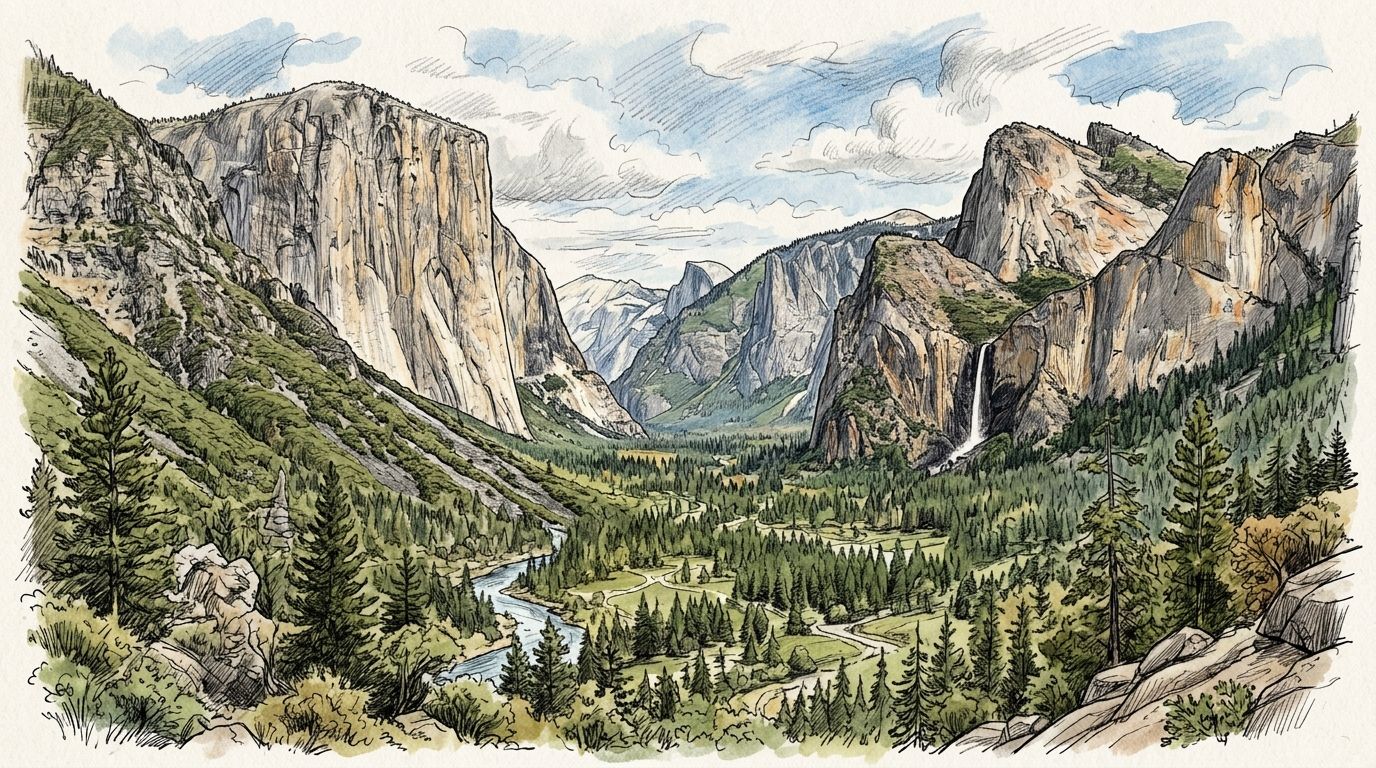
Yosemite Valley is the home of big-wall climbing: El Capitan, Half Dome and a Valley full of granite cracks, from single-pitch splitters to 1,000 m walls. It's in the Sierra Nevada of California, at about 1,200 m (4,000 ft), and its climate is Mediterranean: wet winters, and long, hot, dry summers. We ran 30 years of weather through our drying model to find out when the granite is most often dry and climbable.
We took 30 years (1996–2025) of daily weather from NOAA's station at Yosemite Park Headquarters, on the Valley floor 4 km from El Capitan, and from Daymet, NASA's 1 km daily weather grid. We used it for El Capitan (1,220 m), and for the shady side of the Valley, Middle Cathedral Rock (1,440 m, north-facing). Then we ran every day through the climbingforecast drying model, with the same granite rules as our live forecasts. Each day is scored for an afternoon session, and again at the day's low for an early start.
When is the best time to climb in Yosemite Valley?
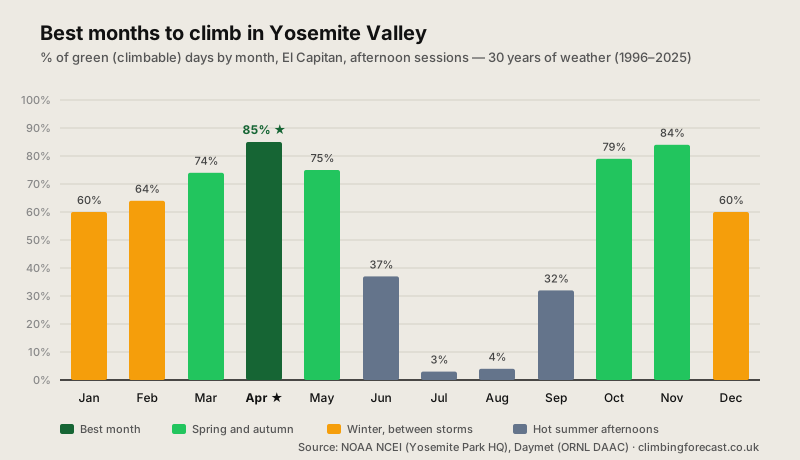
Spring and fall: April and November are best. April scores 85% green afternoons and November 84%, with October (79%), May (75%) and March (74%) close behind. The best two weeks of the year are the first half of November, at 88%. April and November afternoons reached 70% green in 27 and 28 of the 30 years: they're the most reliable months too.
Fall is the classic season. By October the summer heat has gone (highs average 22°C, 71°F), and it rarely rains: October gets 51 mm on about 3 or 4 days. It stays good until the first big winter storms, usually in November or December. The second half of October scores 86%, as good as early November.
Spring is just as good, but wetter early on. March still gets winter storms (137 mm), but April (69 mm) and May (42 mm) dry out fast, and April is the best month of the year. Late spring is also when the waterfalls are at their biggest, and when the walls that hold snowmelt seep the most, so pick sunny, quick-drying routes.
Yosemite climbing conditions month by month
| Month | Afternoon | Morning | North face | High | Rain | Rain Days |
|---|---|---|---|---|---|---|
| Jan | 60% | 57% | 39% | 9°C / 48°F | 172 mm | 8.8 |
| Feb | 64% | 60% | 46% | 11°C / 51°F | 159 mm | 9.3 |
| Mar | 74% | 67% | 53% | 14°C / 57°F | 137 mm | 9.4 |
| Apr ★ | 85% | 80% | 68% | 17°C / 63°F | 69 mm | 6.2 |
| May | 75% | 87% | 71% | 22°C / 72°F | 42 mm | 4.6 |
| Jun | 37% | 97% | 44% | 28°C / 82°F | 9 mm | 1.4 |
| Jul | 3% | 100% | 8% | 33°C / 91°F | 4 mm | 0.7 |
| Aug | 4% | 100% | 8% | 32°C / 90°F | 3 mm | 0.7 |
| Sep | 32% | 99% | 37% | 28°C / 83°F | 9 mm | 1.8 |
| Oct | 79% | 91% | 76% | 22°C / 71°F | 51 mm | 3.5 |
| Nov | 84% | 77% | 66% | 14°C / 57°F | 98 mm | 6.5 |
| Dec | 60% | 58% | 43% | 9°C / 47°F | 161 mm | 9.2 |
El Capitan (1,220 m), 30 years (1996–2025) of daily weather: temperatures from NOAA's Yosemite Park Headquarters station on the Valley floor, rain and humidity from NASA's Daymet grid. Afternoon and Morning are the % of green (climbable) days at El Capitan, scored at the day's high and at the day's low. North face is the afternoon score at Middle Cathedral Rock (1,440 m, north-facing). High is the average daily high at El Capitan, Rain the monthly average (rain and melted snow), and Rain Days the days with 1 mm or more. Factors in rain, drying time, wind, humidity, snow and heat. Cold, dry days count as green.
Can you climb in Yosemite Valley in summer?
Not in the afternoon. July and August highs on the Valley floor average 32°C (90°F), and reach 32°C on 17–19 days a month, so only 3–4% of summer afternoons score green. June (37%) and September (32%) are better, but still hot. On a sunny granite wall, it feels hotter than the air temperature.
But it almost never rains. Scored at the day's low, June to September come out 97–100% green: in our replay, July and August get about 4 mm of rain a month. So summer is about the heat, not the weather. Start at first light, follow the shade (north-facing walls go into the shade early), and rest in the afternoon. Our model reads the air temperature, not the rock, so shady walls will be better than the summer numbers suggest, and sunny ones worse.
Or go high. Tuolumne Meadows, on the Tioga Road, is about 1,400 m (4,600 ft) higher than the Valley, with highs around 20°C (high 60s to low 70s °F) in summer. It's the classic summer escape, with domes and slabs of the same granite. The Tioga Road usually opens in late May or June, depending on the snow, and closes with the first big snowfall in the fall. Watch for afternoon thunderstorms on the exposed domes.
Can you climb in Yosemite in winter?
Often, between storms. December to February score 60–64% green afternoons on El Capitan. Winter is the wet season: January gets 172 mm of rain and snow on about 9 days. But the storms come and go, the sun is low and warm on south-facing granite, and it dries fast. Snow lies at El Capitan on about 4 to 7 days a month in our replay.
Choose the sunny side. North-facing walls get little winter sun, so they stay cold and wet for longer: Middle Cathedral Rock scores 39–46% from December to February, against 60–64% for El Capitan. Days are short, nights below freezing on 16–21 nights a month, and big walls can seep or shed ice after a storm. Single-pitch, sunny crags are the safest winter bet.
Trad climbing in Yosemite: what to expect
Granite cracks of every size. Yosemite is crack climbing, from finger cracks to wide chimneys, on clean, smooth granite, and the routes go from single pitches by the road to multi-day big walls. Most of it is trad, so bring a full rack of cams and nuts, and expect slippery, polished rock on the most popular routes.
Big walls need a permit. The park requires a free, self-registered wilderness permit for overnight big-wall climbs. You can't camp at the base of any wall in the Valley, and fires aren't allowed at the base or summit of any formation. Some walls have spring closures for nesting peregrine falcons: check at the Camp 4 kiosk, the permit kiosk at El Capitan Bridge, or the Mountain Shop.
Plan around the crowds. Spring and fall are also the busiest seasons for climbers, and park entry rules can change from year to year. Check the National Park Service website for current entry and camping rules before you go.
Best: April and November
85% and 84% green afternoons. Early November is the best fortnight of the year, at 88%.
Winter Between Storms
December to February score 60–64% on sunny walls. North faces stay wet longer.
Summer Heat
Only 3–4% of July and August afternoons are green, but mornings are 100%. Climb at dawn, or go to Tuolumne.
How we calculated this
NOAA's station at Yosemite Park Headquarters (1,225 m) sits on the Valley floor at Yosemite Village, 4 km from El Capitan and at the same height, and is one of NOAA's long-running climate stations. About a quarter of its temperature days are missing, mostly in 2008–2009 and from 2020, so we filled them from Daymet at El Capitan, adjusted to the station. Rain and humidity come from Daymet at El Capitan; the station's own rain gauge, used as a check, gives the same results within a point or two every month. There's no long wind record in the Valley, so wind is set to a light breeze; it hardly changes the results. Middle Cathedral Rock is moved up 220 m at the standard rate of 6.5°C per km.
Every day is rated on recent rain, drying time, wind, humidity, snow and heat, at the day's high (afternoon) and low (morning). The model reads the air temperature, not the rock, and doesn't know about seeping cracks or ice on the walls, so use the numbers to choose your month and the live El Capitan forecast to choose your day.
Data retrieved 8 October 2026. Temperatures and the rain check from NOAA NCEI GHCN-Daily (station USC00049855, Yosemite Park HQ), public domain. Rain and humidity from Thornton, M.M., R. Shrestha, Y. Wei, P.E. Thornton, S-C. Kao and B.E. Wilson (2022), Daymet: Daily Surface Weather Data on a 1-km Grid for North America, Version 4 R1, ORNL DAAC. Park rules from the National Park Service; Tioga Road and Tuolumne weather from Yosemite Park. For more granite, see our Joshua Tree, Red Rocks and Squamish guides, and for desert cracks, Indian Creek.
Good luck and enjoy the climbing!